
Unbiased headlines. Facts, not spin.
Unbiased Headlines is an independently owned news organization. We bring you the facts, not opinions, written fresh from 110+ named sources. Sources linked so you can verify it yourself.
 defense
Major Story (7/10)
Russia Test-Fires Bulava Missile Toward Arctic Range a Day After Putin's Call With Finnish and Norwegian Leaders
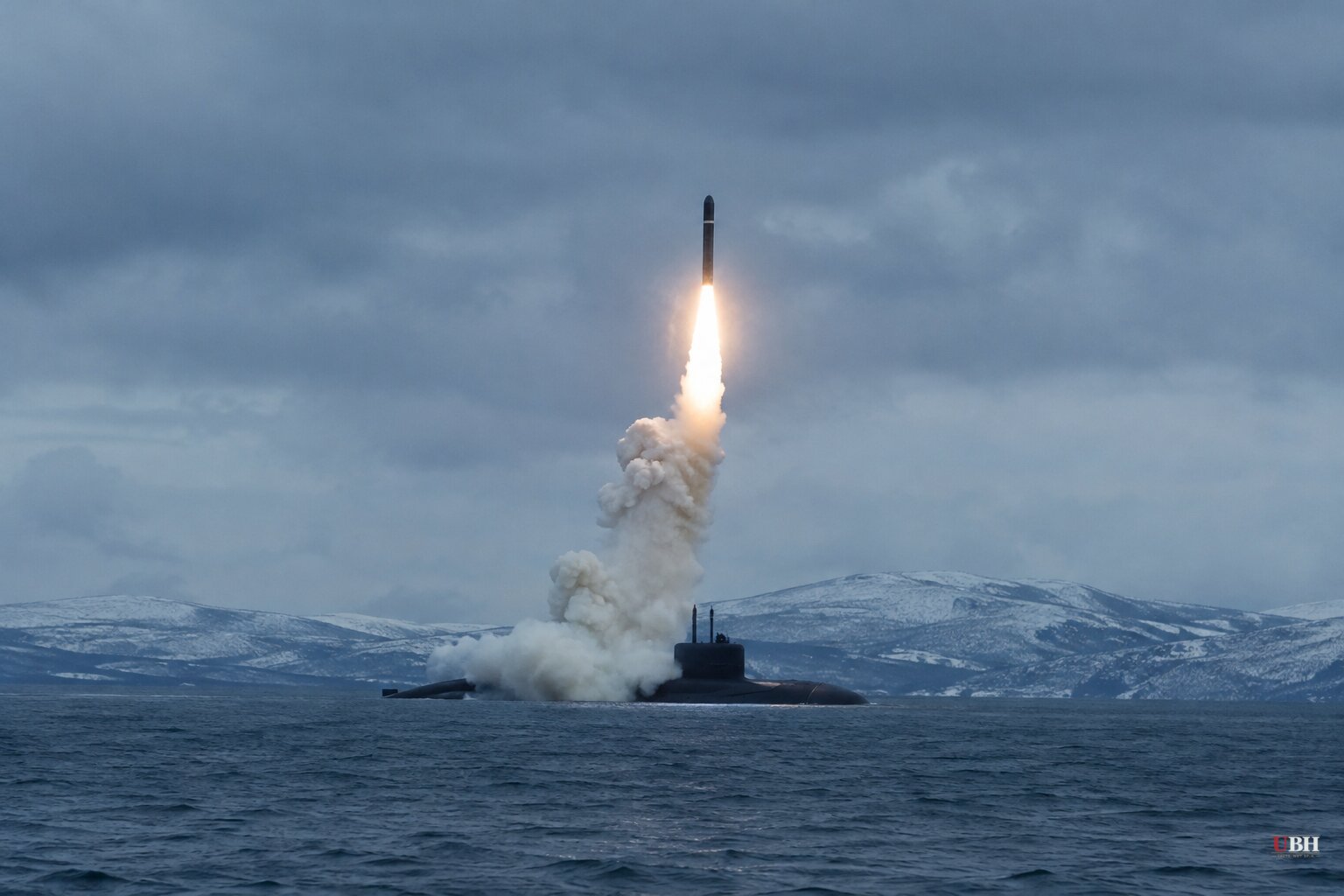
Russia's Defense Ministry said Wednesday, Oct. 28, that the nuclear-powered submarine Generalissimus Suvorov fired a Bulava intercontinental ballistic missile from a submerged position in the Sea of Okhotsk. The ministry said the missile's warhead units reached the Chizha test range in the Arkhangelsk region at the scheduled time.
The flight covered roughly 3,400 miles across Russian territory. Chizha sits on the Kanin Peninsula, about 320 miles from Vardø in Norway and 386 miles from Nuorgam in Finland.
The ministry described the launch as part of the "combat training plan" for the Pacific Fleet's Project 955A Borei-A submarine. It did not link the launch to diplomacy.
The call that came first
The launch followed a phone call on Tuesday, Oct. 27, between Vladimir Putin, Finnish President Alexander Stubb and Norwegian Prime Minister Jonas Gahr Støre. The Finnish government's readout said the two Nordic leaders initiated it. The Kremlin said the same.
Støre told Norway's public broadcaster NRK that the call ran 90 minutes. It had been planned for 20. "It was professional. There are large gaps in positions," he said.
Stubb called the discussion "frank and substantive." "We are neighbouring countries to Russia. The outcome of this war will have a direct impact on our and the broader European security. Ending the war requires direct discussions," he said.
Støre said the leaders stressed de-escalation and that Norway stands by Ukraine's right to defend itself.
Both leaders said they spoke for their own countries, not for Europe. They said Ukraine knew about the call in advance. It followed a meeting in Oslo a week earlier, where they hosted Ukrainian President Volodymyr Zelenskyy and U.S. envoy Steve Witkoff, with Germany and Poland among those represented.
Russia's Foreign Ministry said Putin told them a lasting peace is possible only if Russia's "legitimate interests are fully and unconditionally taken into account." The Kremlin said Putin accused the EU and NATO of prolonging the war through "confrontational policies."
The call was the first known direct contact between these two leaders and Putin since the early months of the February 2022 invasion. The last notable contact by any Western European leader was French President Emmanuel Macron's in July 2025, according to the BBC.
Europe is not on one page
The rebuke from Copenhagen came almost immediately. Danish Prime Minister Mette Frederiksen told TV 2 she was "very sceptical about this Norwegian and Finnish solo initiative. It has not been coordinated with the rest of us." Her line to Danish media: "I think that we should keep Europe together instead of going solo."
Poland's Donald Tusk called for "absolute caution and vigilance" in any European contact with Putin. Lithuanian Foreign Minister Kęstutis Budrys wrote that "engaging with Putin one by one and without clear agenda has never worked for Europe. Not once."
Swedish Prime Minister Ulf Kristersson said he had "quite low expectations" and had not been told about the call beforehand.
Stubb and Støre's side of the argument is simple. Finland and Norway share a border with Russia, and they say ending the war requires direct talks. They also point out that Ukraine was consulted and that the call is tied to planned three-way talks among Moscow, Washington and Kyiv in Abu Dhabi next month.
Not an unusual test, but not a quiet region
Russia periodically test-fires Bulava missiles from its Borei-class submarines. The Bulava has a touted range of more than 5,000 miles, and each Borei-class boat can carry up to 16 of them. These boats are central to Russia's second-strike deterrent. No source has said the launch was added to the schedule because of the call, and Moscow's stated reason is routine training.
The backdrop is tense anyway. Finland and Norway are both NATO members bordering Russia, and both are rushing to build up their militaries amid warnings from across the alliance that Russia could attack NATO territory in the next few years.
The Wall Street Journal has reported that U.S. intelligence agencies concluded the failed drone attack on a cargo plane at Germany's Leipzig-Halle Airport earlier this year was the first of several planned sabotage operations in NATO countries. The paper reported that Putin ordered the campaign. Russia has repeatedly denied involvement in such incidents. Germany said the Leipzig attempt "fits the established pattern of Russian hybrid operations in Europe" and took diplomatic measures.
The Wall Street Journal has also reported that France and 10 other European countries are working on a "forward deterrence" plan, including potentially basing nuclear-capable Rafale jets in partner states. Stubb said Finland has no plans to put nuclear weapons on its soil in peacetime, but does have "plans for creating a strategic dilemma for Russia."
Katarzyna Zysk, a professor at the Norwegian Defence University College's Institute for Defence Studies, spoke at the Arctic Circle Assembly in Reykjavik about the pattern. She calls it "salami tactics." "You slice off one thin piece at a time, until a new normal is established," she said. In her view, weak responses to incremental provocations let Moscow conclude "the costs remain too low to deter further action."
The Abu Dhabi talks are the next concrete test. Whether Putin moves from restating Russia's terms to negotiating them, and whether Europe can agree on who speaks to him, will decide if Tuesday's call was an opening or a one-off.
Sources used for this briefing
7 links from 7 independent newsrooms (syndicated copies of the same report count once)
These are the sources it draws on, linked so you can verify.


