
Unbiased headlines. Facts, not spin.
Unbiased Headlines is an independently owned news organization. We bring you the facts, not opinions, written fresh from 110+ named sources. Sources linked so you can verify it yourself.
 defense
Major Story (7/10)
Event date: October 26, 2026 ·
Pentagon Wants Bases Self-Sufficient for 90 Days as Britain Sets a 1,000-Day War Readiness Clock
Governments on both sides of the Atlantic are now planning in public for a war that reaches their home territory.
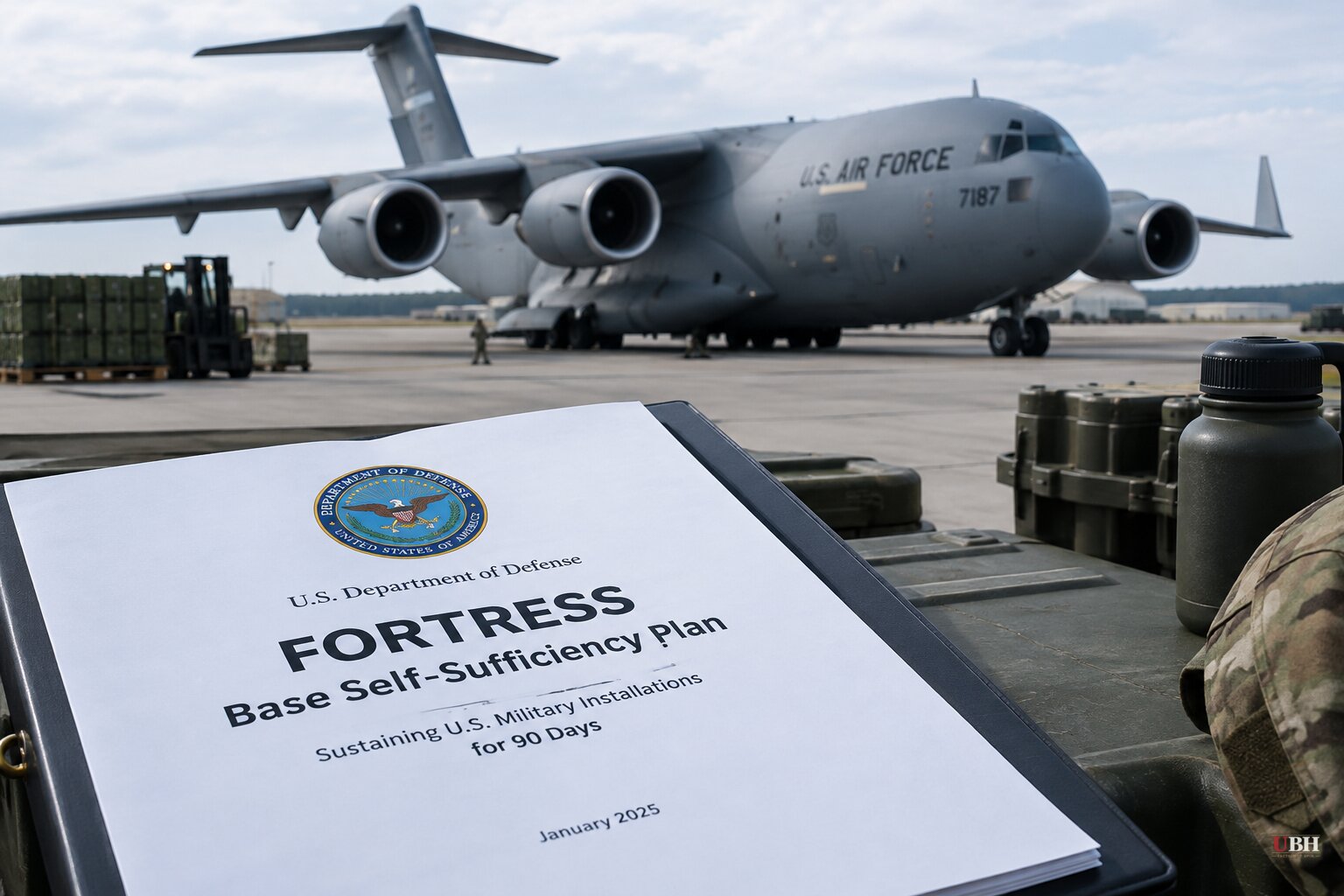
The Pentagon is preparing to require every major U.S. military installation in the continental United States to sustain essential operations for at least 90 days without outside support, according to documents reviewed by Fox News Digital. That covers electricity, water, fuel and communications. The requirement is part of an initiative called FORTRESS.
"We don't want to rely on standard civilian municipal infrastructure to run our national defense. We just simply can't. It's an intolerable risk," Pentagon chief spokesperson Sean Parnell told Fox News Digital. Parnell, who led FORTRESS, added: "Power is combat now. Without electricity, you lose communications, water, logistics, assembly lines and just basic military command structures."
The plan also lays groundwork for civilian factories to shift to defense production in a crisis, and for alternative supply chains and strategic reserves of weapons and fuel. Parnell said homeland defense had been "built around the antiquated assumption that two oceans would protect us."
Separately, the Pentagon announced Project Meridian, a study of future warfare led by chief technology officer Emil Michael and co-led by Elon Musk, Palmer Luckey and Newt Gingrich. Its findings are due within 120 days.
Britain sets a date
In the UK, Defence Secretary Wes Streeting put a number on the timeline. Writing in the Telegraph over the weekend, he said adversaries' "force strength and war economy could put them in a position to attack" by 2030. "That gives us a little over 1,000 days to complete our mission: to be ready with our allies to fight and win," he wrote.
Streeting, who has no military background, was appointed in July by Labour Prime Minister Andy Burnham. He told Parliament on Oct. 19 that he prefers to call Russia's campaign across Europe "state-sponsored terrorism" rather than "hybrid threats" or "gray zone" activity. He also said: "We are not at war with Russia, nor do we seek confrontation."
The government's Be Ready campaign launched Oct. 22. It asks households to hold nine liters of bottled water and three days of food, plus blankets, cash, a first-aid kit, a flashlight and a wind-up FM radio. The Cabinet Office framed it around weather, cyber and other emergencies.
Ministers have said government messaging on defense and security will build toward Exercise ALBISTON SHADOW and a NATO crisis management exercise in spring 2027.
Submarines and a Polish pact
The Times reported Wednesday, Oct. 28, that HMS Vanguard, HMS Vigilant and HMS Vengeance are all at sea at once, the first time in five years. HMS Victorious is in maintenance. A navy source told The Times the deployment was "unusual" and did not elaborate.
The Ministry of Defence did not confirm a change in posture. A spokesperson called the deterrent the "cornerstone of our national security" and noted that Britain is "the only European ally to commit its nuclear deterrent to the defence of NATO."
Navy Lookout, an independent publication covering the Royal Navy, says one ballistic-missile submarine has been on patrol without a break since 1969. It said a second boat was believed to be preparing to relieve the patrol boat and a third was likely doing sea trials or work-up. That is a routine explanation, and nobody on the record has said otherwise.
On Tuesday, Oct. 27, Streeting and Polish Defense Minister Władysław Kosiniak-Kamysz signed a three-year defense plan in Warsaw. It builds on the Northolt Treaty signed in May. It covers air defense co-development tied to Poland's Narew and Pilica programs, drones and counter-drone systems, Baltic naval activity, cyber resilience, and ammunition production involving BAE Systems and Poland's PGZ.
Iran stays unresolved
The U.S.-Israeli war on Iran began in February. Nearly nine months later, it has settled into a stalemate, with both sides claiming victory. Iranian officials have been issuing public threats to deter Trump from restarting it.
"The war is not over," Revolutionary Guards spokesperson Hossein Mohebbi said. "The Islamic Revolutionary Guard Corps has prepared itself for a long-term war." He added that Iran has "new targets that have not yet been attacked." Iranian officials have floated cutting undersea internet cables, striking AI data centers and hitting regional oil and gas facilities.
Residents in Tehran told CNN, speaking anonymously, that they are stocking water and charging power banks in expectation of renewed strikes.
The argument over how far to go
Not everyone thinks London is moving fast enough, or in the right direction. Dr. Simon Bennett, director of the Civil Safety and Security Unit at a UK university and author of a 2025 book on lessons from Ukraine, says Britain "must prepare ourselves to fight alone." He called Trump "a lost cause" and demanded core defense spending of 5% of GDP immediately.
Ministers have committed to NATO's target of 3.5% of GDP on core defense by 2035, plus 1.5% on resilience and infrastructure, for the alliance's headline 5%. Bennett wants the 5% on core defense now. His view is one academic's. It runs against the Pentagon's own framing, in which Parnell cites President Trump's Golden Dome missile defense and a renewed focus on the Western Hemisphere as the new thinking.
The Pentagon has not published a FORTRESS timeline, and Meridian's findings are due 120 days from its announcement. The first public stress test on the British side comes in spring 2027.
Sources used for this briefing
6 links from 6 independent newsrooms (syndicated copies of the same report count once)
These are the sources it draws on, linked so you can verify.


