
Unbiased headlines. Facts, not spin.
Unbiased Headlines is an independently owned news organization. We bring you the facts, not opinions, written fresh from 110+ named sources. Sources linked so you can verify it yourself.
 defense
Major Story (7/10)
Event date: September 25, 2026 ·
Anthropic Offers Governments 40% Discount on Claude While Fighting Pentagon Blacklist in Court
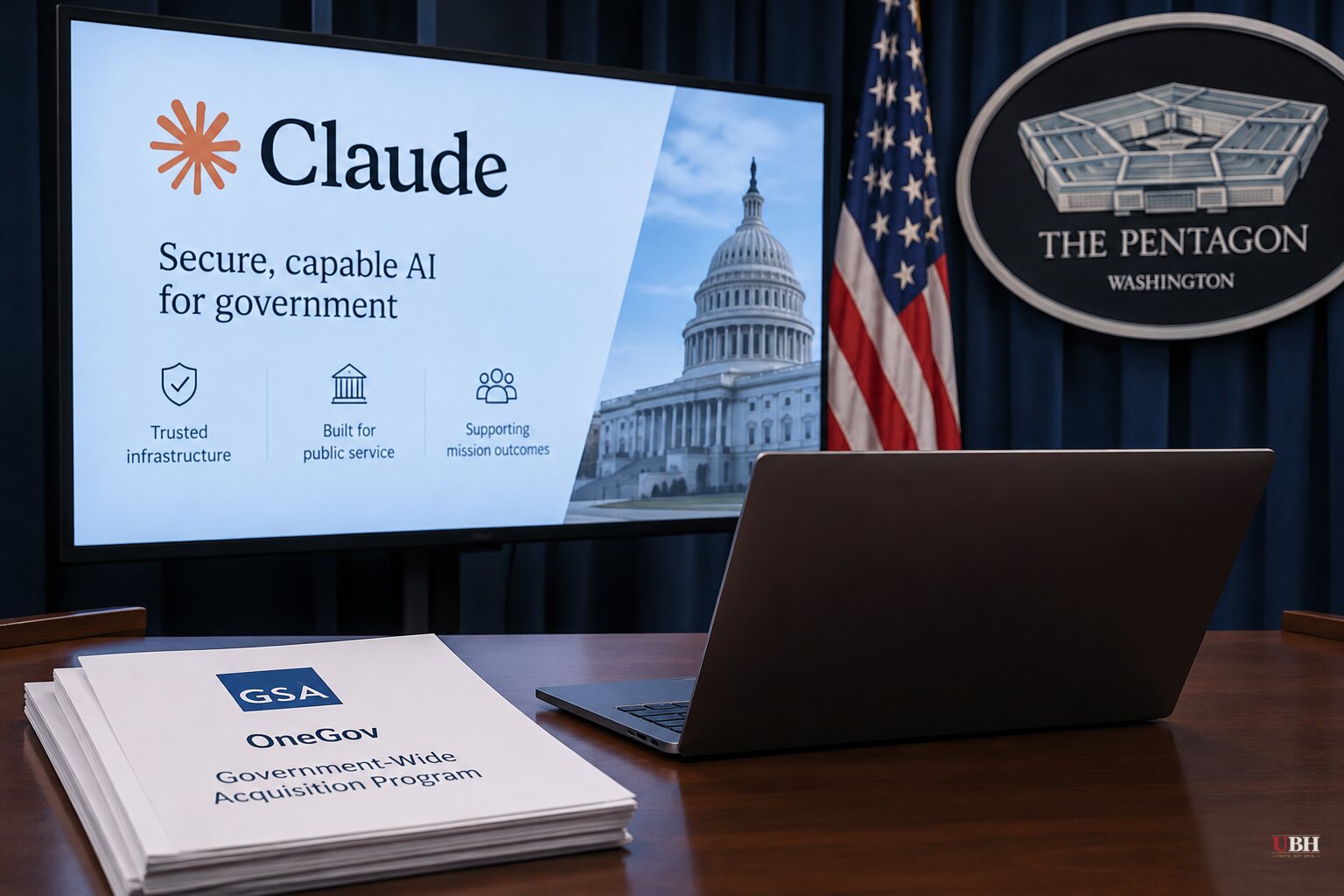
One part of the federal government is cutting Anthropic a discount. Another part has branded it a national-security supply-chain risk.
Anthropic announced on Oct. 27 an expanded agreement with the General Services Administration under the agency's OneGov program. Eligible government customers get 40% off token-based usage of Claude Enterprise, Claude for Government and the Claude API.
The company estimates the discount could save the federal government $1 billion. That is Anthropic's own projection, not a GSA figure.
What the GSA deal covers
Agencies pay for what they use. There is no minimum spending commitment.
The agreement reaches beyond federal departments. It covers the executive, legislative and judicial branches, plus state, local, tribal and territorial governments. It also includes authorized environments for sensitive but unclassified work.
Agencies can buy through the GSA's Multiple Award Schedule now. Sales through major cloud platforms are to be added over the coming months, according to the company.
OneGov is not new. The GSA announced expanded OneGov terms for OpenAI's ChatGPT on Sept. 10, also with consumption-based pricing. A GSA update in April said the program had saved taxpayers $1.1 billion in its first year.
Anthropic's usage claims
Anthropic says about 500 federal, state and local government organizations now use Claude. It says weekly active users of Claude for Government are up roughly eightfold since February 2026, and that usage across federal civilian agencies has grown about 20-fold in a year.
The company also cited a four-week pilot with 34 developers across 10 Utah state agencies. Per Anthropic, 71% of participants reported saving at least 20 hours. It added that a state government team used Claude to respond to a ransomware attack in eight minutes, against the usual two to three days.
All of those numbers come from Anthropic and have not been independently verified.
The Pentagon fight
The dispute began when Pentagon leadership pushed AI vendors to allow use of their models for "all lawful use cases" without limitation. Anthropic refused two uses: mass surveillance of Americans and autonomous weapons that attack targets without human intervention.
Talks failed. The Pentagon then designated Anthropic a supply-chain risk to national security. Defense Scoop reported that Defense Secretary Pete Hegseth made the designation in February; other outlets date the Pentagon's designation to March. The label is typically reserved for foreign, adversarial entities, and it functionally bars defense contractors from doing commercial business with Anthropic.
Anthropic sued. Its lawyers argue the government acted because the company declined those uses and said so publicly. In their words: "The Secretary of War branded Anthropic — an American AI company whose models help defend the nation— a national-security 'supply chain risk' because it declined to permit its models to be used for mass surveillance of Americans or lethal autonomous warfare and publicly explained those AI-safety commitments."
A Pentagon spokesperson told CNBC the department does not comment on pending litigation.
Two courts, two answers
In August, a federal judge in San Francisco found the Defense Department violated Anthropic's First Amendment rights and that the designation was unlawful retaliation.
In September, a three-judge panel of the D.C. Circuit went the other way, 2-1. It rejected Anthropic's arguments that the restrictions were arbitrary, exceeded the department's authority and violated the Constitution.
Congress gave the D.C. Circuit exclusive jurisdiction over supply-chain risk designations. A bipartisan group of 17 former senior national security officials, diplomats and intelligence professionals filed a 26-page brief on a Tuesday, as reported by Defense Scoop on Oct. 21, saying this makes the panel's ruling the governing law nationwide. "No other court can revisit it," they wrote. They warned that "left undisturbed that ruling will threaten all defense contractors."
Anthropic has asked the full D.C. Circuit to rehear the case. Its attorneys say the panel ignored "straightforward evidence the designation was retaliation for Anthropic's speech about AI safety."
What the GSA deal does not change
The GSA agreement is a separate procurement track. It leaves the Pentagon designation and the litigation untouched. It shows civilian and state buyers continuing to purchase Claude while defense contractors are cut off.
Anthropic's filing with the Securities and Exchange Commission for an IPO has drawn its own attention. Axios reporter Madison Mills noted the word "jobs" appears five times in the filing. Three of those references concern how public worry over AI and employment could hurt Anthropic's reputation, invite regulation or slow adoption. Mills said the filing "says nothing about what mass unemployment could mean for its own business."
The next move belongs to the D.C. Circuit. Reporting available so far identifies no ruling on the rehearing request. If it declines, the 2-1 panel ruling stands as the governing law on supply-chain risk designations.
Sources used for this briefing
6 links from 6 independent newsrooms (syndicated copies of the same report count once)
These are the sources it draws on, linked so you can verify.


