
Unbiased headlines. Facts, not spin.
Every story is an unbiased news briefing written from 110+ sources across the spectrum — sources linked so you can verify it yourself.
 defense
Major Story (8/10)
Event date: September 15, 2026
defense
Major Story (8/10)
Event date: September 15, 2026
Russia Shifts to Ballistic Missiles Over Kyiv, Cutting Warning Times to Minutes
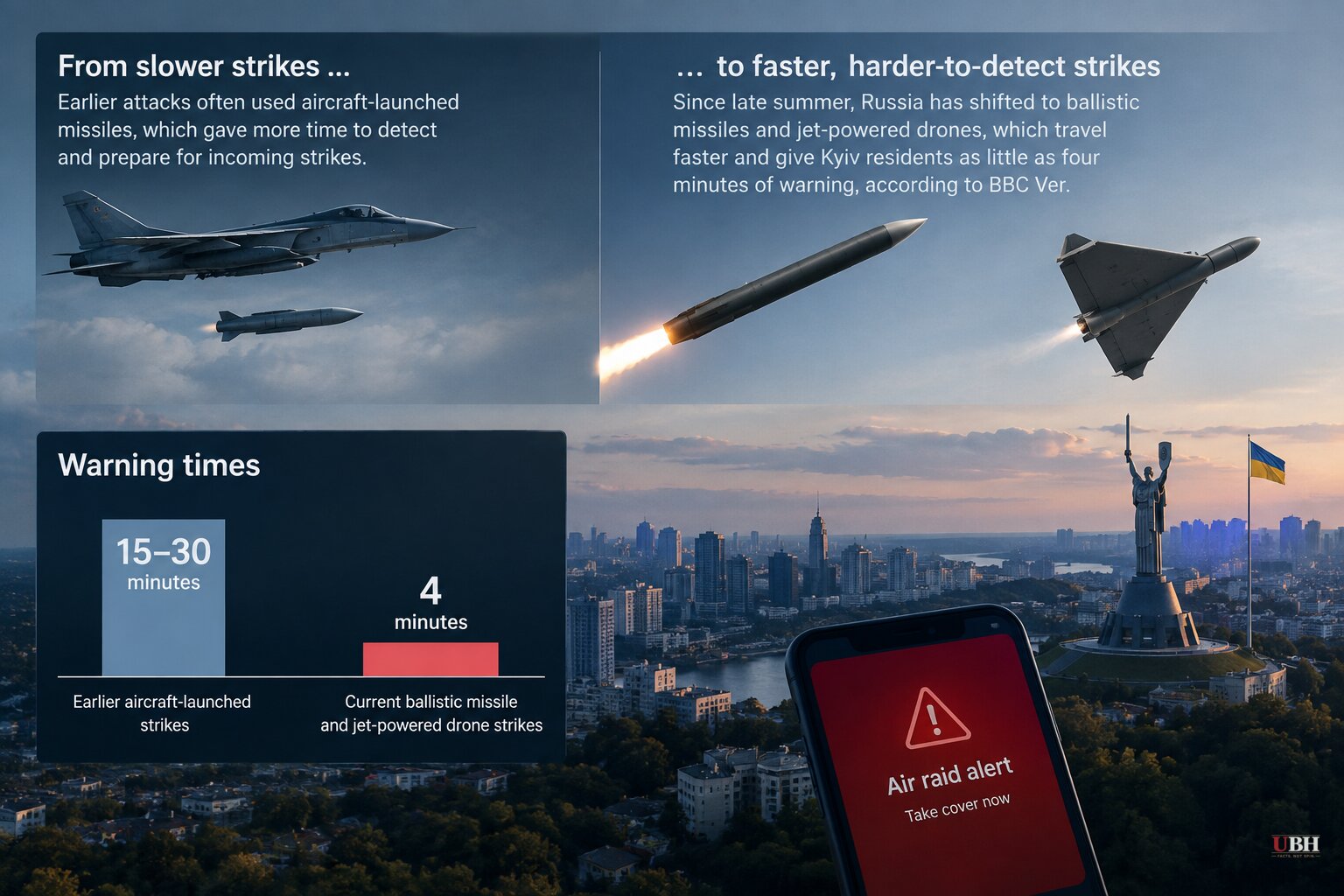
For most of Russia's full-scale invasion, Kyiv residents lived by what they called the two-wall rule: stay behind two interior walls during a strike and you'd probably be fine. That calculation has broken down.
According to BBC Verify's analysis of Ukrainian government data, Kyiv is now experiencing more daily air raid alerts than at any point since the 2022 invasion began. The reason isn't just volume. It's timing.
Russia has shifted away from aircraft-launched strikes, which Ukrainian intelligence could often detect and warn about hours in advance, toward ballistic missiles that travel too fast for meaningful notice. BBC reporting found that sirens now sometimes sound only minutes before impact, or even alongside the first explosions.
Daria, a 27-year-old who works in Ukraine's defense sector, told the BBC she used to sleep through shelling in her ninth-floor Kyiv apartment. That changed in May, when blast waves from a nearby strike kept slamming her windows open and shut during a boxing match she was watching with her boyfriend. In June, after a young mother was killed running to a shelter, Daria moved to her family's house 30 kilometers away in Romankiv and now commutes four hours a day to her job in the capital.
The intensified campaign accelerated in late August. Ukrainian President Volodymyr Zelenskyy said Russia fired nearly 1,500 drones at Ukraine over four days between Aug. 27 and Aug. 31, more than half of them jet-powered, according to the Associated Press. A strike on the village of Myla killed 38 people on Aug. 28, per Reuters. By Sept. 1, on the sixth straight day of attacks, Zelenskyy reported 12 more deaths, including seven killed in a strike on a railway depot in Kyiv, with additional strikes hitting Odesa, Chernihiv, Dnipro, Donetsk, Kharkiv, Kherson, Sumy, Zaporizhzhia and Zhytomyr, per the Epoch Times.
Russia's Ministry of Defense said on Telegram that the strikes targeted military sites and energy facilities, along with ports and cities it said were being used to store and supply weapons.
The campaign has also hit civilian logistics hard. Ukraine's Agriculture Minister Taras Vysotskyi told reporters in Kyiv that roughly 90% of the food logistics infrastructure run by retail chains has been destroyed, according to Ukrinform, though he said retailers were shifting to alternative delivery methods. The Associated Press reported bare supermarket shelves in Kyiv following repeated strikes on warehouses in Brovary and Boryspil that wounded four people, according to regional administration head Tymur Tkachenko.
There was a brief reprieve. Kyiv Post reported that Russia and Ukraine agreed to hold off on strikes against Moscow and Kyiv on Sept. 6 and 7, while U.S. envoys Steve Witkoff and Jared Kushner visited Moscow. For those two days, the outlet said, the capital briefly felt normal again. Then the drones came back.
On Sept. 17, Russia carried out a ballistic strike on Kyiv that wounded 20 people, including two children ages 10 and 12, according to Mayor Vitali Klitschko.
The disruption isn't limited to casualties. Olha Vlasova, 62, cares for her 98-year-old bedridden mother, Nadia Tsybina, on the seventh floor of a Kyiv apartment building. Neither can reach a shelter during an alert. Olha's routine now involves placing a mattress against the window, covering her mother with a blanket, and hiding in a closet behind two walls, per BBC reporting.
Natalia Bushkovska, 37, prepares three separate contingency plans and a go-bag with a tourniquet and whistle every night. Her nine-year-old daughter carries her own bag with toys, lip balm, and a tourniquet.
Viola, a Kyiv mother whose husband is deployed in southern Ukraine, told Kyiv Post her nine-year-old daughter Oleksandra started fourth grade this month but spends much of the school day in a shelter. "There can be up to 10 air raid alerts a day," Viola said. She now checks drone-tracking maps before deciding whether it's safe to leave the apartment.
Ukrainian Foreign Minister Andrii Sybiha argues the strikes prove Russian President Vladimir Putin has no interest in ending the war, and is pressing the U.S. House to pass a Russia sanctions bill the Senate approved in July, championed by Sen. Lindsey Graham, which would target Russian oil buyers with tariffs. That bill remains stalled in the House as of this month, with no vote scheduled.
Zelenskyy has separately acknowledged Ukraine is struggling to counter Russia's jet-powered drones, saying four Ukrainian companies are developing interceptor technology and one has the most promising results, though he did not name which one. U.S.-led peace talks remain stalled, with Ukraine refusing Russian demands to cede territory, even as Zelenskyy describes his contacts with Trump envoys Witkoff and Kushner as "detailed and constructive." Whether that diplomacy produces anything before winter, when Russia has previously targeted Ukraine's power grid, is still an open question.
Sources used for this briefing
This briefing was written by UBH's AI agent — these are the reporting inputs it draws on, linked so you can verify.


