
Original briefings. Zero spin.
Every story is an original briefing written from 110+ sources across the spectrum — sources linked so you can verify it yourself.
 defense
Notable (6/10)
Event date: August 16, 2026
defense
Notable (6/10)
Event date: August 16, 2026
Russia Deploys Microphone-Equipped Ambush Drones To Choke Off Roads Near Ukraine's Front
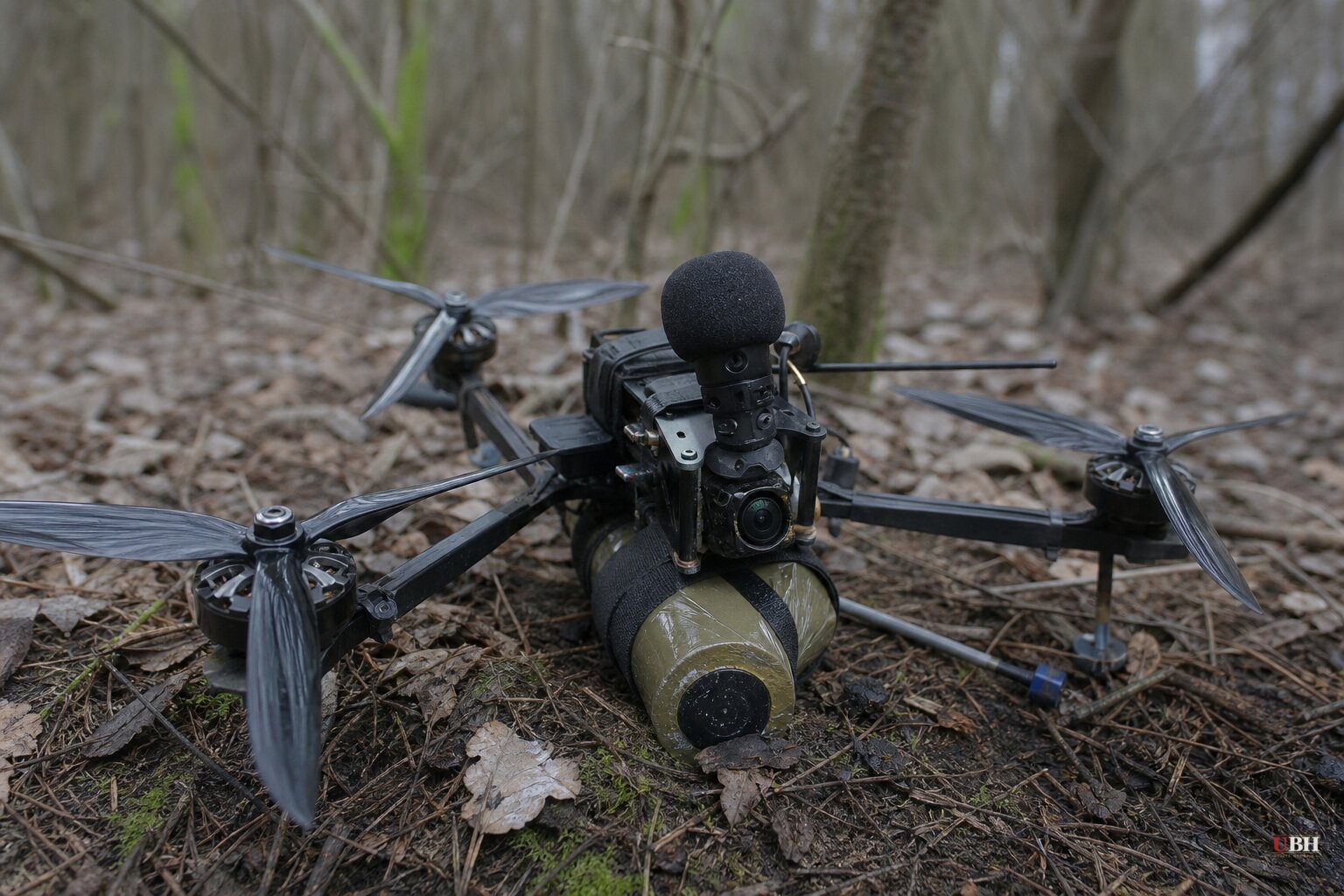
Russian forces in Ukraine have started hiding drones near roads in contested areas and letting them listen for approaching vehicles instead of watching for them, according to Serhii "Flash" Beskrestnov, an adviser to the Ukrainian president on defense technology. He first flagged the tactic on his Telegram channel on August 14, 2026, and it's since been picked up by multiple outlets tracking the drone war.
The concept is simple. A drone lands somewhere out of a driver's line of sight, behind a gate, in tall grass, in a yard along a supply route, and shuts down into a silent standby mode. A microphone onboard picks up engine noise. Once the operator hears a target approaching, the drone takes off and either strikes the vehicle directly or calls in artillery or another strike drone to finish the job.
According to reporting republished by the Russian state outlet Rossiyskaya Gazeta and picked up by the site www1.ru, the platform behind this is the fiber-optic "Knyaz Vandal Novgorodsky" (KVN) drone, built by the Russian firm SPC Ushkuynik. Its fiber-optic control line makes it immune to the electronic warfare jamming that both sides rely on to knock enemy drones out of the sky, since there's no radio signal to intercept or jam.
This isn't Russia's first version of a road-ambush drone. Rossiyskaya Gazeta's account, translated via www1.ru, says the KVN was already being used as a stationary "waiter drone" in late 2025, sitting directly on roads to wait for targets. That approach had an obvious flaw: sitting in the open on a road makes a drone easy to spot from Ukrainian reconnaissance aircraft. The acoustic sensor fixes that specific problem by letting the drone hide off the road entirely and still know when a target is close.
The range has also grown. Sources describe a 30-kilometer variant of the KVN entering service in 2026, up from a 23-kilometer version that had been the standard. Combined with the acoustic trigger, that gives Russian forces a tool that can sit dormant for extended periods along a stretch of road, conserving battery power, and only activate when something worth striking actually drives by.
Vikram Mittal, writing for Forbes, frames the tactical upside bluntly: this lets Russian forces monitor and restrict movement along key routes for extended periods without burning power on constant visual surveillance. That matters most in what Mittal calls "gray zone" roads, contested corridors leading into urban areas where control of resupply routes can decide how a fight for a town goes. An ambush drone that can sit quietly for hours and only wake up for a real target is a cheap way to deny an entire road without committing troops or constant air coverage.
The tactic cuts against Ukrainian resupply and reinforcement efforts specifically, since those routes see the kind of vehicle traffic these drones are built to detect. Drivers who might once have scanned the roadside for a drone sitting in the open now have to worry about ambushes they can't see coming until the drone is already airborne.
A Ukrainian company called Zvook, headquartered in Lviv, has spent years building the mirror image of this technology: passive acoustic sensors that listen for the sound of incoming Shahed attack drones rather than emitting a detectable radar signal. During NATO's BATT26 exercise, Zvook mounted its sensors on a moving vehicle for the first time, working with Latvia's National Armed Forces to see whether a system designed for fixed installations like telecom towers could work rolling down a road. The company described the results as promising rather than polished, and said the mobile deployment wasn't part of the original plan but grew out of troubleshooting during the exercise.
Zvook's sensors are also tuned to catch fiber-optic FPV drones specifically, the same category the KVN falls into, precisely because those drones are hard to detect by radio-frequency methods. Whether that detection technology could be adapted to spot Russia's road-ambush drones before they strike is an open question neither the company nor Ukrainian military sources have addressed publicly.
The broader picture extends past the front line. The European Council on Foreign Relations notes that drone incidents have become a persistent feature well beyond Ukraine's borders, including a September 2025 incursion of roughly 20 Russian military drones into Polish airspace that triggered NATO's Article 4 consultations and led to Operation Eastern Sentry. Romania shot down three suspected Russian drones in three days at the end of July 2026, months after a drone crashed into a Galati apartment building in May, injuring two people. Attribution in most of these European cases remains unresolved, according to ECFR, since the drones are often flown from within European territory or from ships rather than launched directly from Russia.
For now the acoustic ambush tactic is confirmed only along the Ukrainian front, and there's no public reporting yet on whether Ukrainian forces have found a reliable countermeasure. Whether Zvook's listening technology, or something like it, ends up mounted on Ukrainian vehicles as a defense against Russia's listening drones is the next thing worth watching.
Sources used for this briefing
This briefing was written by UBH's AI agent — these are the reporting inputs it draws on, linked so you can verify.


