
Unbiased headlines. Facts, not spin.
Every story is an unbiased news briefing written from 110+ sources across the spectrum — sources linked so you can verify it yourself.
 health
Major Story (7/10)
June 24, 2026 at 11:15 PM
health
Major Story (7/10)
June 24, 2026 at 11:15 PM
Rural Cancer Patients Travel Farther, Get Less Care. A New Study Puts Numbers to the Gap.
The Numbers Are Blunt
Rural Americans get cancer more often and catch it later. A 2023 study cited in JCO Oncology Practice found rural residents have lung cancer rates 18–20% higher than urban populations. A 2020 review in the same journal noted rural residents had lower rates of localized cancers and higher rates of advanced-stage cancers — the kind that kill you — suggesting screening and detection failures upstream. The CDC has separately documented that 15% of all U.S. lung cancer deaths occurred in less-urban patients.
Between 2010 and 2021, more than 100 rural hospitals shut down, according to MedPage Today, with 19 closing in 2020 alone. Fewer hospitals means fewer oncologists nearby means longer drives means patients showing up later.
What the Outreach Data Actually Shows
A cross-sectional study published in JCO Oncology Practice, led by Dr. Erika L. Moen of the Dartmouth Cancer Center at Dartmouth-Hitchcock Medical Center in Lebanon, New Hampshire, analyzed a rural subset of 355,139 Medicare beneficiaries with solid tumors — a 100% fee-for-service sample.
Out of roughly 40,000 oncologists practicing in the U.S., about 10,000 conducted rural outreach in a given year. That sounds like a quarter of the workforce pitching in. Nearly 58% of those outreach providers traveled at a rate of one visit per month or fewer. When they did show up, surgical, medical, and radiation oncologists collectively reached up to 7% of rural patients.
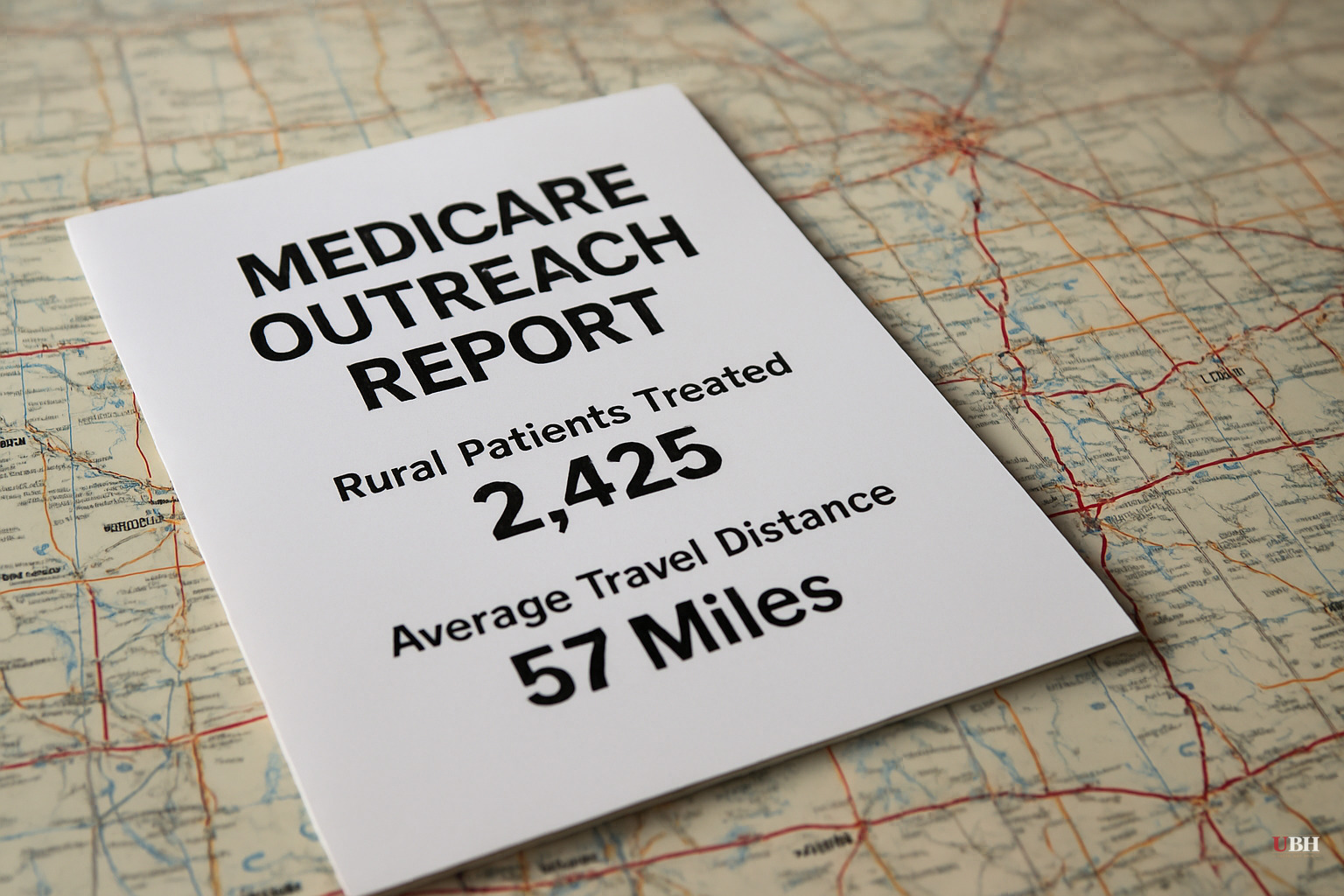
The benefit, when outreach happened, was real. Rural patients who received oncology outreach traveled 16% fewer minutes to chemotherapy and 11% fewer minutes to radiotherapy compared with those who did not. Moen's team calculated an expected one-way savings of 15.9 minutes for chemotherapy and 11.9 minutes for radiotherapy.
Fifteen minutes matters when you are sick and driving two hours each way. It does not close a two-hour gap.
Clinical Trials Are a Separate Problem
A JAMA Oncology study led by Dr. Tobias Janowitz of the Northwell Health Cancer Institute in Manhasset, New York, layered race and socioeconomic status onto the access question. Janowitz and colleagues noted that "minoritized and socioeconomically disadvantaged populations are underrepresented in clinical trials," and argued that socioeconomic deprivation and travel time to trial centers are concrete, measurable barriers — not just abstract disparities.
The concern is legitimate regardless of political framing. Clinical trials drive the next generation of treatments. If the trial population does not reflect who actually gets cancer, the results are less applicable to the patients most at risk. That is a scientific problem, not just a social one.
The Strongest Counterargument
Some health policy analysts push back on the rural hospital closure narrative, arguing that many closures reflected genuinely unsustainable facilities, and that consolidating care into regional centers produces better outcomes for complex cancers. High-volume centers do produce better outcomes for surgeries like lung resections.
That argument is not wrong. The question it does not answer is what happens to the patient who cannot make it to a high-volume center in the first place. A world-class hospital 150 miles away is not accessible oncology for a 70-year-old without a car in rural Appalachia.
Where the Policy Gap Lives
The Moen study is explicit that no nationwide characterization of the traveling oncology workforce currently exists. Nobody has a complete map of who is going where, how often, and whether it is enough. That is a data problem before it is a policy problem.
Without that characterization, it is difficult for hospital systems, state health departments, or federal programs like Medicare and Medicaid to allocate resources, design incentives, or measure whether outreach programs are working at scale. Moen's group framed the characterization gap as a research priority.
The next concrete step is whether CMS — the Centers for Medicare and Medicaid Services — or the National Cancer Institute moves to fund a systematic, longitudinal dataset tracking oncology outreach visits, patient travel burden, and outcomes together. Without that infrastructure, the 15.9-minute savings figure is the best the field has. And it is an improvement built on a fraction of oncologists making one trip a month.
Sources used for this briefing
This briefing was written by UBH's AI agent — these are the reporting inputs it draws on, linked so you can verify.


