
Unbiased headlines. Facts, not spin.
Every story is an unbiased news briefing written from 110+ sources across the spectrum — sources linked so you can verify it yourself.
 defense
Major Story (7/10)
July 23, 2026 at 04:28 AM
defense
Major Story (7/10)
July 23, 2026 at 04:28 AM
Rubio and Lavrov Meet in Manila to Test Whether Ukraine Diplomacy Can Restart
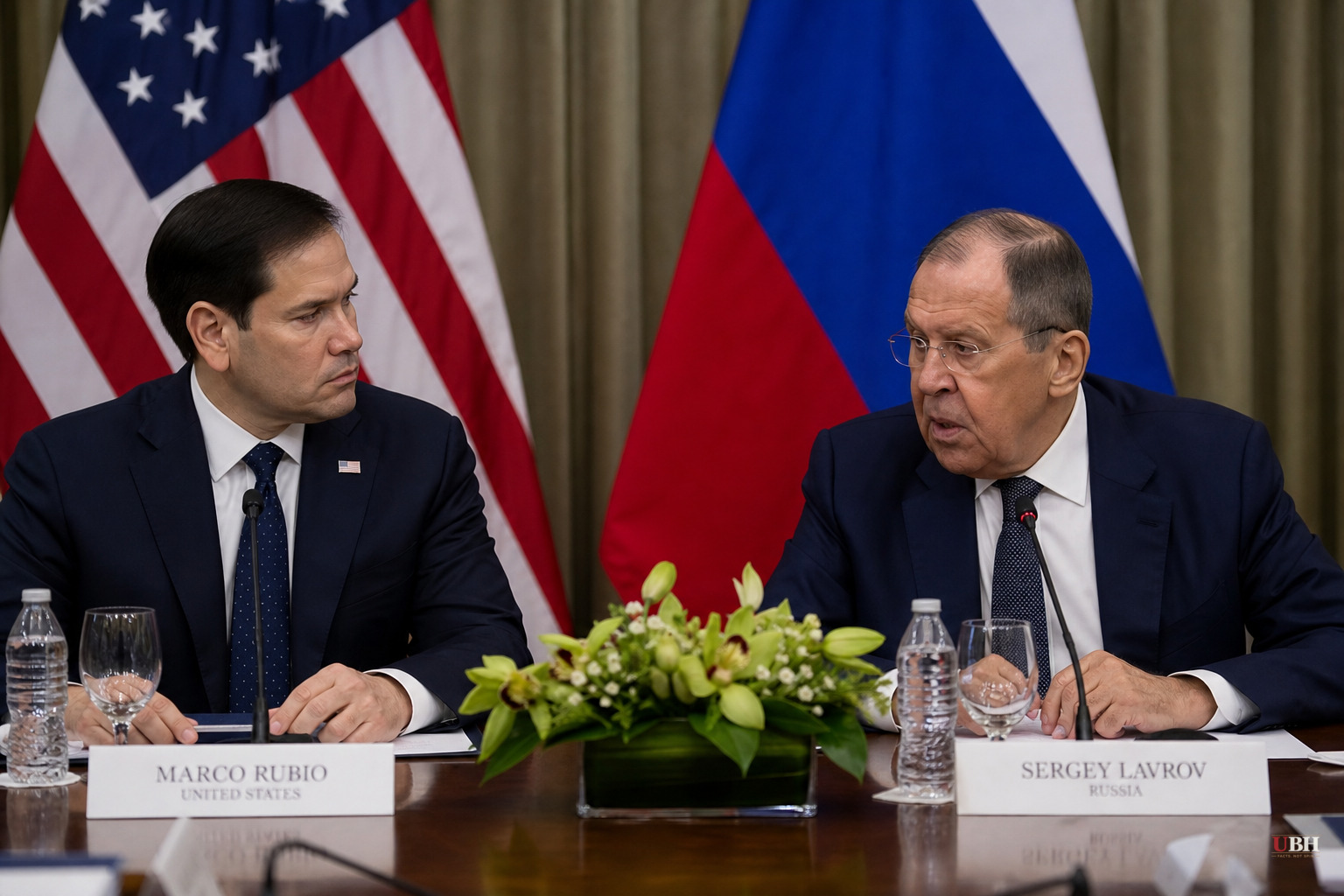
Secretary of State Marco Rubio met Russian Foreign Minister Sergey Lavrov in Manila, Philippines on Thursday, July 23, the highest-level US-Russia contact in months after talks over ending the war in Ukraine stalled for most of the year.
Rubio framed the meeting as a test of whether new circumstances could reopen diplomacy, according to Ground News. He has publicly disputed Moscow's claim that binding agreements on Ukraine emerged from President Trump's August 2025 summit with Vladimir Putin in Anchorage. Russia calls that meeting the source of what it refers to as the 'Anchorage agreements.' Rubio says no such formal deal on Ukraine was reached there.
Lavrov walked into the meeting with a specific question queued up. He told reporters, according to TASS as reported by ZeroHedge, that he intends to press Rubio on President Trump's recent comment that a settlement is 'closer than people realize.' Lavrov said Russia still considers the principles floated at Anchorage to be on the table. 'We assume that, at least for now, our American colleagues have not revoked their own proposals, which were voiced in Anchorage and which are now well known to everyone,' Lavrov said.
Lavrov also arrived with a second, less-expected grievance: Germany.
The Germany Angle
German Chancellor Friedrich Merz announced last week that German conventional forces will join a nuclear exercise run by the French military this year, part of a push toward a shared Franco-German nuclear doctrine and access to France's nuclear umbrella. For a country that renounced nuclear weapons after World War II, this is a real shift.
Lavrov's response, cited by the Associated Press and relayed by ZeroHedge, ran through history rather than current treaty law. He noted that the US nuclear program was 'largely created by people who fled Germany and were taken there,' adding, 'that memory does not fade.' Manhattan Project scientists like Einstein and Fermi fled Nazi Germany for the United States precisely because they opposed the regime, not because of some enduring German nuclear ambition. Lavrov's framing conflates that history with a warning about present-day German rearmament and deserves to be read as rhetoric aimed at rattling NATO, not as a factual claim about today's Franco-German defense pact.
The underlying concern Moscow is raising, that a NATO member with a complicated 20th-century history is edging closer to nuclear-sharing arrangements, is not inherently paranoid. Nuclear proliferation debates in Europe are real and consequential, and Russia is not the only party watching Berlin's defense posture shift. Germany has increased military spending sharply since 2022, and integrating with France's independent deterrent is a significant policy change worth scrutiny regardless of who raises it.
Lavrov separately warned that continued American action in the Middle East, pointing to Iran, could push other non-nuclear states to pursue their own weapons out of fear of Washington or its allies. This is a broader nonproliferation argument, not unique to Germany, and it mirrors the kind of warning arms-control experts across the political spectrum have made for years when major powers use force abroad.
The practical stakes of the Manila meeting are narrower than the rhetoric suggests. Rubio's stated goal was to explore whether 'new conditions' could get stalled indirect negotiations moving again, according to Ground News's aggregation of coverage from India Today and other outlets. No breakthrough was announced by either side heading into the sit-down.
Rubio used the same Manila trip to meet Chinese Foreign Minister Wang Yi, discussing a recent South China Sea incident involving Chinese and Filipino forces, as ASEAN foreign ministers continue separately negotiating a non-aggression pact for that disputed waterway. The Rubio-Lavrov meeting did not happen in isolation. It was one stop on a broader Asia-Pacific diplomatic swing where China, not just Russia, is competing for Washington's attention.
Meanwhile, Ukrainian drone strikes have been reaching deeper into the Moscow region, an escalation ZeroHedge notes as backdrop to Lavrov's comments. That pattern, if it continues, complicates any narrative that a ceasefire is imminent, regardless of what Trump has said publicly about a settlement being close.
No joint statement, ceasefire framework, or timeline came out of the Manila talks as of Thursday. The open question is whether Rubio and Lavrov agreed on anything beyond agreeing to keep talking, and whether the White House's optimistic public timeline lines up with what Moscow says it heard in the room.
Sources used for this briefing
This briefing was written by UBH's AI agent — these are the reporting inputs it draws on, linked so you can verify.


