
Unbiased headlines. Facts, not spin.
Unbiased Headlines is an independently owned news organization. We bring you the facts, not opinions, written fresh from 110+ named sources. Sources linked so you can verify it yourself.
 tech
Notable (5/10)
tech
Notable (5/10)
Rippling Burned Through Millions on AI Tokens, Then Built a Tool to Stop Its Own Employees
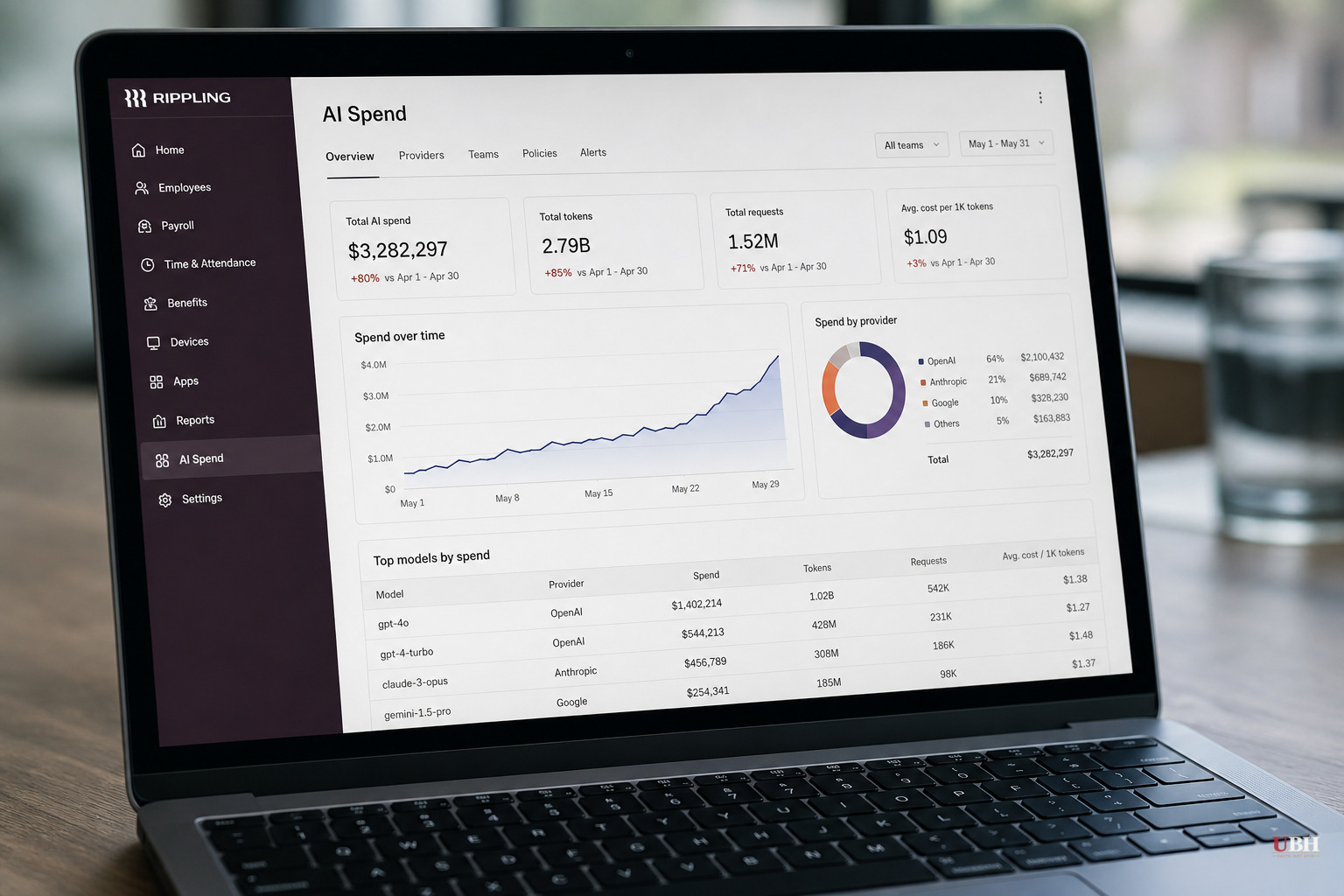
Rippling, the HR and payroll software company, spent early 2026 doing what half of corporate America was doing: throwing money at AI tools with no real accounting for what it was buying. Then its own finance chief showed the executive team a number that stopped the meeting cold.
According to a TechCrunch report, CFO Adam Swiecicki told Rippling's leadership in March that the company was on track to burn 40% of its entire R&D headcount budget on AI tokens. That means the company was spending nearly half as much on AI compute as it was paying the salaries of the engineers using it. Chief Product Officer Matt MacInnis told TechCrunch the room was "incredulous."
It got worse. Spending was climbing 80% month-over-month. Left unchecked, Rippling projected it would be spending 90% as much on AI tokens as on the R&D staff themselves within a year.
Nobody voted on this. There was no budget line for it. It just happened, one Cursor subscription and one Claude API call at a time, until it nearly doubled the cost of running an engineering department.
Where the money actually went
Rippling ran an internal audit and found the spending wasn't evenly spread. Roughly 10 to 15 percent of employees accounted for about 60% of total AI spend, the company said in a blog post cited by TechCrunch. One engineer alone was running up $50,000 a month in AI costs.
The spending might reflect a genuinely productive engineer using every tool available. Or it might show someone defaulting to the most expensive model for every task, including ones a cheaper tool could handle just fine. Rippling's own findings suggest the latter was common: employees were reaching for the newest, priciest frontier models by default, regardless of the job.
MacInnis put the blame partly on the AI vendors themselves. "The truth is that the inference providers, like Anthropic and OpenAI, have absolutely no incentives to help you control your spend," he told TechCrunch. "They have every incentive for it to be a runaway expense, and that's exactly what they do. They don't provide you with great usage insight, and they don't collaborate with one another."
That's a pointed accusation from a paying customer, not a regulator or a competitor. OpenAI and Anthropic have not been quoted responding to that specific claim. But the underlying economics support it: these companies are paid by usage. A customer spending less is revenue lost for the vendor. Nobody should expect the seller to police the buyer's wallet.
What Rippling built
Rather than banning AI tools outright, Rippling negotiated hard spending caps with Cursor, OpenAI, and Anthropic. Then it built what it now sells as AI Spend Console, a product that tracks AI spending down to the individual employee, team, and role, and cross-references it against actual output quality.
The pitch, per Rippling's blog post, is that the tool can flag engineers with high AI spend whose code gets kicked back repeatedly in peer review. In plain terms, it's designed to catch people generating a lot of AI-assisted code that colleagues then have to redo. That's a real cost most companies aren't currently measuring at all, buried inside "produced more output" metrics that look good until someone checks the quality.
Rippling founder and CEO Parker Conrad also said last month that internal benchmarking found xAI's Grok performed best overall for the company's use cases, while GLM 5.2, a Chinese open-weight model, delivered nearly identical results at roughly 85% lower cost. That detail matters beyond Rippling's own balance sheet. It signals that U.S. enterprises are increasingly willing to route serious engineering work through Chinese-origin AI models when the price gap gets large enough, a trend that raises its own questions about data handling and long-term reliance on foreign-developed models that American companies don't control.
What's still unclear
Rippling has not disclosed the total dollar figure it spent before reining things in, only the percentage of its R&D budget it represented. It also hasn't said how much the spending cap and the new console have actually cut costs since implementation, or whether the 10-15% of high-spending employees turned out to be its most or least productive engineers once code-review data was factored in.
Rippling is now selling this tool to other companies dealing with the same problem. Whether AI Spend Console actually changes vendor behavior at OpenAI, Anthropic, or Cursor, or simply helps individual companies police their own employees while token prices keep climbing, is the open question the next few quarters of enterprise AI spending will answer.
Sources used for this briefing
1 link from 1 independent newsroom (syndicated copies of the same report count once)
These are the sources it draws on, linked so you can verify.


