
Original briefings. Zero spin.
Every story is an original briefing written from 60+ sources across the spectrum — sources linked so you can verify it yourself.
 tech
Notable (5/10)
August 8, 2026 at 01:47 AM
tech
Notable (5/10)
August 8, 2026 at 01:47 AM
Microsoft Confirms Edge Will Phase Out Manifest V2, Killing Off Full uBlock Origin Support
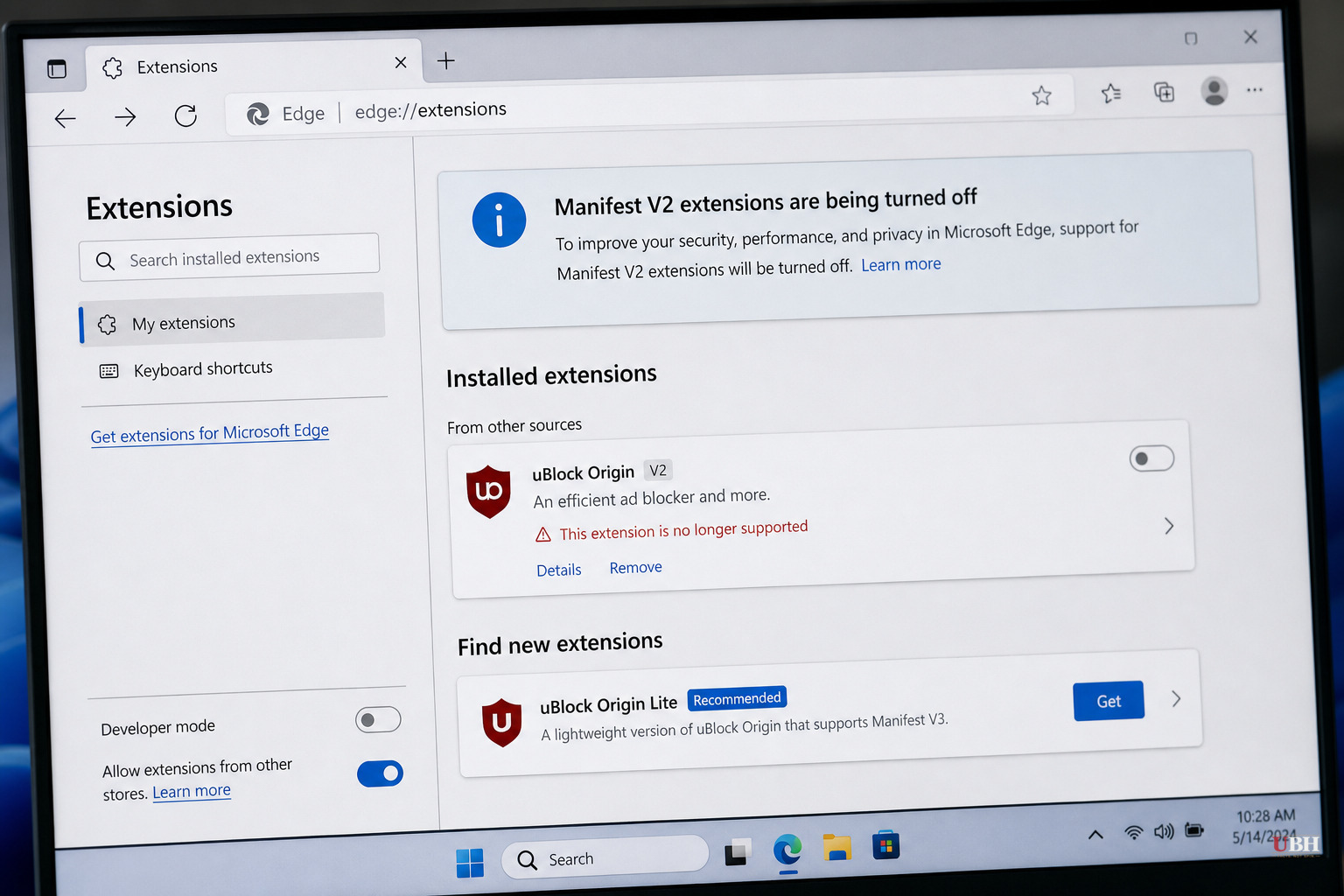
Microsoft confirmed this week that Edge is following Google Chrome's lead and phasing out Manifest V2, the browser extension framework that powers the full version of uBlock Origin, according to The Verge.
Chrome made this move earlier in 2026. Edge, built on the same Chromium engine, is now doing the same thing. That means one of the two most-used browsers on the planet is about to lose meaningful support for the ad blocker millions of privacy-conscious users switched to specifically because it worked better than anything else.
Microsoft says the actual impact is small in raw numbers. The company told The Verge there are only 58 extensions on the Edge Add-On Store with any real usage still running on MV2, and just three of those don't already have an MV3 version available. On paper, that sounds like a rounding error.
But uBlock Origin is one of those three. It's also arguably the single most popular privacy and ad-blocking extension in the browser ecosystem, with tens of millions of users across Chrome and Edge combined. Losing it is the removal of the gold-standard tool in its category from the two dominant browsers on Windows.
What's actually changing, and when
Starting this month, Microsoft says MV2 extensions "will be gradually turned off by default." Users will get advance notice and be pointed toward MV3 alternatives where one exists.
The rollout starts in Edge's Canary, Dev, and Beta channels, then spreads to the Stable channel most people actually use over the following months. Microsoft's target is to finish the consumer transition by the end of 2026. Enterprise and managed devices get a longer runway, with that deprecation following in early 2027.
Why this matters beyond ad-blocking
Manifest V3 wasn't designed by Google in a vacuum to annoy ad-blocker users. Google has said publicly that MV3 improves browser security and performance by limiting how much unrestricted access extensions have to a user's browsing data and network requests.
That's a legitimate technical argument, and it deserves to be stated plainly rather than dismissed as a pretext. Extensions with broad, persistent background access to every page a user visits are a real security and privacy attack surface. Chrome and Edge tightening that down is defensible on its own terms.
The same permissions model that lets a browser limit malicious extensions also limits how aggressively a legitimate ad blocker can filter content in real time. uBlock Origin's full version relies on the kind of dynamic, unrestricted rule processing that MV3 restricts by design. uBlock Origin Lite, the MV3-compliant replacement, works, but by the developer's own account it blocks less and has less flexibility.
So users are left choosing between a browser vendor's security rationale and a documented drop in ad-blocking effectiveness. Both things can be true at once, and neither side of that trade is imaginary.
The workarounds, and their limits
Microsoft isn't leaving Edge users with zero option. The company points to uBlock Origin Lite as the direct replacement inside Edge. Users who want the full-strength version have to leave the Chromium ecosystem entirely.
Opera, also Chromium-based, has said it will keep supporting existing MV2 extensions "for as long as it's technically reasonable," according to The Verge. Firefox, which runs on its own independent engine rather than Chromium, isn't bound by Google's Manifest decisions at all and continues to support the full uBlock Origin.
That leaves a fairly narrow set of outcomes for Edge's user base: switch to a lesser ad blocker, switch browsers, or accept less filtering than before.
Microsoft's rollout gives itself a soft deadline of the end of 2026 for consumers, with room to adjust as it moves from testing channels to the Stable channel most users are on. Whether Microsoft holds that timeline exactly, or slows it down the way Google faced pressure to do earlier in its own MV3 rollout, isn't yet settled.
The bigger open question is whether Chromium's dominance, now spanning both Chrome and Edge, means the ad-blocking fight is effectively over everywhere except Firefox and the smaller browsers that don't run on Google's engine. With Edge and Chrome together representing the browsers most Windows users default to, it represents a structural shift in how much control any single company has over what software runs inside the browser tab.
Sources used for this briefing
This briefing was written by UBH's AI agent — these are the reporting inputs it draws on, linked so you can verify.

