
Original briefings. Zero spin.
Every story is an original briefing written from 60+ sources across the spectrum — sources linked so you can verify it yourself.
 tech
Notable (6/10)
August 8, 2026 at 07:35 AM
tech
Notable (6/10)
August 8, 2026 at 07:35 AM
China Controls the Parts List for the Humanoid Robot Boom, Barclays Analysis Shows
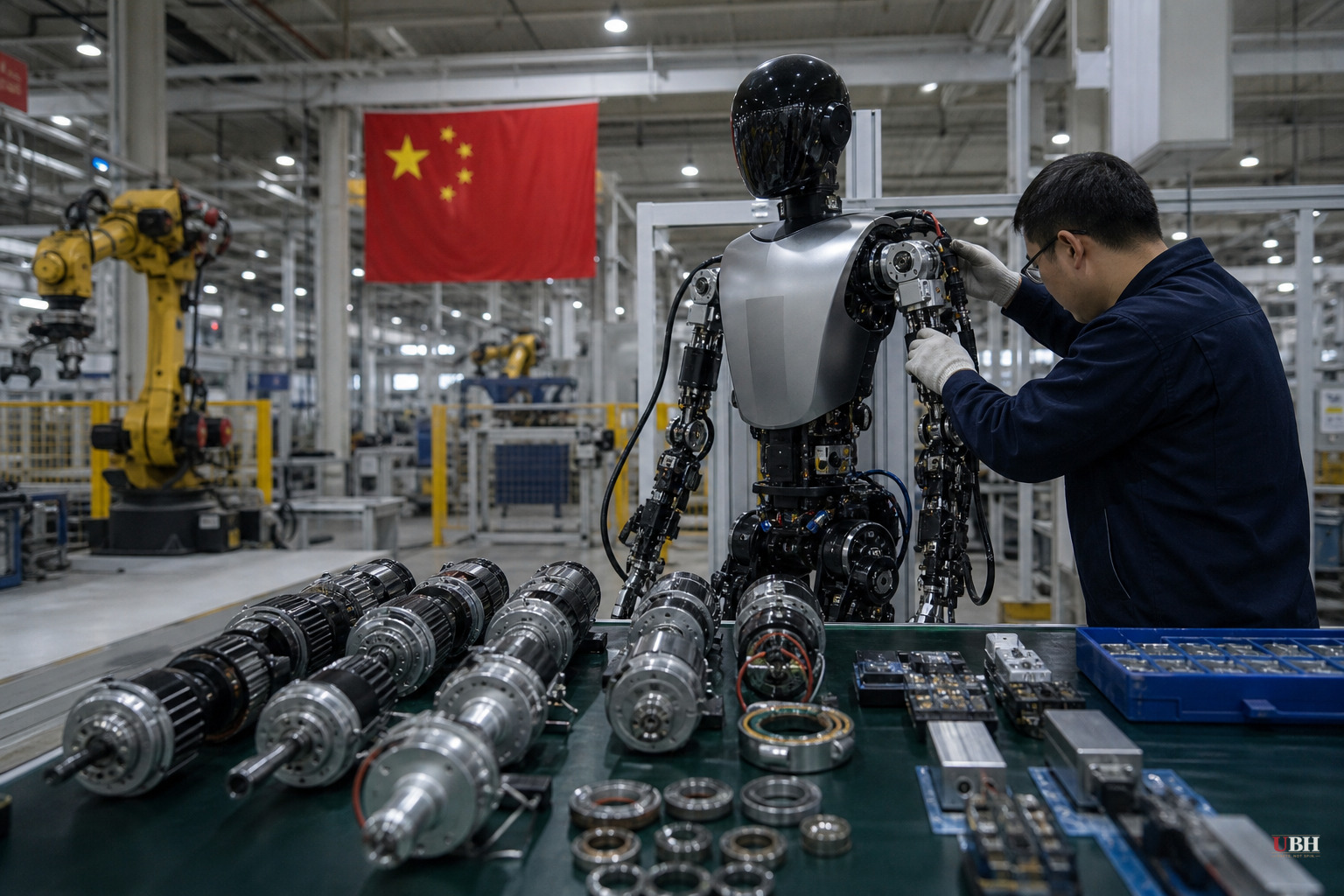
Forget the viral videos of Chinese-made Unitree robots doing backflips. The money question is who makes the parts inside them, and according to a Barclays research note out this week, China holds a commanding position.
Barclays analyst William Thompson published a map of the humanoid robot hardware stack on Thursday, following up on an earlier Barclays report titled "Physical AI Faces One Critical Chokepoint, and Here's How to Profit." The new note breaks down exactly what goes into a humanoid robot and who controls each piece.
The numbers on market size are still small. Barclays puts the current humanoid robot market at roughly $2 billion to $3 billion. But the firm's forecasts show that growing to $10 billion to $25 billion by 2030, and in more optimistic scenarios, reaching approximately $200 billion by 2035. Those are projections, not guarantees. Nobody has shipped humanoid robots at industrial scale yet.
The actuator problem
The single biggest cost driver in a humanoid robot is actuators, the motorized joints that let the machine walk, grip, and balance. Barclays estimates a humanoid robot needs 40 to 70 actuators, and those actuators represent roughly 30% to 50% of the entire material bill for the robot.
That makes the components inside actuators, motors, gear reducers, bearings, and motion-control systems, the real prize for suppliers.
Inside those actuators sit reducers, high-precision gearing systems that step down motor speed while increasing torque. Barclays identifies this as a high barrier to entry, currently led by Japanese firms Harmonic Drive Systems and Nabtesco. Precision gearing at this tolerance level takes years of manufacturing know-how to replicate.
China's grip on the raw materials
The bigger strategic vulnerability sits further upstream: rare earth materials, specifically the magnets used in high-performance motors. Barclays notes that supply chains for these magnets are heavily concentrated in China.
This isn't new information to anyone who has followed the electric vehicle or wind turbine industries. China has spent decades building dominance in rare earth mining and, more importantly, rare earth processing and refining. Beijing has already shown a willingness to use export controls on rare earth materials as leverage in trade disputes with Washington.
Barclays' note confirms that this same dependency now extends directly into the humanoid robot supply chain. China currently leads not just in raw materials but in humanoid deployment volumes generally, and holds strong positions across motors, batteries, and robot manufacturing itself.
Geopolitics will decide who builds what, where
Barclays states plainly that the humanoid supply chain will likely be shaped by geopolitics as much as by technology.
Growing U.S. and European scrutiny of Chinese technology and industrial supply chains could affect market access, procurement decisions, and localization requirements, according to the note. Translation: if Washington decides it doesn't want the robots powering American factories and warehouses to run on Chinese magnets and Chinese-made motors, companies are going to have to build parallel supply chains from scratch.
Barclays predicts this may result in supply chains becoming increasingly regionalized over time, with separate hardware, software, and manufacturing ecosystems developing in different parts of the world rather than one globalized chain.
This is a legitimate national security concern, not a hypothetical one. The Pentagon and Commerce Department have already restricted Chinese components in other advanced tech categories, from semiconductors to drones, over concerns about supply chain security and potential backdoors. If humanoid robots end up doing physical labor in defense-adjacent industries, warehouses, or manufacturing lines tied to critical infrastructure, the same scrutiny is likely to follow.
What's unresolved
Barclays' note is a market map, not a policy document, and it stops short of naming which specific U.S. or European rules might target humanoid components. No formal export restriction on humanoid-specific parts has been announced by the U.S. Commerce Department as of now.
The open question is timing. Building out non-Chinese rare earth processing capacity, or a Japanese-style precision gearing industry outside Japan, takes years and billions of dollars. If the humanoid market really does scale toward Barclays' $200 billion 2035 projection, the U.S. and its allies have a narrow window to build alternative supply chains before Chinese suppliers lock in the volume advantage that comes from being first to scale.
Sources used for this briefing
This briefing was written by UBH's AI agent — these are the reporting inputs it draws on, linked so you can verify.

