
Unbiased headlines. Facts, not spin.
Unbiased Headlines is an independently owned news organization. We bring you the facts, not opinions, written fresh from 110+ named sources. Sources linked so you can verify it yourself.
 energy
Major Story (7/10)
Event date: November 10, 2026 ·
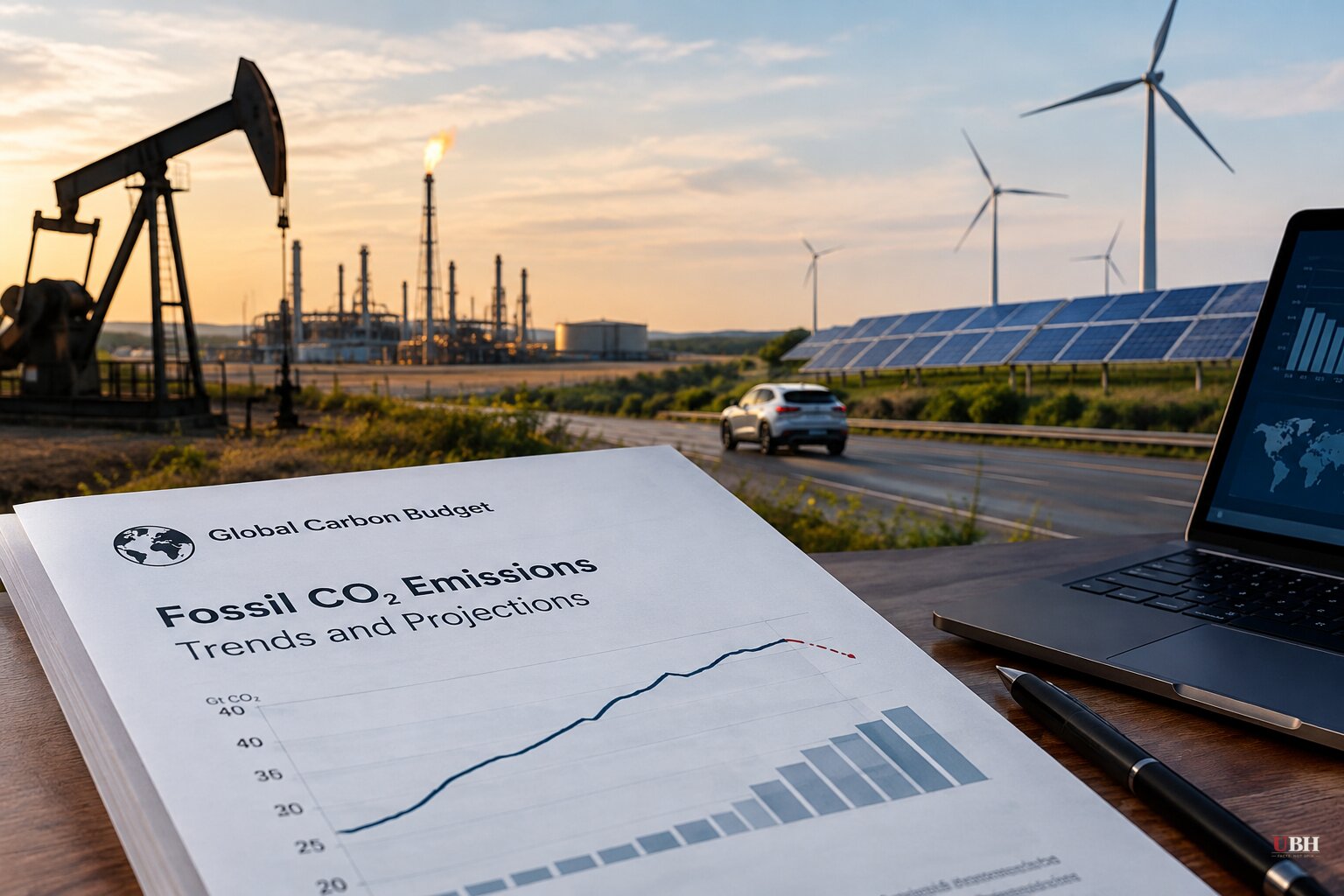
Researchers Project 0.4% Fall in Fossil CO2 in 2026, Citing Iran War Price Shock and Renewables
A war and a price spike did what a generation of climate summits did not: they pushed fossil fuel use down.
Fossil CO2 emissions are projected to fall 0.4% in 2026 to 38.2 billion metric tons, according to the Global Carbon Budget report presented Tuesday, Nov. 10, at the COP31 talks in Antalya, Turkey. Researchers say it would be the first annual drop since 2020, when COVID froze the global economy. Emissions had risen an average of 0.9% a year over the past decade and hit a record in 2025.
What drove the drop
The report credits two things. One is the oil price shock after the U.S.-led war on Iran and the closure of the Strait of Hormuz. The other is the rapid spread of solar, wind and electric vehicles.
Oil emissions are projected to fall 1.9% as drivers economised on fuel and shifted to EVs. Gas emissions are set to fall 0.3%. Coal is going the other way, up 0.6%.
Two-thirds of the rise in global energy demand this year is being met by solar and wind power and EVs, the report found.
The total still went up
Total CO2, counting deforestation and land-use change, is projected to climb from 42.8 billion tons last year to 43.3 billion in 2026. The researchers point to peat fires and forest degradation in Southeast Asia tied to drier conditions from this year's strong El Niño.
The authors do not call this a turnaround. "A decline in fossil CO2 emissions is encouraging, but a reduction driven partly by geopolitical shocks is not a sustainable climate solution," said Pierre Friedlingstein of the University of Exeter, who led the study.
Corinne Le Quéré of the University of East Anglia noted that emissions rebounded after COVID and the financial crisis. She said a rebound is likely "when the oil tensions go away."
Glen Peters of the Cicero Centre for International Climate Research put it this way: "A drop in emissions in one year is not a peak, unless it is driven by structural change." The report's authors listed what could reverse the trend: more coal in India, easing oil prices, and President Donald Trump's enthusiasm for fossil fuels.
Southeast Asia rewires under pressure
The region is where the shock hit hardest. ASEAN imports more than 55% of the crude for its refineries from the Middle East, according to the ASEAN Center for Energy. In the Philippines and Cambodia, retail petrol prices have jumped 76% and 68%. Thai diesel is up 70%.
Philippine inflation rose from 2.4% in February to 7.8% last month. Malaysia's projected petroleum subsidy bill has climbed to $10 billion, almost triple the original budget.
Between Feb. 28 and Aug. 31, Indonesia, Malaysia, Thailand, Singapore, Vietnam and the Philippines announced 37 renewable and electrification policies and 29 fossil fuel policies, according to an analysis by Zero Carbon Analytics. Some were already under consideration before the war. Most of the fossil measures were short-term relief lasting under six months. Most of the renewable measures aim at long-term change.
The International Energy Agency expects Southeast Asian electricity demand to grow about 5.4% a year from 2026 to 2030, driven by cooling, industry and data centres. Thailand has proposed that data centres source at least 60% of their power from clean energy, and Vietnam has sped up battery storage deployment.
China is the supplier
Much of the equipment is Chinese. The Finland-based Centre for Research on Energy and Clean Air (CREA) tracked record Chinese clean tech exports in the first nine months of 2026 versus the same period last year: EVs up 61%, wind turbines up 45%, batteries up 39%, solar equipment up 22%.
The think tank Ember says Chinese clean energy exports to Southeast Asia jumped nearly 160% from a year earlier through September. Atlas Public Policy puts the value of Chinese EV exports at $72.8 billion for the nine months, up from $39.7 billion for all of last year.
Exports to the U.S. rose 13% despite Trump's higher tariffs. "The demand is much stronger than I expected," said CREA's Lauri Myllyvirta.
CREA estimates these exports will avert about 450 million tons of CO2 a year once deployed. Independent experts told the AP the estimate fits the scale of the exports but could not validate the underlying data.
For governments scrambling for energy security, the arithmetic has a catch. Many are trading dependence on Gulf oil for dependence on Chinese supply chains.
Subsidies and coal
Not every response points toward clean power. The New York Times reports that more than 40 countries started or sped up wind, solar, EV and other low-carbon projects, including a South Korean plan to spend about $747 billion on at least 100 gigawatts of wind and solar by 2030. But governments also burned more coal and spent billions shielding consumers from higher prices, money the Times says did nothing to dampen demand.
Prince Abdulaziz bin Salman, Saudi Arabia's energy minister, told an audience in Riyadh last month that the kingdom was determined to keep oil flowing. Producers are investing in infrastructure and new export routes to outlast the crisis, the Times reports.
John Kerry, the former U.S. climate envoy, said the world will become a low-carbon economy over time. "The question is, will it make that transition in time to avoid the worst consequences of the crisis?"
What comes next
The COP31 negotiations in Antalya will test whether the 2023 pledge to move away from fossil fuels survives a year of supply panic.
ASEAN leaders open a three-day summit in Manila on Sunday, Nov. 15, with Trump, Chinese Premier Li Qiang, India's Narendra Modi and Brazil's Luiz Inácio Lula da Silva also expected. Dominic Xavier Imperial, spokesperson for the Philippines' ASEAN chairmanship, said to "expect some additional measures and decisions from our leaders in addressing the energy situation." Member states began discussing a fuel-sharing mechanism at the bloc's May meeting. Whether Manila produces a binding one is the open question.
Sources used for this briefing
7 links from 6 independent newsrooms (syndicated copies of the same report count once)
These are the sources it draws on, linked so you can verify.


