
Unbiased headlines. Facts, not spin.
Unbiased Headlines is an independently owned news organization. We bring you the facts, not opinions, written fresh from 110+ named sources. Sources linked so you can verify it yourself.
 energy
Notable (6/10)
Event date: October 25, 2026 ·
Gas Falls to $3.64 as Refiners' Gasoline Margins Shrink to Near Zero
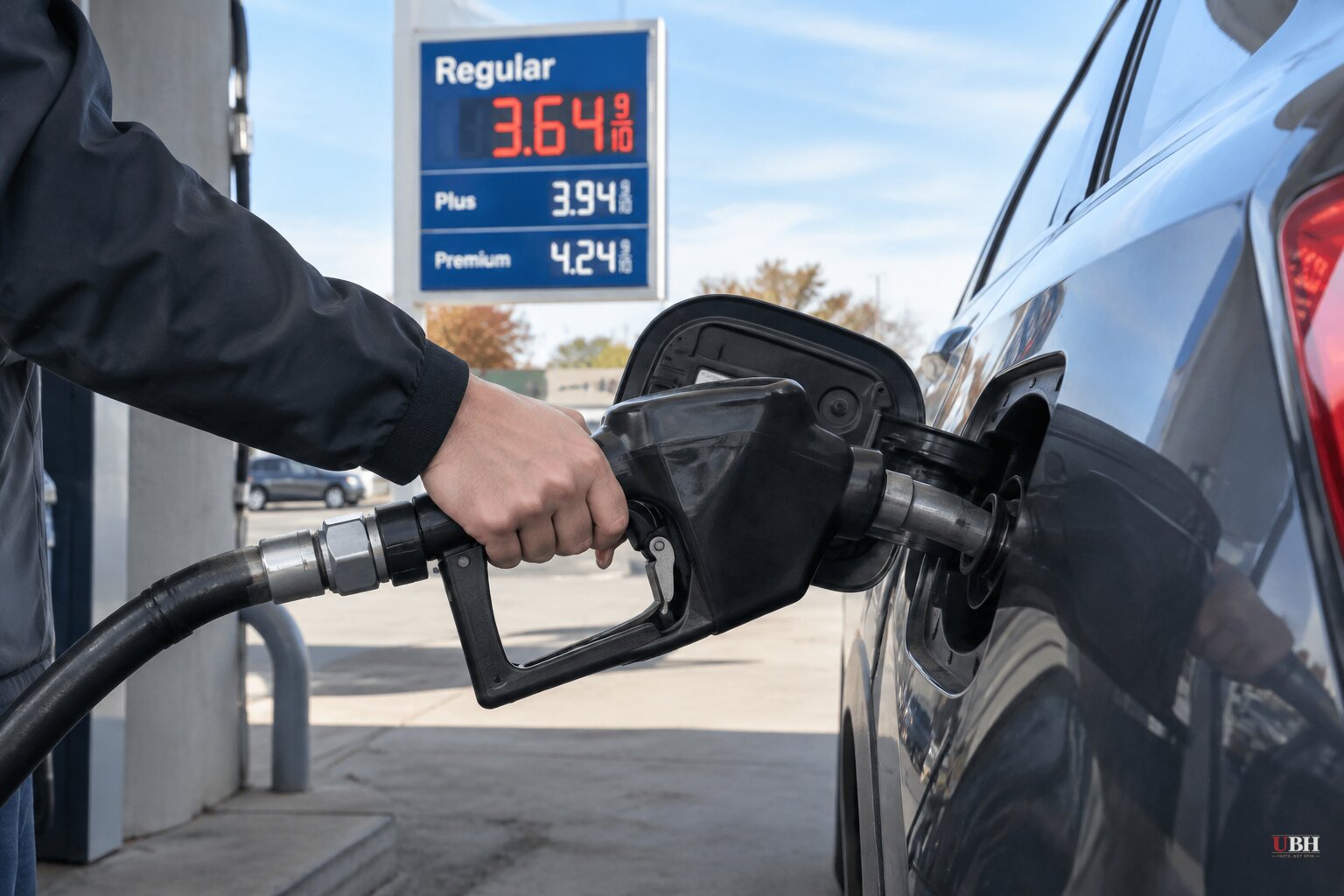
Drivers are getting relief at the pump. The refiners who make the fuel are getting less out of it.
The national average for regular gasoline was $3.72 a gallon on Nov. 19, according to AAA. That was down 18 cents in a week and down from $4.30 a month earlier. It slipped to $3.64 by Monday, Nov. 23. The price is still more than 60 cents above a year ago.
AAA said it could fall another 15 cents by Thanksgiving, when it expects nearly 73 million Americans to drive. That would be enough to stay below the holiday record of $3.58 set in 2022.
Refiners chased diesel and jet fuel
Energy Information Administration data show U.S. refiners spent 2026 squeezing less gasoline out of each barrel. Gasoline yields averaged below 45% in the first eight months of the year. They fell below the previous five-year low in every one of those months.
The barrels went elsewhere. Jet fuel's share of output topped 12% in March for the first time on record and stayed at or above that level through August.
Refiners also ran harder. They raised crude processing by 500,000 barrels per day in the second quarter and by another 500,000 in the third. In the week to Nov. 13, refinery utilization hit 95.7%.
The incentive was obvious. Valero Energy's third-quarter release showed a Gulf Coast ultra-low-sulfur diesel margin of $72.27 a barrel over Brent, up from $21.05 a year earlier. Its gasoline margin was $24.08. Valero reported net income of $6.8 billion, against $1.1 billion a year earlier, and a refining margin of $39.24 per barrel of throughput, against $13.14.
Too much gasoline anyway
Even with lower yields, the volume was enough to swamp the market. In the week to Nov. 13, gasoline inventories rose 5.2 million barrels to 215.9 million. Analysts polled by Reuters had expected a build of 1.6 million. Distillate stocks rose 1.6 million barrels to 104.9 million.
Reuters columnist Ron Bousso wrote Monday that gasoline stocks sit above their five-year average, while distillate inventories are about 15% below it.
Will Kubzansky wrote in Bloomberg's Energy Daily newsletter Monday that the gasoline crack spread, adjusted for real-world crude prices and renewable fuel credits, is "barely positive." He said it has turned negative in some parts of the country. Kubzansky put the turn down to the refiners' own supply response after a year of operating close to maximum capacity.
Diesel is cooling too. U.S. diesel margins were above $80 a barrel on Friday, the lowest since mid-July. They fell from a record $118 in mid-September. The broader U.S. crack spread has dropped from a record $72 to about $41, according to Bousso.
What is pulling prices down
American Petroleum Institute CEO Mike Sommers credited falling crude. In a thread on X, he said Brent dropped 11% on Nov. 2 and another 9% on Nov. 4, on optimism over the Iran conflict and more crude moving through Hormuz. Crude is roughly half the cost of a gasoline gallon, he said. He added that decreased seasonal demand was the other layer.
Sommers said the decline started in October and that prices fell 26 cents between Oct. 1 and Nov. 3, so the slide began before Election Day.
President Donald Trump drew attention to the timing. At a press conference Friday, he noted the sharp drop since the Nov. 3 election and said the timing was very interesting. Sommers' figures show the decline was already under way in October.
The supply picture is not settled. Iranian attacks on tankers in the Strait of Hormuz have intensified in recent weeks, and disruption to fuel shipments from the Persian Gulf is in its ninth month.
The regional spread is huge
AAA's state numbers show how uneven the relief is. Hawaii averages $5.60 and California $5.51. Nevada, Washington, Oregon, Alaska, Pennsylvania, New York and Vermont are all still in the $4 range.
The cheapest states are North Carolina at $3.05, Indiana at $3.16 and Texas at $3.20. Oklahoma, Ohio and Georgia are all around $3.25.
Gasoline demand ticked up last week from 8.76 million barrels per day to 8.79 million, per EIA data cited by AAA.
A windfall-tax fight is coming
The refiners' record quarter is feeding a political argument. Democrats captured both chambers of Congress in the Nov. 3 midterms. Bloomberg reported Nov. 4 that oil executives and Washington lobbyists are preparing for Democrats to use their strengthened position to push a windfall-profits tax on energy producers. The proposed legislation could raise approximately $33 billion annually if crude averages $100 a barrel, with the revenue intended to finance rebate payments for households.
Democratic lawmakers argue households absorbed the cost of the Iran war while producers benefited from higher selling prices. ExxonMobil and Chevron both reported extraordinary earnings as oil prices surged.
Industry representatives warn that additional taxation could discourage investment and threaten future domestic production. The White House has rejected speculation that Trump is considering an agreement with Democrats to impose a windfall levy.
Any bill would need to pass both chambers and receive presidential approval, or overcome a veto. The new Congress is scheduled to convene in January 2027.
The near-term test comes this week. AAA expects the national average to drop another 15 cents by Thanksgiving. Whether diesel and jet margins stay strong enough to keep refiners tilting away from gasoline, with Hormuz still disrupted, will determine what happens after that.
Sources used for this briefing
6 links from 3 independent newsrooms (syndicated copies of the same report count once)
These are the sources it draws on, linked so you can verify.


