
Unbiased headlines. Facts, not spin.
Unbiased Headlines is an independently owned news organization. We bring you the facts, not opinions, written fresh from 110+ named sources. Sources linked so you can verify it yourself.
 energy
Major Story (7/10)
Brent Settles at $89.37, WTI at $80.17, Lowest Closes Since August, as Returning Gulf Supply Outweighs Weekend Attacks
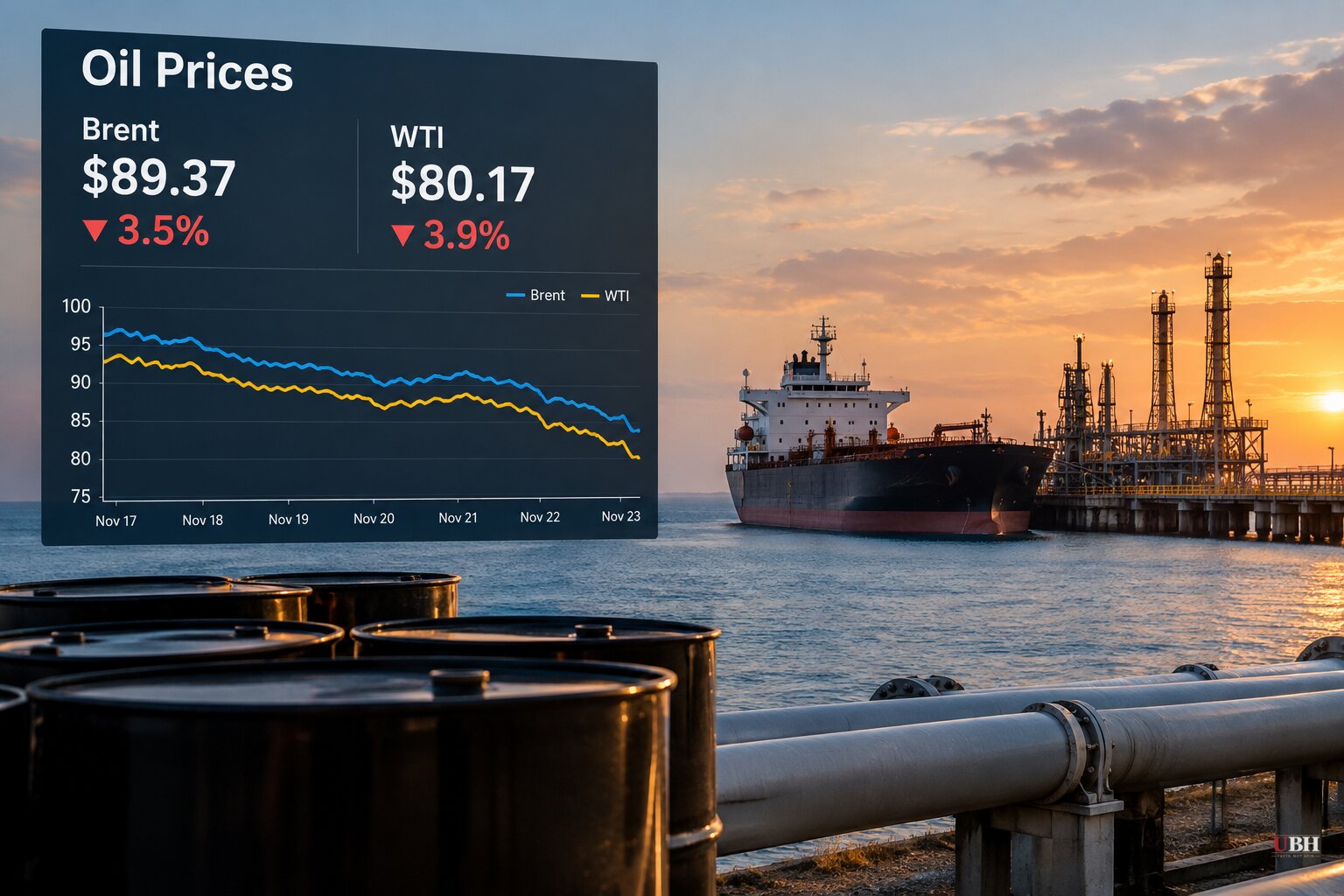
Since Iran effectively shut the Strait of Hormuz at the start of the war in February, oil has been the main pressure point in the conflict. Today, Nov. 23, that pressure eased again. Brent settled at $89.37 a barrel, down almost 3.5%. West Texas Intermediate fell $3.24, or 3.9%, to $80.17. Both are the lowest closes since August.
In early November, Brent was settling near $98. Prices dropped Monday, right after a weekend in which Iran struck Bahrain and merchant ships were hit near Hormuz.
Supply is back
The International Energy Agency's latest monthly report, published Nov. 13, said global oil supply rose by 2.3 million barrels a day in October to 105.4 million. That followed a 3 million barrel increase in September. The agency said supply surpassed demand "for the first time since the outbreak of the war in Iran" and forecast a surplus in the fourth quarter, with a larger build in 2027.
The IEA credited Gulf exports, which it said rebounded much faster than global demand. Saudi Arabia, Iraq and Kuwait all raised output in October. OPEC+ crude production rose to 37.72 million barrels a day from 35.71 million in September.
Monday added a smaller supply item. Libya's National Oil Corp. said the Sharara pipeline had resumed operations, with crude reaching storage in Zawiya. The state firm had earlier warned that a pipeline closure could remove roughly 350,000 barrels a day from national output.
The physical market has loosened sharply. Goldman Sachs noted that Dated Brent, which was trading about $31 above futures in early October, is now only about $1 above. PVM analyst Tamas Varga said oil logged a third straight weekly loss, with pressure "primarily from the supply side."
Attacks no longer move the price
The weekend was not quiet. Bahrain reported an Iranian strike on a civilian industrial site, while Iran said it had targeted U.S. military positions there. Yemen's Houthi movement claimed an attack on a Saudi refinery. The UK Maritime Trade Operations agency reported several attacks on vessels in the Gulf and near Hormuz.
Ukraine said it struck Russia's Perm refinery and the Kaleykino pumping station. Russian shipments from Baltic and Black Sea terminals also faced delays tied to weather and drone attacks, according to sources cited by Reuters.
Crude fell anyway. Data from Kpler, cited by Reuters columnist Ron Bousso, show Hormuz flows averaged about 9.5 million barrels a day in the ten days ending Nov. 19, down from 12.2 million in October. Flows are still below last month's level, yet prices have fallen.
On the CNN analysis of Iran's position, David Oxley of Capital Economics said it "certainly seems that Iran is either unwilling or unable to prevent the flow of crude oil at present." Danny Citrinowicz of Israel's Institute for National Security Studies said that if prices keep falling despite Iranian attacks, "an important part of that strategy becomes less effective."
Tehran sees it differently. Mohsen Rezaei, head of Iran's Supreme National Security Council, said: "We want to impose a cost on the Americans that makes attacking Iran too expensive, and that serves as a deterrent." Iranian officials have claimed the closure already produced major strategic gains.
What the cheaper oil does not fix
The IEA did not call the crisis over. It said fuel markets remain under severe pressure, particularly diesel, and that member countries are accelerating emergency stock releases, including more than 20 million barrels of diesel.
Inventories are the weak point. Global stocks have fallen by a cumulative 462 million barrels since the war began. OECD onshore inventories are at their lowest since at least 2016, even though oil on tankers rose by 86 million barrels to its highest since January.
Forecasters split on what comes next. J.P. Morgan expects futures to retreat into the upper $70s in the first half of 2027, anticipating a surplus from Middle Eastern producers outside Iran and from the Americas. Bank of America warned that low global inventories leave the market exposed to supply interruptions.
Politics and the next decision points
Energy costs were a major factor in the Republican losses in this month's midterms, and Trump acknowledged the war was partly to blame, according to CNN. Trump met with his national security team in early November about whether to resume strikes on Iran. He has since told Fox News that attacks could resume after the new year if talks fail, according to a Bloomberg account of his remarks. The market read that as more time for negotiations.
The COP31 climate talks in Turkey ended without an agreement, amid divisions over language on a fossil fuel phase-out.
The next scheduled catalysts are on the calendar. A preliminary Reuters survey of five analysts points to a build of about 900,000 barrels in U.S. crude and product stocks for the week ended Nov. 20. OPEC+ ministers are due to meet Nov. 29 to set the group's 2027 production policy. A decision to hold output or add barrels would test whether the surplus the IEA projects is as large as forecast.
Sources used for this briefing
7 links from 7 independent newsrooms (syndicated copies of the same report count once)
These are the sources it draws on, linked so you can verify.


