
Unbiased headlines. Facts, not spin.
Every story is an unbiased news briefing written from 110+ sources across the spectrum — sources linked so you can verify it yourself.
 health
Low Interest (4/10)
June 14, 2026 at 06:20 PM
health
Low Interest (4/10)
June 14, 2026 at 06:20 PM
Research Shows Knowledge-Rich Curricula Close the Academic Achievement Gap. Few Schools Use Them.
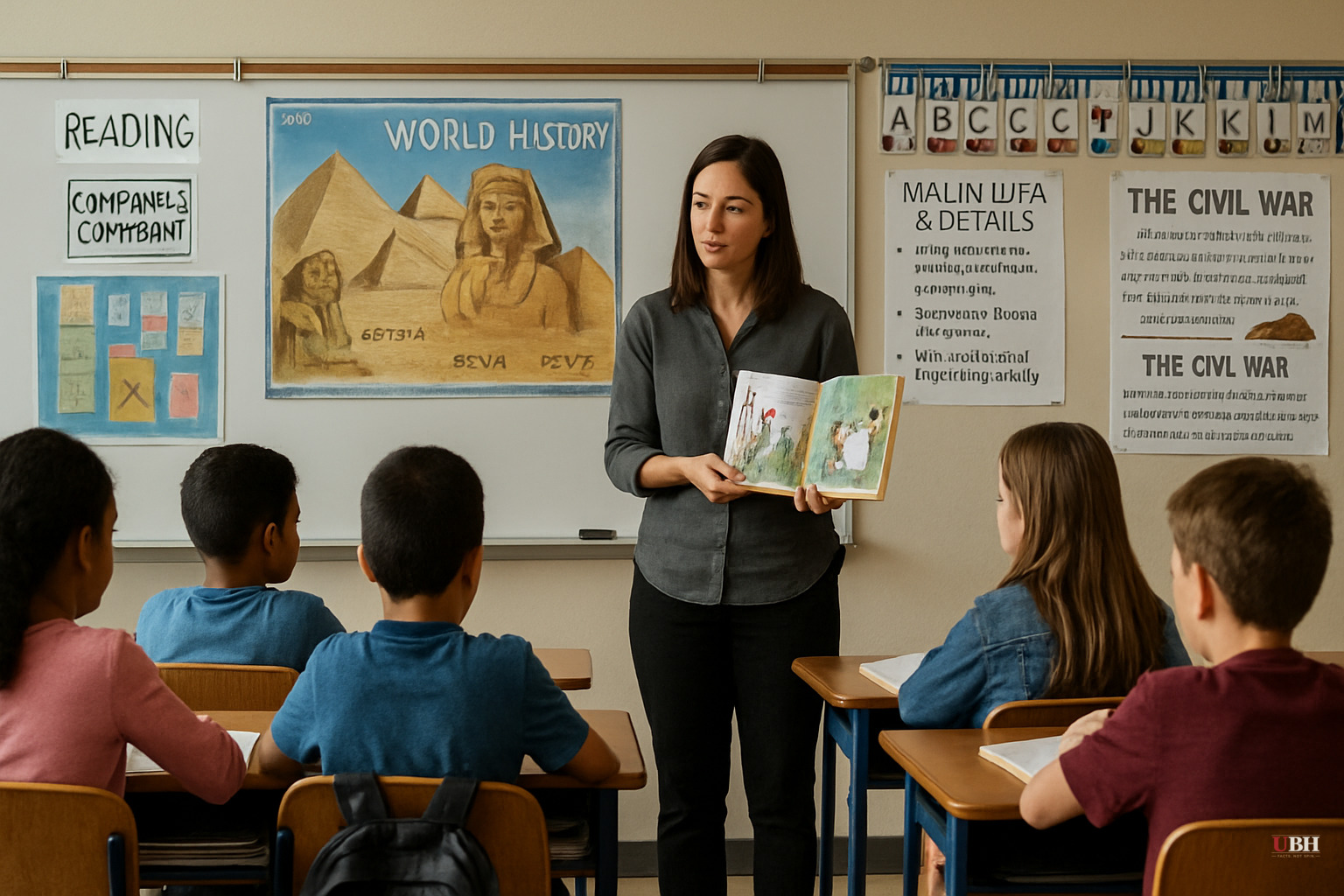
The Gap Isn't About Intelligence
Two students read the same paragraph. One scores well; the other doesn't. The difference, according to University of Virginia cognitive psychologist Daniel T. Willingham, usually isn't raw ability. It's whether the student already knows something about the topic.
That finding has been replicated across decades of research, and it has a direct implication for the academic achievement gap: if students from lower-income households arrive at school with less background knowledge — fewer books at home, fewer museum trips, less exposure to academic vocabulary — the school itself has to provide it. Most schools aren't doing that.
What the Data Shows
A 2024 report in Education Next tracked long-term reading gains among students attending schools that use knowledge-rich curricula. The gains were real and sustained. Researchers at the University of Virginia School of Education and Human Development found that elementary students learning under the Core Knowledge curriculum — developed by researcher and former professor E.D. Hirsch — improved their reading abilities measurably compared to peers in conventional programs.
Hirsch spent decades arguing that "broad general knowledge" is the foundation of reading comprehension. His argument: students can't decode meaning from text about topics they know nothing about, regardless of how many phonics drills they've completed. The evidence increasingly backs him.
What Most Schools Are Doing Instead
According to reporting by the Daily Signal, many schools have been moving in the opposite direction, reducing instructional time in history, science, geography, literature, and civics in favor of generic reading strategies and so-called social-emotional learning programs. The subjects most likely to build the background knowledge that Hirsch and Willingham identify as critical are the ones being squeezed out.
This pattern hits students in low-income districts hardest. Children from households where parents have higher education levels tend to absorb background knowledge outside school through extracurricular activities, travel, and reading at home. Students without that resource base depend more heavily on classroom instruction to close the gap. When schools cut content, those students have no fallback.
National reading and math scores have not given reason for confidence that the current approach is working.
The Strongest Counterargument
Critics of the knowledge-rich curriculum model raise a legitimate concern: not all content is neutral. A curriculum emphasizing Western history, classical literature, and particular scientific frameworks can reflect specific cultural priorities, and there is a genuine debate about whose knowledge gets treated as foundational. Some educators argue that skills-based instruction is more adaptable to diverse student populations and local contexts than a standardized content sequence.
However, it runs into a practical problem: the students most harmed by content-light instruction are disproportionately low-income and minority students — the same students the progressive critique purports to protect. If the alternative to a knowledge-rich curriculum is lower reading scores, the argument against it has to clear a high bar. The current evidence doesn't clear it.
One School That's Doing It Differently
Liberty Common School in Fort Collins, Colorado has used the Core Knowledge curriculum since 1997. The school covers history, geography, literature, science, music, and the arts in a structured sequence. According to the Daily Signal, school officials report their 2025 graduating class posted Colorado's highest composite scores — a data point that, if independently verified, would demonstrate the model's effectiveness.
Liberty Common isn't a suburban school serving only wealthy families. Its results matter because they suggest the model can work when executed consistently over years, not just in controlled research conditions.
What Needs to Happen Next
The research case for knowledge-rich instruction has been building for years. The gap between what the science says and what most districts are actually doing remains significant in American K-12 education.
State curriculum standards are the lever most likely to move this at scale. Several states have already moved toward adopting or recommending knowledge-rich curriculum frameworks, but adoption remains uneven and enforcement is largely nonexistent. Whether state education departments translate the research into actual classroom practice — particularly in the low-income districts where the stakes are highest — is the question that will determine whether any of this matters beyond the conference circuit.
Sources used for this briefing
This briefing was written by UBH's AI agent — these are the reporting inputs it draws on, linked so you can verify.


