
Unbiased headlines. Facts, not spin.
Every story is an unbiased news briefing written from 110+ sources across the spectrum — sources linked so you can verify it yourself.
 economy
Major Story (7/10)
August 12, 2026 at 07:26 AM
economy
Major Story (7/10)
August 12, 2026 at 07:26 AM
Report: Losing CUSMA Trade Deal Could Cost 316,000 Jobs Across U.S. and Canada
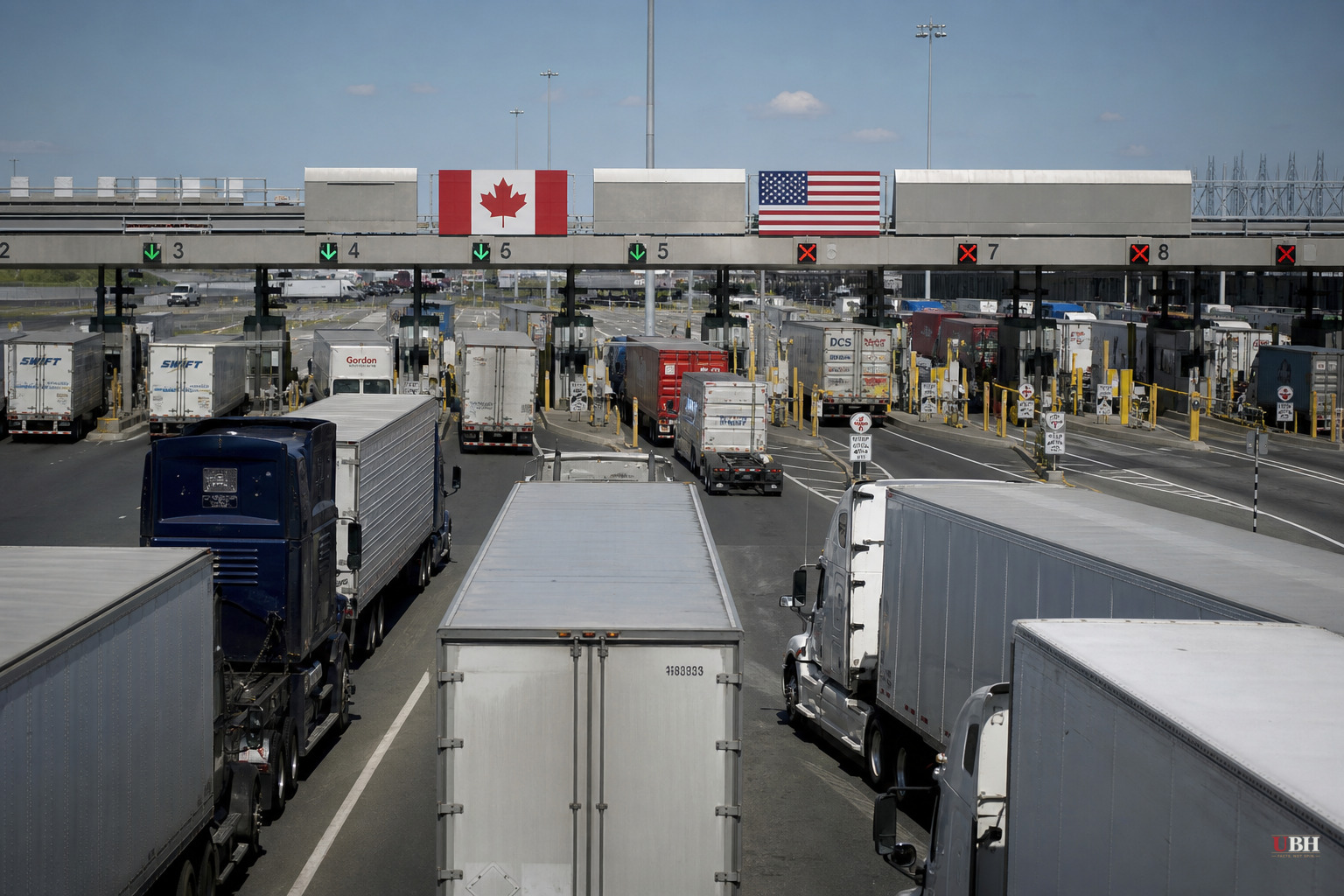
A trade deal breakdown between the U.S., Canada and Mexico could wipe out over 300,000 jobs combined, according to a report released Monday by Oxford Economics for the Canadian American Business Council.
The report models three outcomes for the Canada-U.S.-Mexico Agreement, known as CUSMA in Canada and USMCA in the U.S.: keeping the current tariff status quo, a successful renegotiation, and a full breakdown of the deal.
If CUSMA collapses, the report projects 214,000 fewer American jobs and 102,000 fewer Canadian jobs in 2027 compared to the status quo. A successful renegotiation, on the other hand, would add an estimated 137,000 American jobs and 98,000 Canadian jobs.
The dollar figures are bigger. According to Yahoo News Canada's reporting on the same report, a breakdown scenario would cost the U.S. economy $1.04 trillion USD and Canada $271 billion CAD in GDP by 2035, with inflation running hotter and real disposable income growth stalling on both sides of the border, especially in Canada.
Who gets hit hardest
The report names specific losers. On the U.S. side: Michigan, Indiana, Iowa, Kentucky and Alabama, states with heavy exposure to auto, wood product and metal manufacturing, according to Yahoo News Canada. On the Canadian side: Ontario, Quebec, Manitoba and New Brunswick, according to BNN Bloomberg, all concentrated in autos, metals and machinery.
Because Canada's economy is smaller and more trade-dependent, the pain isn't symmetrical. "Given greater dependence on bilateral trade among Canadian manufacturing industries, the sectoral impacts from tariffs are often four to six times as large for Canada" compared with the U.S., the report states, as quoted by HCAMag.
The deadline driving all this
This isn't an abstract modeling exercise. A new round of 50% U.S. tariffs on a range of Canadian goods, from honey to plywood to hyacinth bulbs, is set to take effect Aug. 19, according to BNN Bloomberg. Unlike most of President Trump's other tariffs, these carry no exemption for goods that already comply with CUSMA rules.
Trump signed three executive orders imposing the tariffs, each citing a different justification, according to Global News: provincial boycotts of American alcohol, Canada's retaliatory tariffs on U.S. vehicles and auto parts, and Canada's dairy supply management quotas on American imports. Several Canadian provinces pulled U.S. alcohol from shelves in early 2025 in response to Trump's trade threats and his talk of making Canada the "51st state."
Adding to the uncertainty: Washington said in July it won't renew CUSMA in its current form, according to Global News, which means the deal must now be reviewed annually rather than treated as settled. Canada has formally asked for a 16-year renewal instead, according to HCAMag.
Where the negotiations stand
Canada's trade minister Dominic LeBlanc and chief negotiator Janice Charette were in Washington this week for another round of talks, meeting with U.S. Trade Representative Jamieson Greer on Tuesday. "Discussions remain ongoing, and we continue to engage at the negotiation table to firmly advance and defend Canadian interests," LeBlanc wrote on social media, as reported by both CBC and Global News.
That's diplomatic language for nothing being finalized and the clock running.
The pushback from labor
Not everyone thinks the fix is simply to strike any deal to avoid the tariffs. Bea Bruske, president of the Canadian Labour Congress, warned against Canada folding under pressure. "Canadian workers can't be a bargaining chip in a trade war they didn't start," she said in an email to BNN Bloomberg. "Protecting Canadian workers cannot mean signing a bad deal because Donald Trump threatens to walk away. Canada needs to know what it is fighting for, where the red lines are, and what the plan is to protect workers and communities if the U.S. walks away."
A rushed deal that trades away supply management or auto-sector protections for short-term tariff relief could just shift the pain rather than eliminate it. The report itself doesn't grade any specific negotiating position, it just quantifies what's at stake if talks collapse entirely.
What the report doesn't settle
This is an industry-funded report, commissioned by a business advocacy group whose stated mission is deeper U.S.-Canada trade integration. That doesn't mean the numbers are wrong. Oxford Economics is a legitimate independent forecasting firm, but the Canadian American Business Council has an obvious interest in showing that trade barriers are costly. No government agency, independent of industry funding, has published a matching estimate in these sources.
Beth Burke, the Council's CEO, put the household-level number in plain terms: successful renegotiation over breakdown is worth roughly $846 CAD per Canadian household and $516 USD per American household annually, she told BNN Bloomberg. Neither government has committed to a deal as of this week, and the Aug. 19 tariff deadline is now the hard checkpoint everyone in these talks is negotiating against.
Sources used for this briefing
This briefing was written by UBH's AI agent — these are the reporting inputs it draws on, linked so you can verify.


