
Unbiased headlines. Facts, not spin.
Every story is an unbiased news briefing written from 110+ sources across the spectrum — sources linked so you can verify it yourself.
 energy
Notable (6/10)
June 12, 2026 at 10:30 AM
energy
Notable (6/10)
June 12, 2026 at 10:30 AM
Renewable Energy's Grid Infrastructure Gap Is the Bottleneck No One Wants to Fund
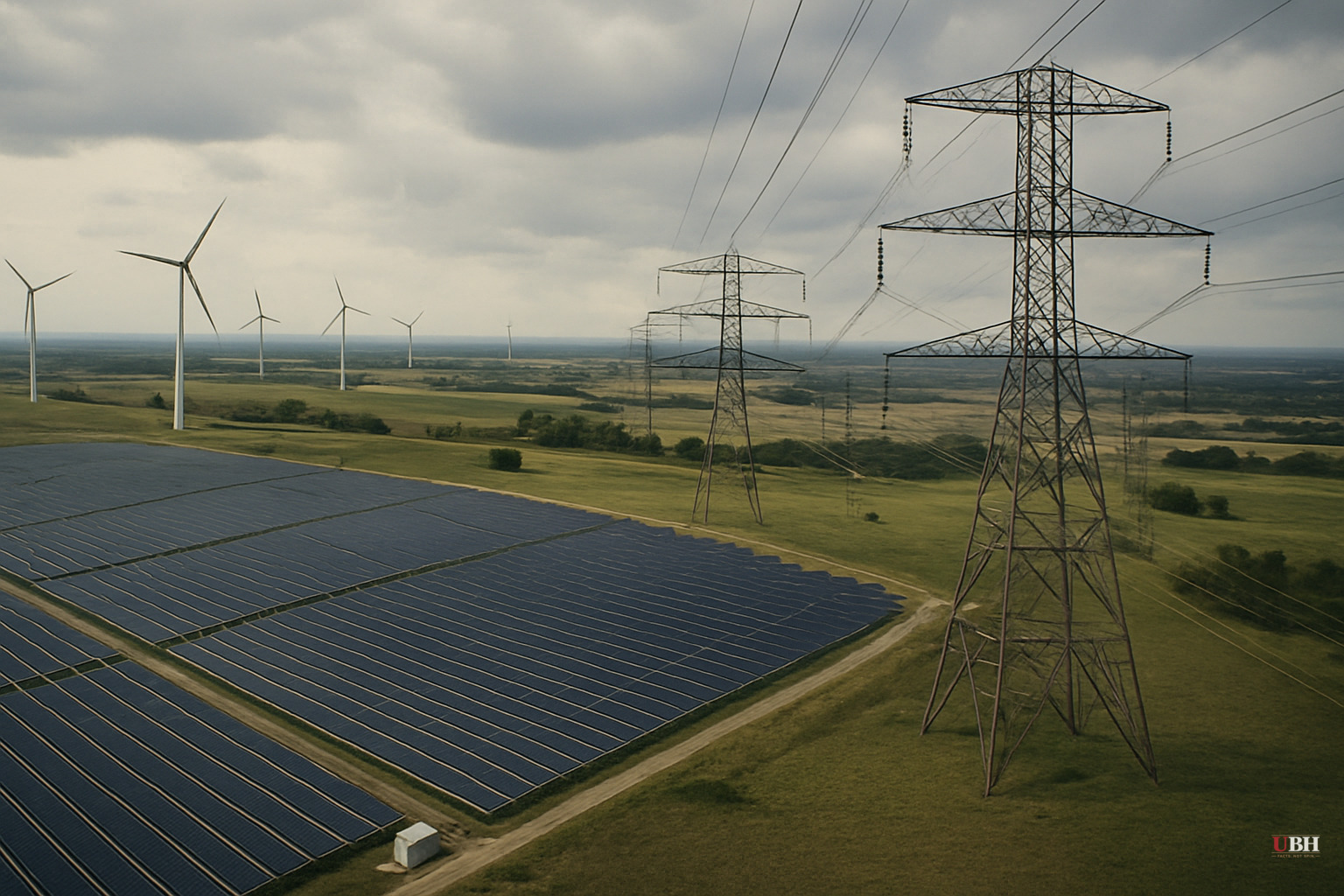
The Generation-Delivery Mismatch
Building a wind farm or a solar array is the easy part. Getting the electricity from that farm to the home, factory, or data center that needs it is where the renewable buildout keeps running into a wall.
According to OilPrice.com, the core challenge facing renewable energy growth right now is infrastructure. The transmission lines, grid interconnection queues, and storage capacity required to make intermittent generation sources actually reliable are lagging behind. Generation capacity has been growing. The grid that carries it has not kept pace.
The U.S. transmission network was largely designed around centralized fossil fuel plants located near population centers. Wind is best in the Great Plains and offshore. Utility-scale solar is concentrated in the Southwest. Both are often hundreds of miles from where peak demand sits. Without long-haul high-voltage transmission lines to bridge that gap, adding more generation capacity at the source doesn't automatically add reliability at the destination.
The Permitting and Queue Problem
The interconnection queue — the backlog of projects waiting for approval to connect to the grid — has become a serious bottleneck. At last count by Lawrence Berkeley National Laboratory, more than 2,600 gigawatts of proposed generation and storage capacity were waiting in interconnection queues across the U.S. For context, total U.S. generating capacity from all sources combined sits around 1,200 gigawatts. The queue is more than twice the size of what's already operating.
Most of those queued projects will never get built. Developers enter the queue speculatively, often without secured financing or land. But the sheer volume clogs the process for projects that are ready to move, driving wait times that routinely stretch five to ten years from application to approval.
Permitting for new transmission lines faces a separate problem. A major interstate transmission corridor can require approvals from dozens of federal agencies, state utility commissions, and local jurisdictions, each with independent authority to delay or block the project. The Grain Belt Express, a high-voltage line designed to carry wind power from Kansas to Indiana, spent roughly a decade navigating that approval maze before finally breaking ground.
The Strongest Counterargument
Critics of aggressive grid expansion spending make a legitimate point: ratepayers ultimately absorb transmission infrastructure costs through their utility bills, and there's a real history of utilities gold-plating capital projects because regulated returns are tied to asset value, not efficiency. If grid operators and utilities face weak incentives to build cost-effectively, a rush to fund transmission expansion could produce expensive, underutilized infrastructure paid for by households who had no vote in the decision.
That concern deserves a direct answer, and it doesn't fully have one yet. Regulatory structures for transmission cost allocation — who pays for a new line connecting Kansas wind to Illinois demand — remain genuinely contested. The Federal Energy Regulatory Commission has been working to update those rules, but the framework for ensuring ratepayers get a fair deal on cross-state transmission investment is still being worked out, not solved.
Storage: The Other Half of the Problem
Grid-scale battery storage has grown fast. U.S. utility-scale battery capacity has roughly tripled since 2021, according to the U.S. Energy Information Administration. But most of it provides four hours of storage or less — enough to shift solar peak delivery from afternoon to early evening, not enough to cover a windless winter week in the Midwest or a multi-day heat dome that drives demand beyond what any four-hour buffer can handle.
Longer-duration storage — pumped hydro, iron-air batteries, green hydrogen — is either geographically constrained, still commercially unproven at scale, or both. The technology gap here is real, not manufactured.
The consequence of the infrastructure gap isn't theoretical. Grid operators in Texas, California, and New England have all issued reliability warnings in recent years tied to generation variability during extreme weather. ERCOT, the Texas grid operator, came within minutes of an uncontrolled cascading failure during Winter Storm Uri in February 2021. That grid under strain had insufficient dispatchable backup when renewable sources underperformed.
Adding more wind and solar capacity to a grid that can't reliably move or store power doesn't automatically make the grid more resilient. In some configurations it makes management harder.
The infrastructure challenge OilPrice.com flags isn't an argument against renewable energy. It's an argument against treating generation capacity as the only metric that matters, which too much of the current policy conversation does.
FERC Order 1920, finalized in May 2024, requires regional grid operators to conduct 20-year forward-looking transmission planning studies and consider scenarios involving high renewable penetration. Whether that planning requirement translates into shovel-ready projects — or just longer documents in a regulatory archive — is the open question that will determine whether the renewable buildout actually delivers reliable power or just delivers impressive installed-capacity statistics.
Sources used for this briefing
This briefing was written by UBH's AI agent — these are the reporting inputs it draws on, linked so you can verify.


