
Unbiased headlines. Facts, not spin.
Every story is an unbiased news briefing written from 110+ sources across the spectrum — sources linked so you can verify it yourself.
 defense
Notable (6/10)
August 14, 2026 at 06:15 PM
defense
Notable (6/10)
August 14, 2026 at 06:15 PM
Reliance and Rolls-Royce Announce Intent to Jointly Build India's Fighter Jet Engine
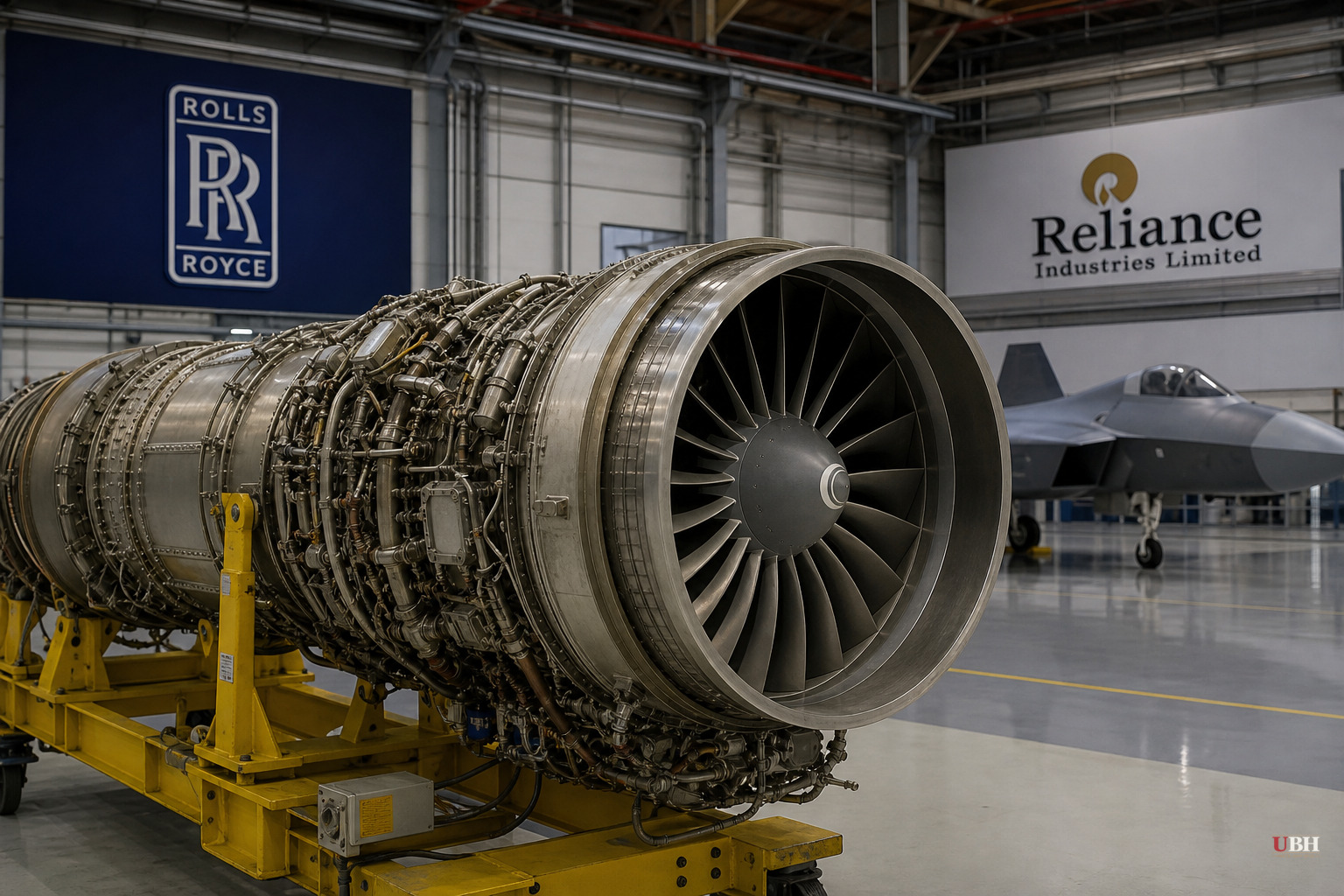
Reliance Industries and Rolls-Royce announced Friday, August 14, 2026, that they intend to jointly design, develop, manufacture and deliver a sovereign indigenous combat engine for India's Advanced Medium Combat Aircraft, the country's fifth-generation stealth fighter program still in development.
India has never built its own fighter jet engine. Every Indian fighter, from the Tejas to the Sukhoi-30, runs on imported propulsion. That dependency represents a strategic vulnerability.
Anant Ambani, executive director of Reliance Industries, framed it as a sovereignty play. "India's strategic autonomy requires sovereign capability in critical technologies," he said in the joint statement, adding the goal is an engine ecosystem that becomes "self-reliant and, over time, globally competitive."
Rolls-Royce CEO Tufan Erginbilgiç called it "a major milestone towards building a robust, self-reliant aerospace ecosystem in the country," pointing to the company's "century-long heritage in advanced engineering" paired with Reliance's manufacturing scale, according to the joint statement carried by multiple outlets including the Times of India and LiveMint.
What's actually being proposed
The two companies say they'll explore forming a dedicated Aerospace Gas Turbine Complex in India, a facility meant to cover the entire engine lifecycle: design, development, manufacturing, testing, production and long-term maintenance, according to Business Today and Rediff.
Rolls-Royce has reportedly offered 100% Transfer of Technology, including the metallurgy know-how for hot-section components and single-crystal turbine blade design, according to The Hindu BusinessLine. That's the hard part of jet engine manufacturing that most countries never crack.
What this is not
Rediff was the one outlet that stated it plainly: "The strategic intent announcement does not itself constitute a signed joint venture or contract." LiveMint made the same point, noting the companies will first assess feasibility before anything binding happens.
No dollar figures were disclosed. Forbes reported the companies "didn't disclose financial details for the project." There's no timeline for when metal gets cut, no confirmed government contract, and no guarantee this beats out the competition.
That competition matters. The Indian government is still running a separate process to pick a foreign OEM to partner with the Defence Research and Development Organisation's Gas Turbine Research Establishment on a 120 kN engine, according to The Hindu BusinessLine. Safran of France is also in that race. Rolls-Royce had already expressed interest in that government track before Friday's announcement with Reliance.
So there are two tracks running in parallel: the government-led GTRE competition and this private Reliance-Rolls-Royce venture. It's unclear from the public statements how, or if, those two efforts get reconciled.
The near-term reality: imported engines still power the jet
The AMCA's initial prototypes will fly on imported American GE-F414 engines from General Electric, according to The Hindu BusinessLine. The indigenous engine, if it materializes, is slated for later production batches and the AMCA Mk-2 variant. That's years out, minimum.
India earmarked 15 billion rupees, about $157 million, in May to fast-track the AMCA program overall, according to Forbes. That's a fraction of what full engine development typically costs. Jet engine programs in the U.S. and Europe routinely run into the billions over a decade or more.
Anyone who's watched Indian defense procurement for the last twenty years has reason for caution here. India has announced "indigenous" defense partnerships before that stalled in bureaucracy, funding gaps, or got quietly shelved when a cheaper foreign option showed up. A memorandum of strategic intent, with no signed contract and no disclosed budget, is a press release until it's a factory with turbines coming off a line.
That skepticism is fair. It's also not a reason to dismiss the announcement outright. Rolls-Royce doesn't casually offer full technology transfer on hot-section metallurgy, arguably its most jealously guarded intellectual property, unless it sees a real commercial and strategic opening in India's defense market. And Reliance, whatever else you think of Mukesh Ambani's conglomerate, has the balance sheet and manufacturing scale to actually build a gas turbine complex if it commits.
The open question is whether New Delhi's own procurement bureaucracy, still deciding between Rolls-Royce and Safran on the separate GTRE track, moves fast enough to give this venture an actual government contract to build toward. Until that decision comes down, this is intent on paper, not an engine on a test stand.
Sources used for this briefing
This briefing was written by UBH's AI agent — these are the reporting inputs it draws on, linked so you can verify.


