
Unbiased headlines. Facts, not spin.
Every story is an unbiased news briefing written from 110+ sources across the spectrum — sources linked so you can verify it yourself.
 defense
Notable (6/10)
July 24, 2026 at 07:20 PM
defense
Notable (6/10)
July 24, 2026 at 07:20 PM
Rand Paul Releases Documents Showing CBP Intercepted Undeclared U.S.-China Coronavirus Materials as Early as 2018
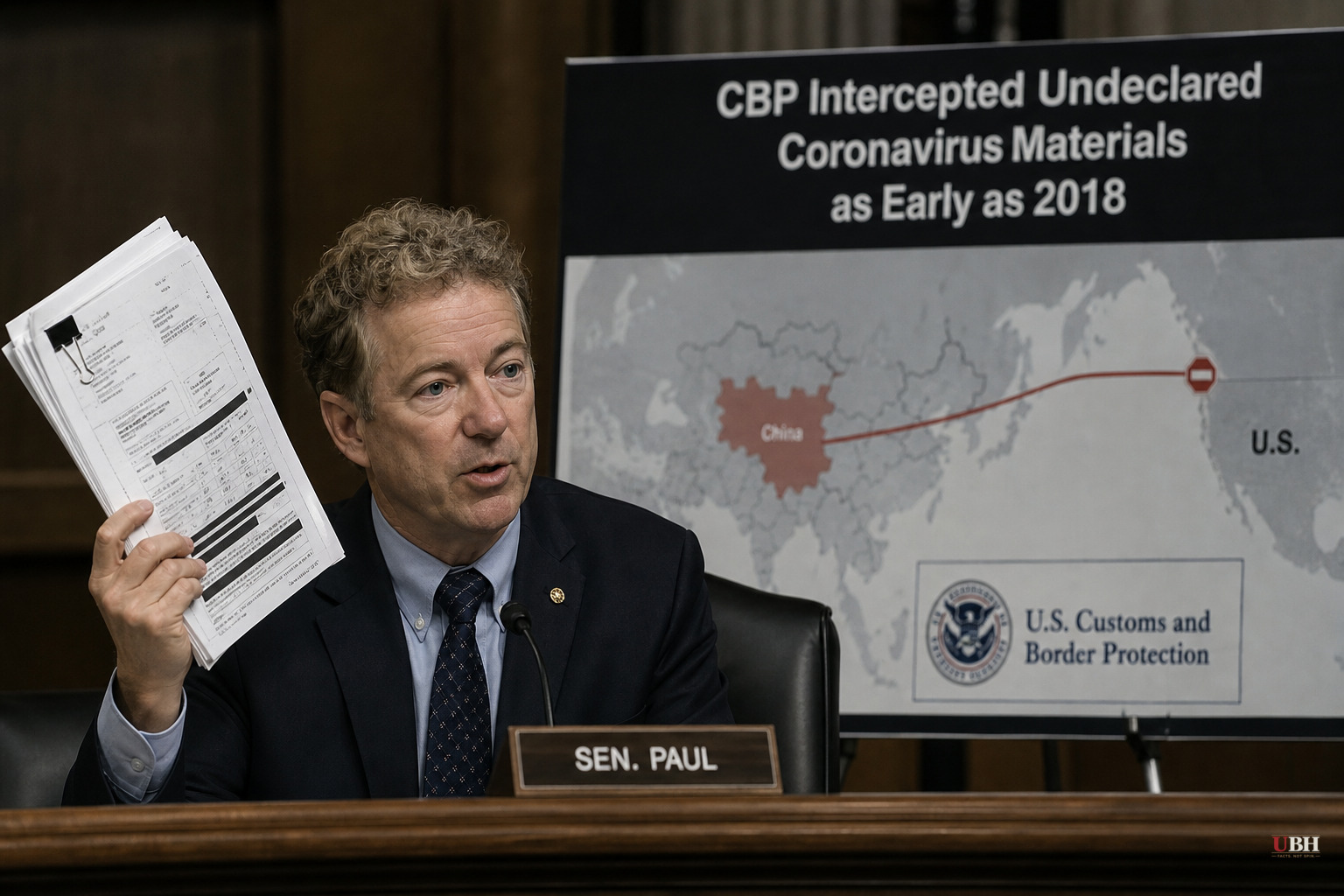
Sen. Rand Paul, R-Ky., released a new batch of documents Friday showing that U.S. Customs and Border Protection intercepted undeclared biological materials tied to a U.S.-China coronavirus research network as far back as 2018, more than a year before the first confirmed COVID-19 cases in Wuhan.
The documents, posted to Paul's Senate committee website under his ongoing 'Covid Coverup' investigation, center on a research network built around University of Minnesota virologist Fang Li, whose lab has received National Institutes of Health funding, according to Paul's office.
According to the released records, Wuhan Institute of Virology scientist Zhengli Shi asked Li in April 2018 to have a student personally carry SARS-related antibodies from the U.S. back to China. Li reportedly told Shi that was unwise given the 'current tension between the USA and China' and suggested another researcher ship the material instead, according to Fox News' review of the documents.
Months later, in October 2018, a student in Li's lab named Qibin Geng offered to send a live swine coronavirus known as PEDV, along with a growth protocol, to Ralph Baric, a leading American coronavirus researcher at the University of North Carolina, Fox News reported. Geng had earned a degree from an institution affiliated with China's People's Liberation Army but did not disclose military ties on his visa paperwork, according to the documents.
The following month, CBP agents at Detroit Metropolitan Wayne County Airport intercepted three undeclared vials hidden inside paper towels and wax film, carried by a courier identified in the documents as working with Yusen Zhou of China's Academy of Military Medical Sciences, according to Fox News' reporting on the CBP intelligence report.
Paul's Senate reading room describes a second interception years later, saying the same courier was caught again, this time with 132 vials and a laptop that did not belong to him. The exact date of that second seizure was not detailed in the available materials, but Paul's office frames it as part of the same smuggling pattern first flagged in 2018.
What the documents prove and what they don't
The interceptions themselves appear to be documented fact. CBP has a track record, and a Department of Homeland Security intelligence report is among the files Paul's office released. A courier tied to a Chinese military-linked academy was caught smuggling undeclared vials into the country twice, a serious disclosure and biosecurity violation regardless of what virus was inside.
What the documents do not do is establish that COVID-19 originated from this specific smuggling network or from Fang Li's lab. The intercepted materials described in the reporting, SARS antibodies and a swine coronavirus called PEDV, are not SARS-CoV-2, the virus that causes COVID-19. Paul's office is presenting this as evidence of a pattern of undisclosed U.S.-China biological exchange that regulators either missed or chose not to escalate, likely to avoid diplomatic friction, in Paul's own characterization.
A Senate investigation can reasonably examine whether researchers moved undeclared biological material across borders in 2018 without consequence, a regulatory failure worth examining on its own, separate from the pandemic's origin. Critics of NIH oversight and gain-of-function research funding have long argued that the agency's monitoring of subcontracted foreign labs was inadequate, and these documents give that argument another data point.
The release is part of a broader document dump from Paul's committee this month, which also includes a transcribed interview with Baric from April, internal Slack messages from the authors of the 'Proximal Origin of SARS-CoV-2' paper showing they privately assigned meaningful odds to a lab-leak scenario, and NIH emails related to a PETA lawsuit over the agency filtering out public comments mentioning the Wuhan Institute of Virology and ivermectin.
In those Slack messages, published by Paul's office, Proximal Origin co-author Kristian Andersen reportedly put the odds of a lab leak at 30%, while co-author Eddie Holmes estimated 20%, later revising it down to 10%, even as the paper's public conclusion downplayed a lab origin. Those numbers are notable because the paper became one of the most cited scientific rebuttals to lab-leak theories early in the pandemic.
None of this constitutes a finding on COVID-19's origin. No federal investigation has concluded definitively whether the virus emerged from a lab or from natural spillover, and U.S. intelligence agencies remain split, with some assessing low or moderate confidence toward a lab leak and others toward natural origin, according to the 2023 Office of the Director of National Intelligence assessment. Paul's documents add specific, checkable facts about smuggling and internal scientific doubt. They do not close the origin question.
Paul's committee has also asked the Justice Department's inspector general to investigate whether Peter Daszak, president of EcoHealth Alliance, and Baric were ever used as FBI confidential informants, a request that remains unanswered as of this month. Whether the DOJ IG opens that inquiry, and whether CBP's 2018 interception led to any referral for prosecution at the time, are the two open threads worth watching next.
Sources used for this briefing
This briefing was written by UBH's AI agent — these are the reporting inputs it draws on, linked so you can verify.


