
Unbiased headlines. Facts, not spin.
Unbiased Headlines is an independently owned news organization. We bring you the facts, not opinions, written fresh from 110+ named sources. Sources linked so you can verify it yourself.
 economy
Notable (6/10)
Event date: October 30, 2026 ·
Quebec Paper Mill Idled Indefinitely by U.S. Owner Amid Trump Tariffs, Leaving 360 Workers on Partial Pay
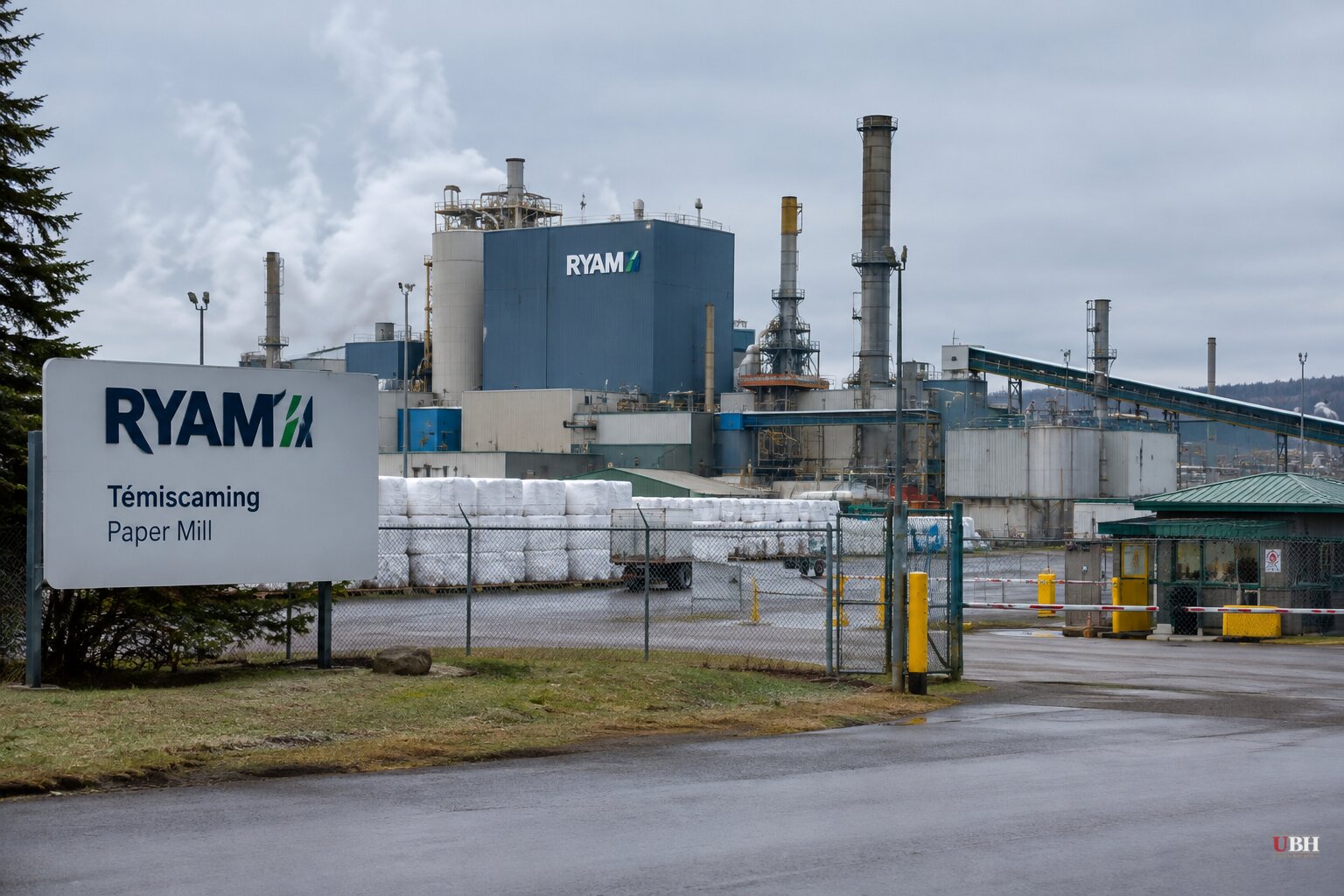
The paper mill in Témiscaming, Quebec sits idle. In early October, RYAM, the American company that owns it, went ahead with what it called an "economic shutdown" for "an indefinite period."
The mill is the town's anchor. Témiscaming was built over a century ago around it and the surrounding pine, birch, spruce and fir forests. Most of its 360 employees are now out of work, kept afloat for the moment by partial pay from government tariff relief.
A town built around one plant
Property values fell almost overnight, and "For Sale" signs now dot the yards of the modest middle-class homes that make up most of the town. Residents fear the people who keep a small town running, from grocery clerks to doctors at the local hospital, will follow the mill workers out.
"If the mill goes down, it'll turn into a ghost town," said Ronnie Raymond, who comes from a family of mill workers. "There'll be nothing, nothing left. There's no work for anybody, really. It's scary."
Nadine Suley, who was heading out moose hunting to take advantage of the short season like much of the town, said the tariffs feel like "a personal attack." "It's not just a job. It's our home," she said.
Stéphane Lefebvre, an employee and union leader whose father and grandfather also worked at the mill, said the pain gets less attention because of where it lands. "If there was 10% of job loss in Toronto or Montreal or Quebec City or Vancouver, it'd be all over the news, and it'd be a lot of pressure on the governments to do something," he said.
Steady nationally, brutal in pockets
Canada's economy as a whole has weathered the trade war with the U.S., its largest customer. The national unemployment rate has stayed largely steady at around 6.5% since Trump's tariffs were first implemented, coupled with tepid but consistent economic growth.
The damage is concentrated. U.S. tariffs of up to 50% have hit steel, aluminium, automobiles and, in Témiscaming's case, lumber, pulp and paper. U.S. tariffs on roughly $20 billion in goods remain in place.
The Bank of Canada says steel exports have fallen by roughly half since the tariffs took effect. Lumber exports were about 20% below 2024 levels earlier this year.
Canadian households are paying too. Government data show consumer prices 3% higher in August than a year earlier, with grocery prices up 2.8% and transportation costs up 7.5%. Retaliatory tariffs on American products added to those costs. The central bank says prices of affected goods, including groceries, household products, furniture, electronics and appliances, rose roughly 6% more than comparable products that were not hit by the tariffs.
The town wants to buy the mill back
The last time Témiscaming faced a threat this existential was in 1973, when the mill's then-American owner threatened to shut it down. Local workers and managers came together and purchased it, turning it into Tembec. RYAM purchased the mill in 2017.
Now workers are mobilising a coalition of locals who want to buy the plant back from RYAM. "We're hoping that lightning will hit twice," Lefebvre said. But he contends they cannot do so without significant help from Prime Minister Mark Carney and the Quebec government, either in the form of tariff relief or financial support. RYAM told the BBC it would not comment on a potential sale of the plant or any prospective buyers.
Mayor Alain Gauthier doesn't blame RYAM for its decision. He calls U.S. tariffs "a bomb to shut down our manufacturing in Canada" and wants Ottawa to retaliate with its own duties on board products coming into Canada from the U.S., currently tariff-free. "We feel we got into a war with kid's water guns to fight back," he said.
A spokesperson for Industry Minister Mélanie Joly said the government has made available $400m to support the forestry sector in rural and remote areas.
Maine and Michigan feel it too
The damage is not confined to Canada. In timber-producing northern Maine, the tariffs and Ottawa's retaliation have taken center stage in the midterm campaign. Residents of the frontier towns worry about a rupture in cross-border relationships built up over decades.
"Tariffs are definitely, economically, going to hurt us here," said Shawn Pelletier, brewery co-owner in Caribou.
Garrett Martin, president of the nonpartisan Maine Center for Economic Policy, said Canadian visits to Maine plunged 43 per cent in the tariffs' first year. Canada retaliated in September with tariffs of 25-50 percent on U.S. lumber, wood furniture and more.
In Port Huron, Michigan, where only the St. Clair River separates the city from Canada, the Washington Post reports that Canadian license plates have become a rarer sight in local parking lots.
The grievance behind the tariffs
The dispute did not start overnight. David Clement, North American affairs manager at the Consumer Choice Center, told Fox News Digital that the administration's complaints about dairy access are "completely valid." He pointed to Canada's "exorbitant tariffs" on chicken, turkey, eggs, cheese and milk.
Clement also noted that differences between American and European access to Canada's market reflect terms negotiated under separate trade agreements, including the USMCA struck during Trump's first term.
Scott Lincicome of the Cato Institute said more than 99% of U.S.-Canada trade was duty-free before 2025, with negotiators historically willing to tolerate disputes over politically sensitive products like dairy. "The Trump administration has so far refused to make the deal," he said. Softwood lumber has long been a source of friction between the two countries.
An American importer sues
The cost is landing on U.S. businesses as well. Gellert Global Group, a third-generation, family-owned food distributor in Elizabeth, New Jersey, has sued the Trump administration over 50% tariffs on certain Canadian goods and is seeking refunds. The company argues the levies are illegal.
The company imports roughly $80 million US worth of Canadian cheeses every year, including Celebrity goat cheese produced by Mariposa Dairy in Lindsay, Ont., as well as brie and camembert. That means it could be paying $40 million US in tariffs for the year.
CEO Thomas Gellert said the company is eating the cost for now. "Customers are not going to take price increases. Everyone is sort of beat down and tired from inflationary pressures," he said. "We can't sustain a tariff like this on these products for much longer."
Gellert said he sought exemptions in meetings with American lawmakers and diplomats, including U.S. Ambassador to Canada Pete Hoekstra, highlighting that American-produced milk is used in some of the products. Those lobbying efforts were not successful.
The tariffs are applied through Section 338 of the U.S. Tariff Act, a Depression-era law that had never before been used for tariff purposes. It lets the president impose tariffs of up to 50 per cent on goods from a country that has discriminated against the U.S. The administration argues Canada's retaliation against earlier U.S. tariffs amounts to discrimination, citing provincial bans on American alcohol, protections for Canada's dairy industry and auto-sector measures.
The lawsuit was filed by the Liberty Justice Center, the same organization that successfully challenged Trump's IEEPA tariffs, which were struck down by the U.S. Supreme Court earlier this year. The group argues Section 338 cannot serve as an "all-purpose authorization for the executive branch to impose sweeping tariffs or import restrictions whenever a trade dispute arises."
Whether a court accepts that argument remains an open question. In Témiscaming, the mill's shutdown is for an indefinite period, and the workers' partial pay is a stopgap, not a plan.
Sources used for this briefing
7 links from 7 independent newsrooms (syndicated copies of the same report count once)
These are the sources it draws on, linked so you can verify.


