
Unbiased headlines. Facts, not spin.
Unbiased Headlines is an independently owned news organization. We bring you the facts, not opinions, written fresh from 110+ named sources. Sources linked so you can verify it yourself.
 economy
Major Story (8/10)
Event date: October 24, 2026 ·
Fitch Cuts France's Outlook to Negative, Projects Debt at 124% of GDP by 2028
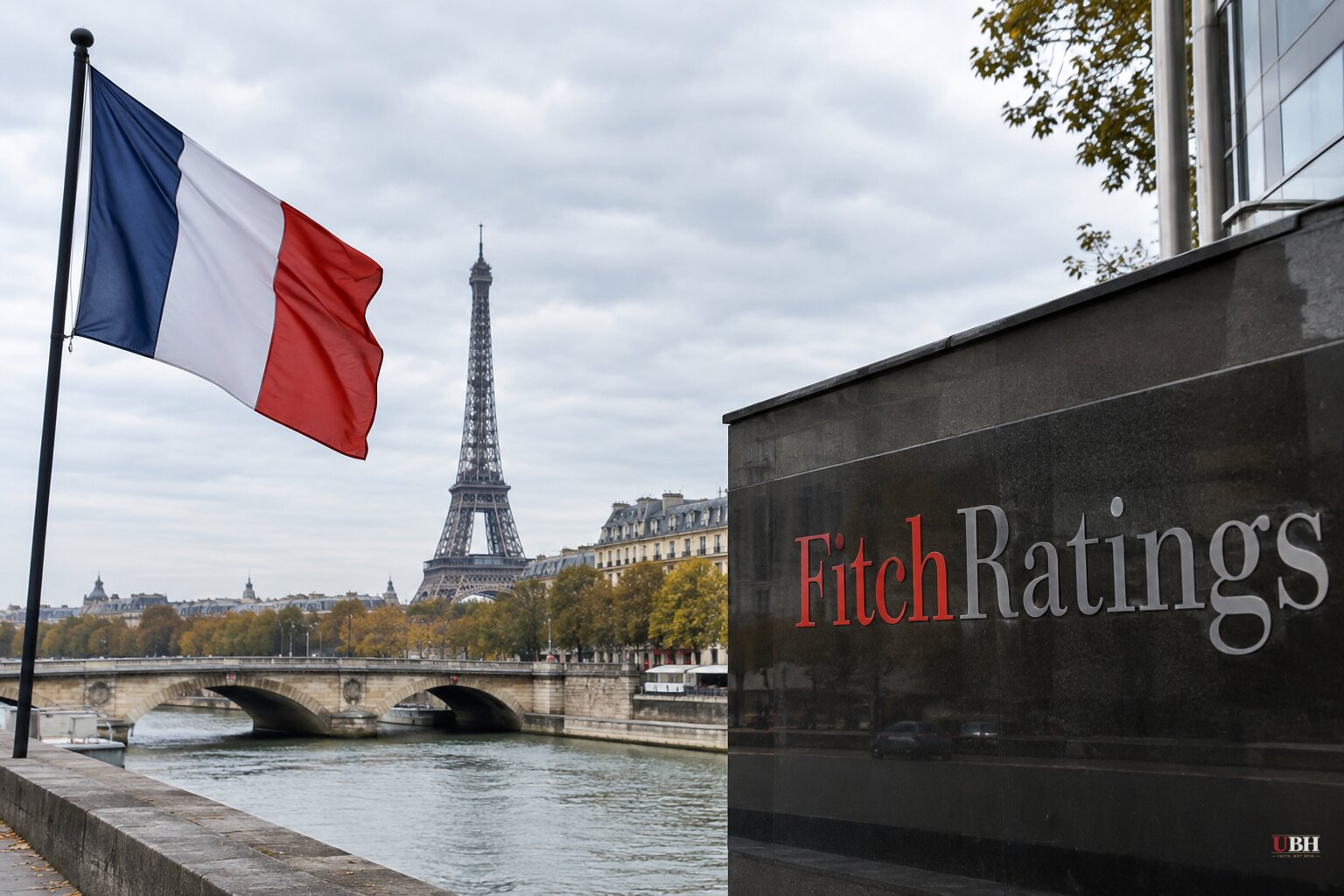
Since French 10-year yields broke above 5% on Oct. 21 and unrest spread across the country's cities, the pressure on Paris has moved from the streets to the ratings agencies. On Friday, Oct. 30, Fitch Ratings made it official: France's outlook is now negative.
The long-term rating stays at A+. The outlook moved from stable to negative, which is a warning that a downgrade could follow if the problems are not fixed.
Fitch breaks its own calendar
Fitch said the change reflects a deterioration since its August review. It named weaker growth, higher borrowing costs and a wider deficit, and said those factors are worsening debt dynamics from an already weak starting point.
The move fell outside Fitch's regular review schedule. The agency said it will reassess France's rating by the end of February 2027 at the latest. A fixed date has not been set.
Fitch also pointed to politics. "The emerging policy debate ahead of the presidential election has not materially strengthened Fitch's confidence in the prospects for durable deficit reduction that could lead to debt stabilization," the agency said.
The numbers Fitch put on the table
Fitch now projects France's government debt rising from 115.7% of GDP in 2025 to about 124% in 2028. That is 1.3 percentage points above its August forecast of 122.7%.
The cumulative fiscal adjustment needed to stabilize the debt has grown from 3.0% of GDP to around 3.5%.
Interest payments are projected to climb from 2.5% of GDP in 2025 to 3.3% in 2028. Fitch put the median for countries in the same rating category at 1.5%. It also said France's debt ratio is about twice the median for A-rated countries.
Fitch sees the deficit at 5.5% of GDP in 2027, citing weaker growth and the risk of concessions during the budget process. The government expects 5.4% this year.
The agency was blunt about the squeeze: "a significant portion of public spending is politically difficult to cut, while the tax burden is already high, leaving little room to raise additional revenue."
Bond market moved first
The 10-year French yield topped 5% on Oct. 21, the first time since July 2002. The next day it reached as high as 5.14% intraday. According to Fitch, the yield rose from 4.1% at its August review to 4.9% at the end of October.
The spread over German Bunds widened at one point to 174 basis points before narrowing to the 150-basis-point range.
Fitch said the increase was much larger than in other major economies, which "shows that the market is correspondingly more sensitive to shifts in confidence."
A shrinking economy and hot inflation
France's statistics agency INSEE reported that GDP fell 0.1% in the third quarter from the previous quarter. Markets had expected 0.1% growth. Public debt is closing in on 120% of GDP.
Inflation is moving the wrong way too. The annual rate hit 3.1% in September, the highest since January 2024, driven almost entirely by energy prices after the U.S.-Iran conflict began in late February. October inflation accelerated further, to its highest level since late 2023.
Economy Minister Roland Lescure described the situation as an unprecedented mix of external and internal shocks.
Unemployment reached 8.3% in the second quarter, the highest since the third quarter of 2020. Youth joblessness is near 22%.
Moody's sees it differently, for now
The case for patience comes from Moody's. On Oct. 23 it kept France at Aa3, citing the country's diversified economy and strong public institutions. It retained a negative outlook, pointing to political fragmentation and protests.
Moody's said it expects a deficit-reduction budget for 2027 to be adopted and that financing pressures and social tensions will ease in the coming months. Fitch's action shows it is less willing to bank on that. Moody's rating is also a notch above Fitch's and S&P Global's. S&P cut France to A+ in October 2025.
Streets and the ballot box
Hundreds of thousands of people have marched in Paris and other French cities in recent weeks over the cost of living, school conditions and pensions. Masked groups have fought police, torched cars and looted shops. More protests are planned this weekend.
Eurasia Group's Mujtaba Rahman put the government's bind this way: it is difficult to respond to the legitimate demands of students and others "because it has no money," and impossible to respond to the demands of the violent minority "because they have none except screw the system."
The presidential election is next year, and the candidates are staking out very different positions. The Wall Street Journal reported that Marine Le Pen has cast herself as a unifying figure, while Jean-Luc Mélenchon has vowed to cancel hundreds of billions of euros in French national debt. Fitch has said the election debate has not raised its confidence in debt stabilization.
The next test is the 2027 budget. Moody's is counting on it passing. Fitch's review is due by the end of February 2027, and a downgrade from A+ is the risk it has flagged if the deficit path does not improve.
Sources used for this briefing
6 links from 6 independent newsrooms (syndicated copies of the same report count once)
These are the sources it draws on, linked so you can verify.


