
Unbiased headlines. Facts, not spin.
Unbiased Headlines is an independently owned news organization. We bring you the facts, not opinions, written fresh from 110+ named sources. Sources linked so you can verify it yourself.
 economy
Major Story (7/10)
DOJ Charges Five in Operation Ghostbusters, Flags 830,840 Potentially Fraudulent Student Aid IDs
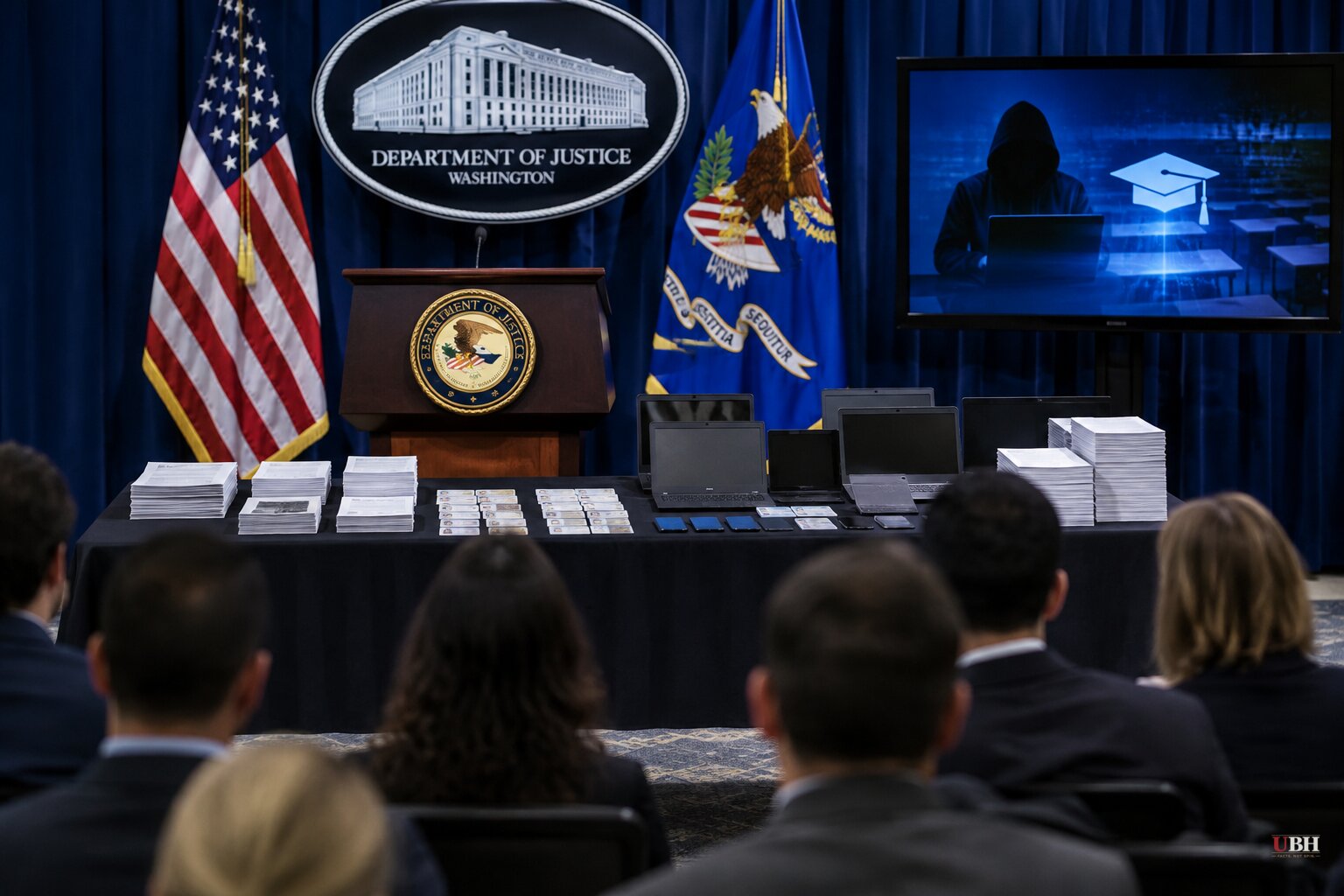
On Thursday, Oct. 29, the Justice Department unveiled the first results of Operation Ghostbusters, a nationwide push against fake college students who collect real federal aid money.
Assistant Attorney General Colin McDonald, head of DOJ's National Fraud Enforcement Division, said five defendants are charged in Virginia, New Jersey and Nebraska. He said more than 40 cases are open across 26 FBI field offices. Authorities put the alleged fraud in the charged cases at about $2.9 million.
"These are not isolated errors. This is organized fraud at scale," McDonald said at a press conference in Alexandria, Virginia.
How the alleged scheme worked
Per DOJ, it starts with buying Americans' personal information. Targets are often high school graduates who went straight to work and never applied to college, which makes them harder to cross-check.
The fraudsters file a FAFSA in the victim's name and enroll a "ghost student" at a college or university. Aid goes to the school first to cover tuition and fees. DOJ says whatever is left over lands in accounts the fraudsters control.
Dozens of Americans served as money mules, according to the department, receiving the refunds and forwarding them overseas.
The AI angle is what makes this different. McDonald said some schemes used AI to fill out applications and finish coursework, and some created the appearance of a student sitting in an online class. "The goal is to keep the ghost student in school for as long as possible, semester after semester after semester," he said.
The charges
Court documents describe a New Jersey case with three defendants: Mabed Patricia Utate-Alberto, Patricia Arisleydi Perez and George Arturo Alfau Mendez. Prosecutors allege they conspired with people in Kenya to obtain more than $1 million in federal aid, kept a cut, and sent the rest overseas. One allegedly collected more than $1 million tied to more than 300 fraudulent student accounts. Money allegedly went to accounts tied to a Kenyan safari company, according to the criminal complaint. DOJ said it intends to charge two co-conspirators associated with that company.
Francis Mogambi, a Kenyan citizen who entered the U.S. through the diversity visa lottery in 2024, faces five counts of theft of government money and five counts of aggravated identity theft. Court documents allege he tried to recruit another person and claimed he was making $2,000 a week.
Another Kenyan national is charged with conspiracy to commit wire fraud and student aid fraud. DOJ alleges that person obtained nearly $1.5 million in disbursements and moved at least $1.3 million to accounts in the U.S. and Kenya. In one case, DOJ said, a defendant received more than 700 fraudulent aid-refund deposits totaling roughly $1.44 million.
These are charges, not convictions. No defendant has been found guilty.
The 830,840 number
The Education Department has identified 830,840 federal student aid IDs as potentially fraudulent and recommended disabling them. DOJ said that if every one proves to be a ghost student, total losses would approach $130 million.
That is a ceiling built on an "if." The FBI's confirmed figure is lower: more than $32 million in losses tied to specific suspects in similar schemes, with officials saying the real total is substantially higher.
Investigators say the scheme may date to 2021 or earlier. The probe began when the Education Department's inspector general referred leads to the FBI's Richmond office. Working with Kenyan authorities, agents seized more than $750,000 from a cryptocurrency account. McDonald called it the first international seizure of its kind in Kenya.
Who pays, and who is blamed
The victims are real people. Many learn about the loans only when the government comes to collect, years later, with their credit already damaged. McDonald acknowledged that unwinding those debts is messy, even with Education Department help.
Under Secretary of Education Nicholas Kent blamed the previous administration. "When we walked in the door last January, we were extremely troubled to find that the Biden administration had turned off nearly every fraud detection measure," he said. No one from the former administration is quoted responding.
The scheme reportedly ran for years. The Education Department has since added online identity verification. Applicants hold a government ID up to a camera, an automated system assigns a risk rating, and high-risk applicants are rejected, leaving schools to follow up.
That fix has critics who say it carries costs. MorraLee Keller, a senior consultant at the National College Attainment Network, warned that some low-income students lack a driver's license, so getting another acceptable ID could take time and money. She also raised concern that false rejections during FAFSA corrections could delay aid students need to pay bills and start classes.
Taxpayer money flowing to fake students for years is a failure of basic controls. A check that stops a real 18-year-old from getting aid is also a failure. The Education Department has not said how many legitimate applicants have been flagged as high risk since the new system began.
What comes next
McDonald said the crackdown has only just begun. DOJ has officers in Kenya tracing the money network, and the department said more arrests may follow. The next concrete step is the announced charges against the two co-conspirators tied to the Kenyan safari company. It remains unclear how many of the 830,840 flagged IDs hold up as fraud once they are actually reviewed.
Sources used for this briefing
8 links from 7 independent newsrooms (syndicated copies of the same report count once)
These are the sources it draws on, linked so you can verify.


