
Unbiased headlines. Facts, not spin.
Unbiased Headlines is an independently owned news organization. We bring you the facts, not opinions, written fresh from 110+ named sources. Sources linked so you can verify it yourself.
 economy
Notable (6/10)
France Has Posted No Quarterly Growth in 2026 as Q3 GDP Falls 0.1% and the Budget Fight Looms
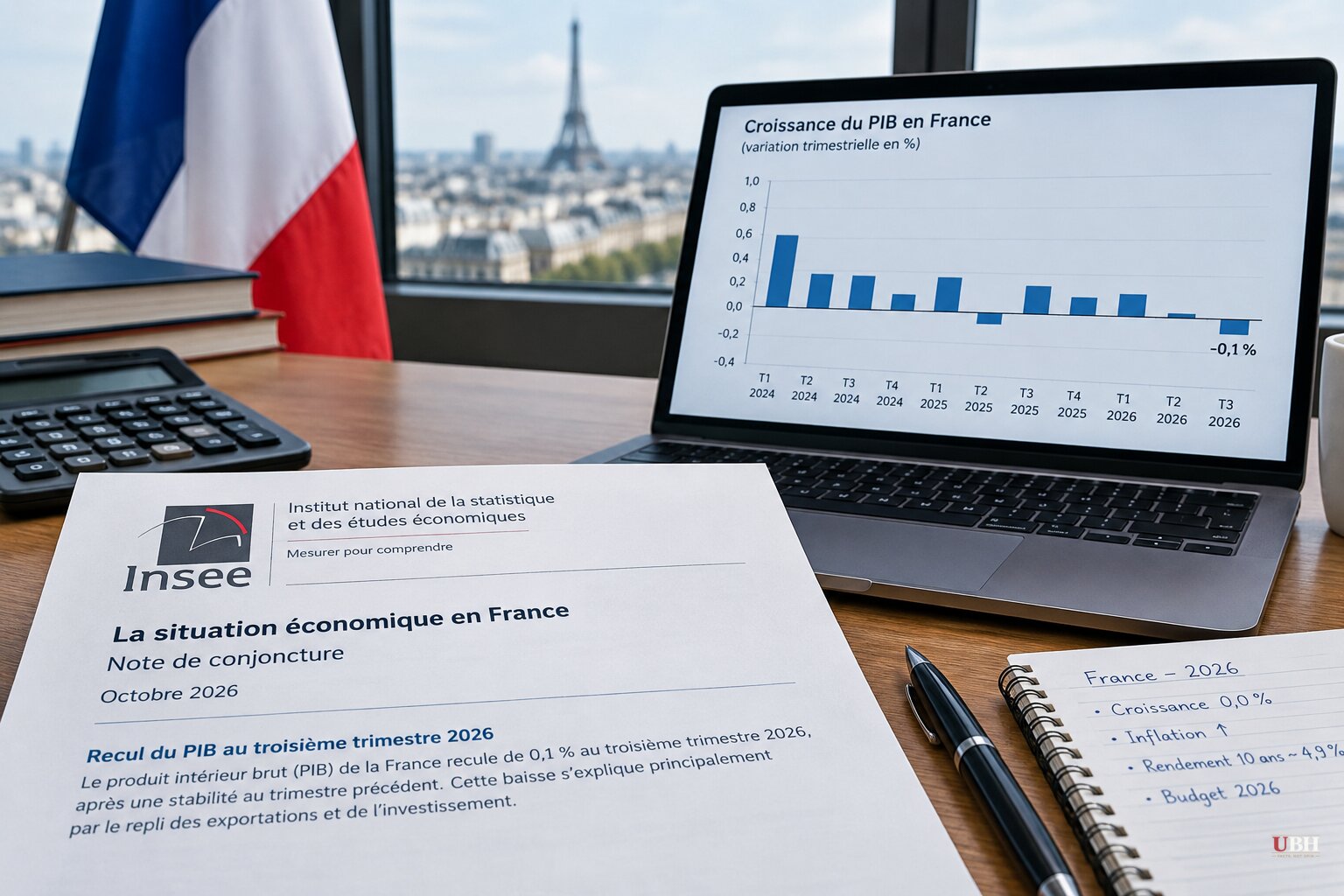
Since the euro zone's 0.4% third-quarter expansion was published on Friday, Oct. 30, the breakdown of France's own number has come into focus. The economy shrank 0.1% from July to September, according to Insee, the national statistics agency. Economists polled by Reuters had expected a 0.1% gain.
That follows zero growth in the second quarter and a 0.2% contraction in the first. France has not posted a single quarter of expansion this year.
Where the output went
Trade was the biggest drag. Exports fell 1.7%, led by a 9.1% drop in transport equipment, with aerospace the main negative driver after a 20.8% surge in the second quarter. Net trade subtracted 0.6 percentage points from GDP.
Investment fell 0.6% after a 0.5% decline in the second quarter. Construction and transport equipment spending weakened, and business investment has now dropped in every quarter of 2026.
On the production side, Insee data show transport equipment output down 3.5%, with aerospace off 4.5% and autos off 1.5%. Agri-food fell 1.5% after poor summer harvests.
Household consumption was the bright spot, up 0.4% after a 0.2% gain, helped by electric vehicle purchases and a 1.2% rebound in energy use. A separate monthly release showed consumer spending fell 0.5% in September alone.
Not a recession yet
The usual technical-recession test is two straight quarters of contraction. Because the second quarter was flat rather than negative, France does not meet it today.
Jérémie Peloso, chief Europe strategist at BCA Research, expects it will. "France is highly likely to experience a technical recession over the coming quarters," he told Euronews. He added that the scenario was conceivable even before the recent budget turmoil and bond-market selloff.
Insee puts the 2026 statistical carry-over at 0.2%, meaning that is the annual growth rate if output is flat in the fourth quarter. Analysts say the data make it hard to reach the government's 0.5% growth forecast for this year, or even the 0.4% projected by Insee and the Bank of France.
Prices and borrowing costs
Insee said national consumer price inflation rose to 3.4% year on year in October from 3.1% in September, the highest since January 2024. On the euro-zone-comparable harmonized measure, inflation hit 3.8%, above the 3.6% analysts expected. Insee attributed the rise to energy prices and higher accommodation and transport costs.
The European Central Bank held rates on Thursday and signaled another hike could come in December. It warned that high and rising energy costs stemming from the Iran war were feeding inflation risks.
French 10-year yields rose 6 basis points to 4.944% after the GDP release, underperforming the rest of the euro zone, and touched about 4.98% at one point. They were near 4.9% at Friday's close, 0.17 points below the Oct. 22 peak, after crossing 5% the previous week. France's deficit is projected at 5.4% of GDP this year, against the EU's 3% limit.
The budget argument
Lescure, speaking on Franceinfo, called the economy "at a standstill." He blamed what he called an unprecedented mix of external and internal shocks, including extreme summer heat and higher energy costs. "France is not heading toward a crisis," he said. "But if we fail to achieve the turnaround outlined in the budget, we are headed straight for a wall."
The government has no majority in parliament. If talks fail, it has not ruled out Article 49.3 of the Constitution, which passes a bill without a vote unless a no-confidence motion succeeds. It has also not ruled out ordinances, a route never used to enact a budget since the Fifth Republic began in 1958.
Jérôme Mathis, an economics professor at Paris-Dauphine University, disputes how much a budget would help. Adopting one is not "crucial" in itself, he argues, since it would not "miraculously revive activity in the short term." A fiscal adjustment plan, he says, generally weighs on growth at first.
Mathis says the issue is giving investors medium- and long-term visibility on public finances. Each rate increase feeds gradually into the state budget, he notes, and uncertainty leads firms to shelve investment, households to defer spending and markets to demand a bigger risk premium.
Streets and the ballot box
The politics are volatile. Nationwide demonstrations on Oct. 17 degenerated into some of the worst rioting in years, driven by anger over living costs and inequality. The protests began as small student demonstrations in suburban Paris in September over school conditions and widened into opposition to the government's economic policies.
The Yellow Vest movement and student unions have called a new protest day for today, Oct. 31.
Presidential elections are due next spring. Opinion polls show Marine Le Pen, whom some analysts describe as a fiscal populist, with a chance of winning. An underwhelming 2027 budget plan last month fed concerns that spending will stay high heading into that vote.
Whether parliament adopts the budget, or Prime Minister Sébastien Lecornu's government reaches for 49.3 and faces a no-confidence motion, is the next test for French borrowing costs.
Sources used for this briefing
7 links from 6 independent newsrooms (syndicated copies of the same report count once)
These are the sources it draws on, linked so you can verify.


