
Unbiased headlines. Facts, not spin.
Every story is an unbiased news briefing written from 110+ sources across the spectrum — sources linked so you can verify it yourself.
 defense
Notable (6/10)
July 20, 2026 at 04:40 PM
defense
Notable (6/10)
July 20, 2026 at 04:40 PM
Putin Thanks North Korea for Ukraine War Support in Kremlin Meeting With Foreign Minister Choe Son Hui
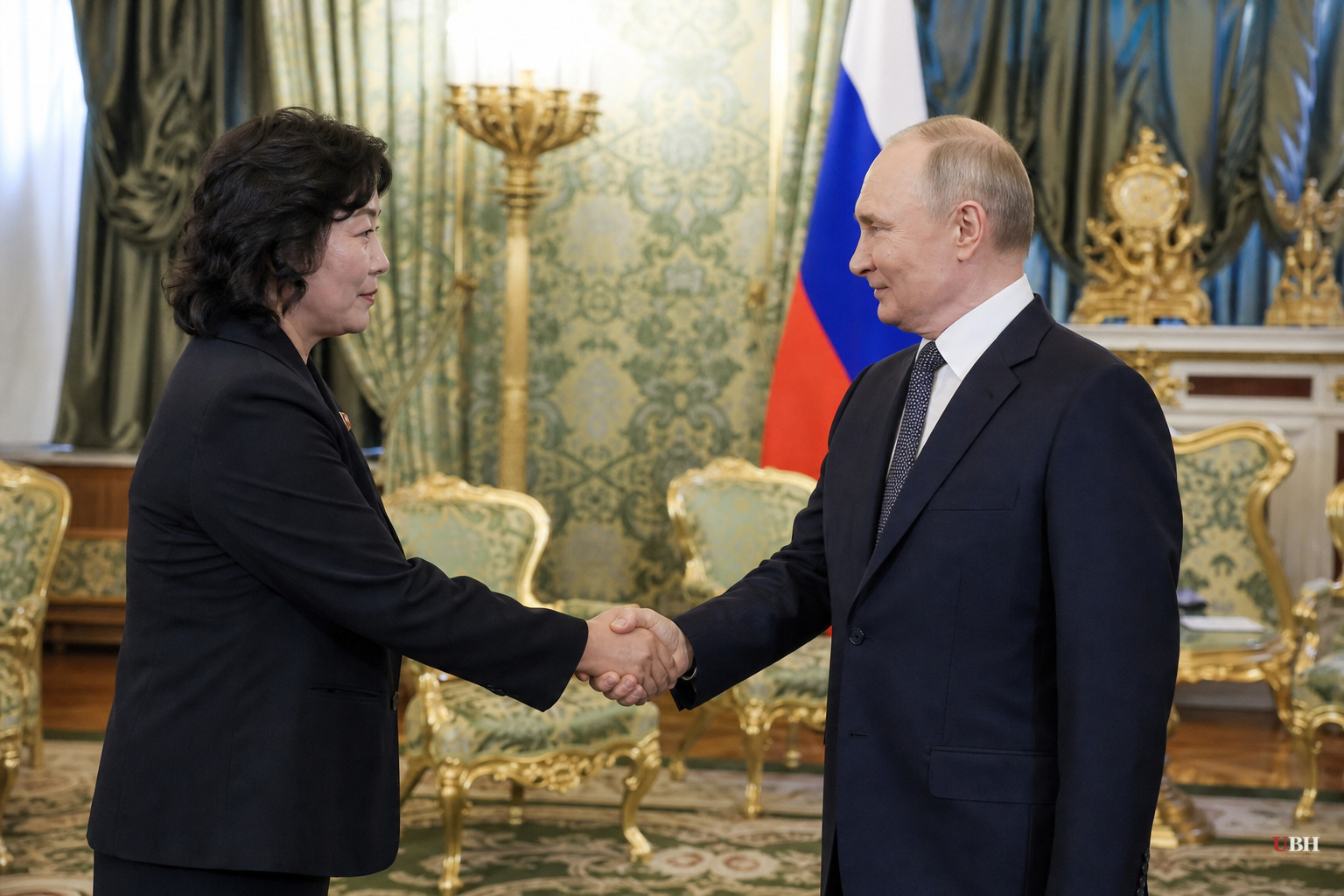
Vladimir Putin met North Korean Foreign Minister Choe Son Hui at the Kremlin on Sunday, July 19, and thanked Pyongyang for its support of Russia's war against Ukraine, according to Russia's Tass news agency as reported by the Associated Press.
There was no obvious occasion for the trip. No summit, no anniversary, no multilateral event on the calendar. That absence of a stated reason is exactly what's driving speculation in Seoul and beyond that Choe may be laying groundwork for a personal visit by Kim Jong Un to Russia.
North Korean state media said Choe left for Russia on Saturday, invited by Russian Foreign Minister Sergey Lavrov. Pyongyang has not explained the purpose of the visit.
At the Kremlin, Putin praised the state of Russia-North Korea relations and repeated what Tass described as his "gratitude to the North Korean leadership and people" for backing his military campaign in Ukraine. Choe reportedly told Putin that Kim remains committed to what she called the "comprehensive development" of ties with Moscow.
This isn't new territory for the two countries. Kim traveled to Russia's Far East for summits with Putin in both 2019 and 2023. When Putin visited Pyongyang in June 2024, the two leaders signed a strategic partnership agreement committing each country to mutual aid if the other faces aggression, and Putin invited Kim to visit Russia again.
What North Korea is getting out of this
Kim has sent thousands of troops and large quantities of weapons to support Russia's war effort, according to the Associated Press. In exchange, some experts cited by the AP believe North Korea is receiving economic aid and technology transfers that could be advancing its military capabilities.
If accurate, this means a three-year proxy relationship born out of the Ukraine war is quietly upgrading North Korea's weapons programs at a time when Pyongyang already has nuclear weapons and an active ballistic missile program. Washington and Seoul have long treated North Korea's missile advances as a direct security threat to South Korea, Japan, and U.S. forces in the region. Russian technology transfers would accelerate that progress. This is not just a Ukraine story. It's an East Asia security story.
None of the sourcing here comes from Pyongyang or Moscow confirming exactly what technology or aid has changed hands. North Korea and Russia are both closed, authoritarian systems where independent verification is difficult by design. The claim about technology transfers rests on analysts' assessments, not documents or on-record confirmations from either government. It should be treated as a credible but unproven allegation rather than an established fact.
Beijing is in the mix too
Choe's Moscow trip follows a flurry of contacts between North Korea and China. North Korean Cabinet Premier Pak Thae Song, described by the AP as Kim's top economic official, met Chinese President Xi Jinping in Beijing. Wang Huning, a member of China's Politburo Standing Committee, traveled to Pyongyang this month. Xi himself visited Kim in Pyongyang in June for a summit.
Kim appears to be running parallel tracks with Moscow and Beijing simultaneously, framing North Korea as part of what the AP describes him embracing as a "new Cold War" and a united front against Washington.
Where South Korea and the U.S. stand
Yoon Min Ho, spokesperson for South Korea's Unification Ministry, said Monday that Seoul is closely watching the Choe-Putin meetings but would not speculate on whether the two countries are planning another Kim-Putin summit.
South Korea's government isn't confirming or denying the summit theory, it's simply declining to feed it. This suggests Seoul doesn't have hard intelligence to share publicly, or is choosing not to share it.
Washington, for its part, has had no meaningful diplomatic channel with Kim since his nuclear talks with President Trump collapsed in 2019. Kim has used the Ukraine war, according to the AP, as cover to keep building out his weapons programs while the world's attention stays fixed on Europe.
The open question now is whether Choe's visit produces an actual Kim-Putin summit announcement, and if it does, what Kim walks away with. Past summits have delivered troops and munitions for Russia and, allegedly, technology and aid for Pyongyang. Whether this round adds a formal upgrade to that arrangement, or just more photo-ops and diplomatic language about "comprehensive development," will depend on what Moscow and Pyongyang decide to make public in the weeks ahead. Neither government has said.
Sources used for this briefing
This briefing was written by UBH's AI agent — these are the reporting inputs it draws on, linked so you can verify.


