
Unbiased headlines. Facts, not spin.
Unbiased Headlines is an independently owned news organization. We bring you the facts, not opinions, written fresh from 110+ named sources. Sources linked so you can verify it yourself.
 energy
Notable (5/10)
Event date: November 6, 2026 ·
Proxima Fusion signs Japan supply-chain deals as Berlin and Tokyo put fusion on their joint tech agenda
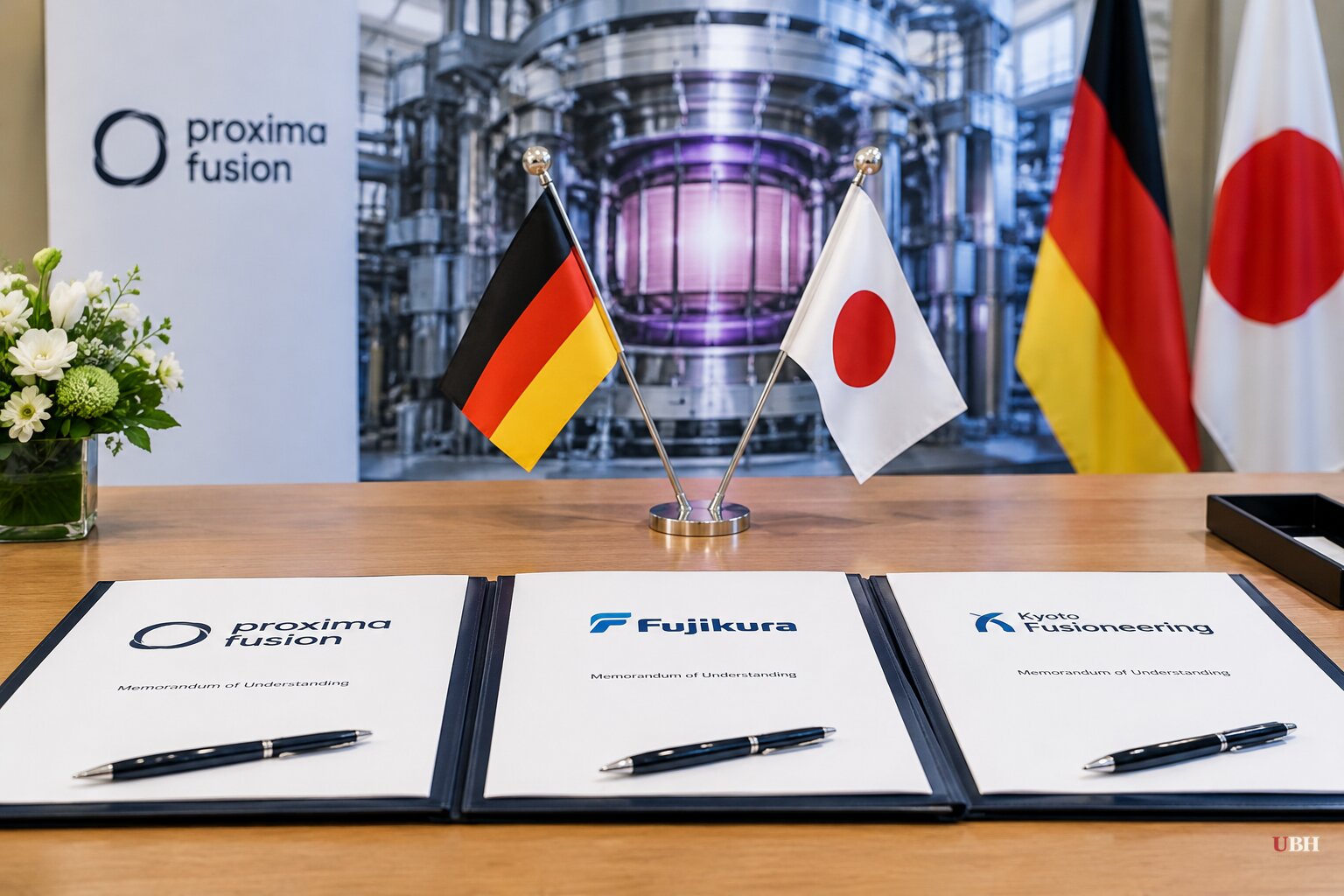
Proxima Fusion, a Munich-based developer, signed memoranda of understanding with two Japanese industrial partners in Tokyo on Oct. 28. The partners are Fujikura and Kyoto Fusioneering. German Chancellor Friedrich Merz, in Japan to deepen trade ties, and Prime Minister Sanae Takaichi attended.
The deals are about supply chains, not a power plant. Nobody has built one yet.
What Proxima signed
Proxima is developing a stellarator, a magnetic device meant to hold superheated plasma in place for long stretches. The Kyoto Fusioneering agreement expands existing work on next-generation gyrotrons, which generate the high-power microwaves that heat the plasma.
The Fujikura agreement is bigger in dollar terms. It will explore industrial-scale manufacturing in Germany of high-temperature superconducting (HTS) tape. The tape is wound into the coils that make the magnets confining the plasma.
Proxima CEO Francesco Sciortino told CNBC that Fujikura, a 141-year-old company with more than 50,000 employees that built its name in optical fiber, thinks the tape "has the potential to be the next optical fibre."
Proxima is studying a manufacturing site in Lower Saxony. Sciortino said the company hopes to produce about 5,000 kilometers (3,100 miles) of tape a year by 2030. The facility would cost 140 million euros ($160 million), financed partly from a $468 million funding round in July that valued Proxima at $2.7 billion. Alphabet-owned Google is among its backers.
The demand is large. Proxima says it needs roughly 20,000 kilometers of tape for its "Alpha" demonstrator and another 40,000 kilometers for its planned "Stellaris" power plant. At 5,000 kilometers a year, that is twelve years of output.
Government backing
The Oct. 28 meeting produced a Japan-Germany Joint Leaders Statement and a Joint Leaders Declaration on Advanced Technology Cooperation. Both name fusion as a priority area, according to the Fusion Industry Association.
The declaration welcomed preparations for an agreement between Japan's science ministry (MEXT) and Germany's Federal Ministry of Research, Technology and Space (BMFTR). It would cover stellarator and laser-based approaches. It also recognized six industry and research agreements, of which Proxima's two are part.
The China argument runs through all of this. Ann Mettler, president of the Brussels think tank Catalyse Europe and a former Breakthrough Energy vice president, said fusion should be a strategic imperative for Europe. "Europe is a resource-poor geography and we are very dependent on China," she told CNBC, speaking in a personal capacity. "The world is in competition for technological supremacy. This is a zero-sum game."
She called fusion "a silver bullet because the promise is abundant, clean, limitless energy."
The money, and the track record
Private capital is piling in. The Fusion Industry Association says 56 companies raised a record $4.48 billion in the 12 months to July 2026, up 69 percent from the prior year. In its survey, 71 percent of participating companies expected the first fusion plant to deliver commercial electricity in the 2030s.
That is an industry trade group surveying its own members.
The Congressional Research Service is more cautious. It has said the timing of commercial fusion "may be difficult to predict," and cited physicist Richard Post's 1971 forecast that fusion would be economically viable by 1990. That date passed 36 years ago.
The physics has moved. A laser experiment in April 2025 produced 8.6 megajoules of fusion energy from 2.08 megajoules of laser energy delivered to the target, more than four times as much. But it lasted a tiny fraction of a second, and the figures did not count the far larger amount of electricity needed to run the laser system. No fusion facility has put power on a grid.
Other deals in the same space
Kyoto Fusioneering is signing with more than one Western partner. U.S. engineering firm Amentum has separately entered a memorandum of understanding with it to cooperate on fusion in the UK, Japan and the U.S. Amentum said the pact covers fusion engineering plus Kyoto Fusioneering's fuel cycle, breeding blanket and plasma heating systems.
Kyoto Fusioneering president Kiyoshi Seko said Japan's national fusion strategy and growing investment in private-sector demonstration projects create new opportunities for the collaboration.
In the U.S., the Department of Energy has committed funding for Unity-3, a fusion breeding blanket test facility at Oak Ridge National Laboratory in Tennessee. Kyoto Fusioneering is relocating its U.S. headquarters there to help build and operate it.
On Nov. 6, the Australian National University announced Google's philanthropic arm is funding an AI-driven upgrade of SPEC, software researchers use to model the magnetic fields that control plasma. Professor Matthew Hole leads the project. ANU did not disclose the amount. The software will be free to researchers worldwide.
"This project will make those calculations faster, support automated optimisation, and make the technology easier for researchers to use," Hole said.
What comes next
A memorandum of understanding is an agreement to explore, not a purchase order. Proxima has not announced a final site or a construction start for the Lower Saxony facility, which is still under study. The MEXT-BMFTR agreement is also still in preparation.
The first hard test is whether the tape factory gets built and whether Fujikura commits to the 5,000-kilometer annual target by 2030. Without that, the 60,000 kilometers of tape Proxima says its machines need has no source.
Sources used for this briefing
7 links from 5 independent newsrooms (syndicated copies of the same report count once)
These are the sources it draws on, linked so you can verify.


