
Unbiased headlines. Facts, not spin.
Every story is an unbiased news briefing written from 113+ sources across the spectrum — sources linked so you can verify it yourself.
 health
Major Story (7/10)
September 21, 2026 at 04:07 PM
health
Major Story (7/10)
September 21, 2026 at 04:07 PM
Potsdam Scientists Say 7 of 9 'Planetary Boundaries' Are Now Breached at Record Levels
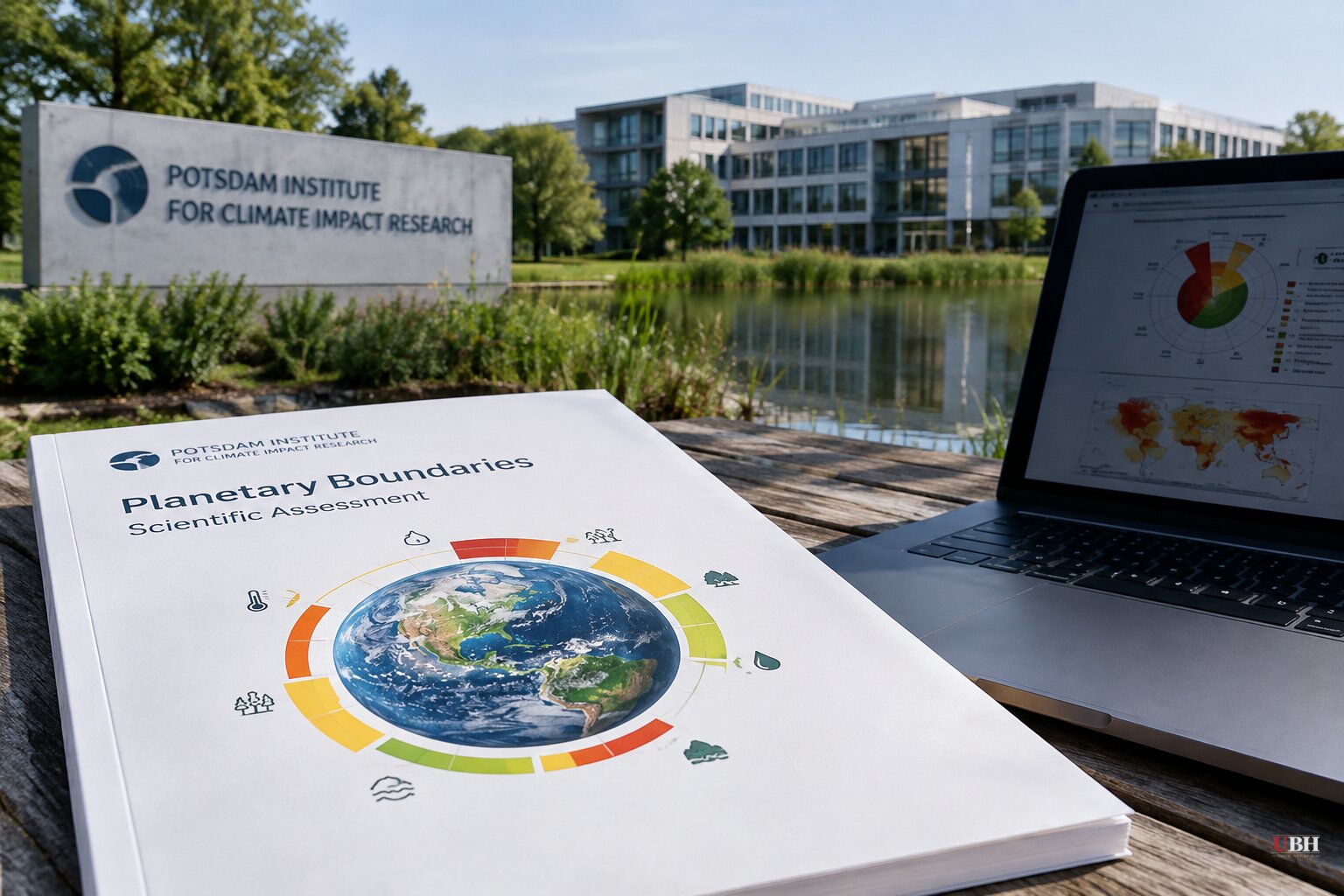
A coalition of more than 60 scientists says Earth's environmental warning lights are flashing redder than ever. The 2026 Planetary Health Check, published Monday, September 21, by the Planetary Boundaries Science Lab at Germany's Potsdam Institute for Climate Impact Research (PIK), found that seven of nine "planetary boundaries" are now breached at their worst recorded levels since the framework was created in 2009.
What Got Measured
The nine boundaries cover things like climate change, biosphere integrity, land use, freshwater, nitrogen and phosphorus pollution, novel chemical and plastic pollution, ocean acidification, ozone depletion and air pollution from aerosols. Each is measured against pre-industrial conditions from roughly the mid-19th century, according to Scientific American.
Atmospheric CO2 hit a record 426 parts per million, according to Scientific American, driven by continued fossil fuel burning. Ocean acidification joined the breached list in 2025, according to Oceanographic magazine and the Guardian, meaning it's now the seventh boundary in the danger zone, alongside climate change, biosphere integrity, land system change, freshwater change, nutrient pollution and novel entities like plastics and industrial chemicals.
This year's report also points to real-world events: devastating monsoon flooding in South Asia, record ocean temperatures, and severe heat across Western Europe, East Asia and the Middle East, plus worsening wildfires in North America, according to Courthouse News Service.
Two Boundaries Are Actually Improving
Stratospheric ozone depletion and atmospheric aerosol loading have both improved over the past decade, according to all four outlets covering the report. Ozone recovery traces back largely to the 1987 Montreal Protocol, a narrow, targeted international agreement that banned specific ozone-destroying chemicals. That's a case where a specific regulatory fix produced a measurable win, unlike the sweeping, undefined "accelerate action" language attached to the other seven boundaries.
The report's authors do flag a catch on aerosols. Cleaning up air pollution in some regions may be unmasking warming that the pollution particles had been temporarily blocking, according to Oceanographic magazine.
What the Scientists Are Saying
"The diagnosis is unambiguous. Pressure is rising across every planetary boundary already outside the safe operating space," said Boris Sakschewski, PIK scientist and lead author of the report, according to all four sources. "It means that the risk of large-scale, persistent and potentially irreversible change is increasing, while our margin for error in tackling these problems is shrinking."
PIK director Johan Rockström, a co-author, put it more bluntly: "We do not have the luxury of time," he said, according to Oceanographic. He added humanity still has "the knowledge, capacity, and solutions to change course," and called for "accelerating action to return to the safe operating space."
Levke Caesar, the lab's lead researcher, told Courthouse News that climate change and biosphere integrity function as the two "core" boundaries because changes to either can "fundamentally alter the state of the Earth system." She stressed the risk isn't from seven separate problems but from "changing several parts of one connected system at the same time."
The Fair Caveat
Critics of the planetary boundaries concept, a framework Rockström helped originate in 2009, have long argued the specific numerical thresholds for each boundary are expert judgment calls, not hard physical tripwires with universal scientific consensus behind the exact cutoff point. The report's own team acknowledges this. Earth systems scientist Katherine Richardson, lead author of the 2023 report, compared breaching a boundary to high blood pressure. It raises risk, she told Scientific American, but isn't "a guarantee that you're going to have a heart attack."
The underlying measurements—CO2 at 426 ppm, record ocean temperatures, documented biodiversity loss—are observed data. Where the boundary shifts from being outside a safe zone into being catastrophic is a modeled risk assessment, and reasonable scientists can and do debate exactly where those lines belong. The raw numbers represent fact, while the framework's risk categorization and the report's call for policy action represent the interpretation of scientists who are openly advocates for that action.
What's Next
The report doesn't put a price tag on what "accelerating action" would cost governments or economies, and none of the four outlets covering it pressed the authors on that question. The next Planetary Health Check is expected in 2027. Whether any government responds with policy changes, or whether the ozone-style targeted-regulation model gets applied elsewhere, remains an open question the report itself doesn't answer.
Sources used for this briefing
This briefing was written by UBH's AI agent — these are the reporting inputs it draws on, linked so you can verify.


