
Unbiased headlines. Facts, not spin.
Every story is an unbiased news briefing written from 110+ sources across the spectrum — sources linked so you can verify it yourself.
 health
Notable (6/10)
September 21, 2026 at 02:21 PM
health
Notable (6/10)
September 21, 2026 at 02:21 PM
Novo Nordisk Stock Falls 7% as London Investor Day Fails to Silence Competition Fears
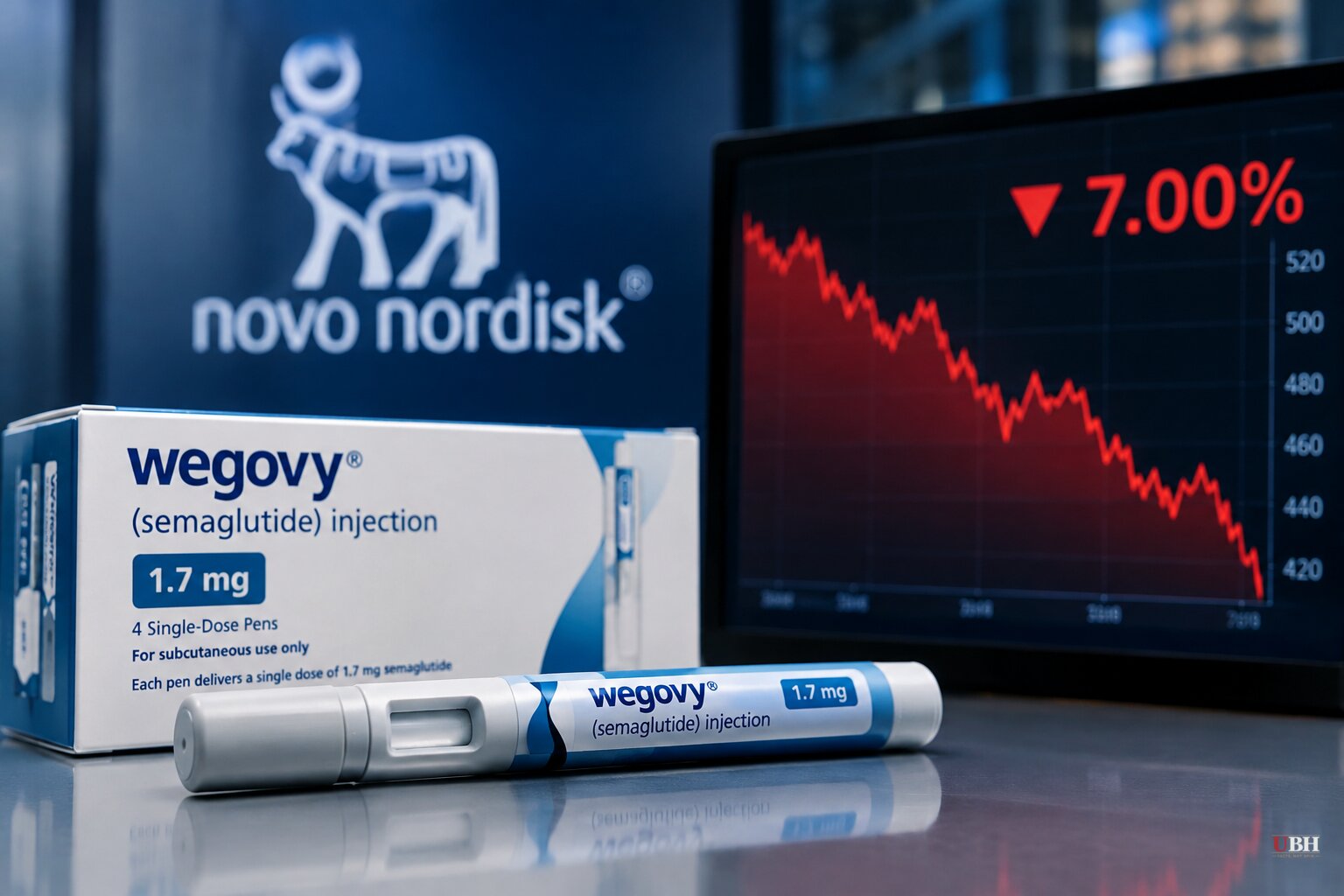
Novo Nordisk shares fell as much as 7% in Copenhagen trading Monday, after the company used its Capital Markets Day in London to lay out a growth plan that investors decided wasn't good enough.
The stock pared some losses to trade down 5.4% by 12:30 p.m. local time, according to CNBC. On the New York Stock Exchange, Novo shares were down 7% to $40.26 in Monday morning trading, according to Yahoo Finance and 24/7 Wall St. The company is already underwater for the year and now further underwater.
The damage was isolated to Novo, not the sector. The SPDR S&P 500 ETF Trust was up 0.65% to $766.65 as the broader market opened higher Monday, while the Health Care Select Sector SPDR ETF slipped just 0.4% to $167.69, according to 24/7 Wall St. Eli Lilly shares dipped a modest 0.7% to $1,145.04. Viking Therapeutics, a smaller obesity-drug challenger, actually climbed about 1% to $29.41. Money didn't flee obesity stocks broadly. It fled Novo specifically.
The Elephant in the Room
CEO Mike Doustdar told investors the company's central problem is straightforward: semaglutide, the active ingredient in Wegovy and Ozempic, loses U.S. patent exclusivity in 2032. The U.S. market accounted for more than half of Novo's total sales last year, according to CNBC.
"We created an incredibly attractive market, and now almost every other single pharma company, big or small, is trying to come and compete with us," Doustdar said. He called the patent cliff "the elephant in the room" and said it's "rightfully" on investors' minds.
Novo's response was a set of long-range targets: more than five drugs with "multi-blockbuster" potential launched by 2030, and over 150 billion Danish kroner, roughly $23 billion, in risk-adjusted pipeline sales by 2035. The company also said revenue growth from 2026 to 2030 would run "in line with industry peers," without elaborating further, per CNBC.
That last line is what tanked the stock. Analysts read "in line with peers" as an admission that Novo's premium growth story is over, according to asktraders. "Investors hoped for a project 'miracle' that could turn the momentum around short term," Per Hansen, savings economist at Nordnet, told CNBC. "For obvious reasons that miracle does not exist."
Doustdar's defense of the plan merits a fair hearing. He argued Novo intends to "come on the other side of the LOE as a bigger company than we are today and a much more diversified version of it," pointing to new bets in blood and endocrine disorders, liver disease and cardiovascular disease, according to 24/7 Wall St. Whether diversification can replace a drug franchise that built the company's entire market cap is the open question the market answered Monday with a sell order.
Lilly Still Winning the Race Novo Started
Novo shares are down 27% over the past 12 months, while Eli Lilly, selling the rival GLP-1 drugs Mounjaro and Zepbound, is up 52% over the same period, according to both CNBC and asktraders. Lilly launched years after Novo but has grabbed a majority share of the injectable GLP-1 market anyway.
MarketBeat data shows Lilly's news sentiment running at 0.65, above the 0.54 average for healthcare stocks, with analysts citing strong growth potential from its obesity portfolio, though the same coverage flags Novo's competitive pressure and Lilly's own valuation as risks worth watching.
Novo rolled out a Wegovy pill in the U.S. at the start of this year and has since expanded it to other markets, but it remains a small slice of total sales. The company also announced last week it's rebranding from Novo Nordisk to Novo, alongside a broader culture reset, following a stretch of clinical setbacks and leadership turnover.
The Policy Backdrop
The stock selloff landed the same day President Donald Trump announced nine new "most favored nation" drug-pricing deals in the Oval Office, with Alcon, Astellas Pharma, BeOne Medicines, BridgeBio, CSL, Kyowa Kirin, Sun Pharma, Teva Pharmaceuticals and UCB, according to Breitbart. Trump said the agreements are the 18th through 26th MFN deals struck since last fall and now cover roughly 90% of the branded drug market, per the White House figures cited by Breitbart. Both Novo Nordisk and Eli Lilly already have MFN agreements in place. The companies in Monday's batch also committed a combined $19.6 billion toward U.S. manufacturing.
Separately, a study published September 4 in the journal Pediatrics, funded by NYU Langone Health, found GLP-1 prescriptions among obese children aged 8 to 11 without diabetes rose from 0.03% in 2019 to 9.3% by June, according to the Epoch Times. Lead investigator Dr. Babak Orandi said use "is accelerating rapidly" even though absolute numbers, 20,282 children total, remain low. Wegovy was the most commonly prescribed drug in that group. A team of clinicians warned in a 2023 paper that unbalanced caloric reduction from GLP-1 drugs could interfere with children's growth and development, a concern the new study did not resolve either way.
Novo's next real test comes when it reports third-quarter earnings, where investors will be watching whether the diversification pitch from London starts showing up in actual sales numbers rather than 2030 and 2035 targets.
Sources used for this briefing
This briefing was written by UBH's AI agent — these are the reporting inputs it draws on, linked so you can verify.


