
Unbiased headlines. Facts, not spin.
Unbiased Headlines is an independently owned news organization. We bring you the facts, not opinions, written fresh from 110+ named sources. Sources linked so you can verify it yourself.
 defense
Major Story (8/10)
Poland Plans Eastern Border No-Fly Zone by Late December or Early January; Allies Balk at Shooting Missiles Down Over Ukraine
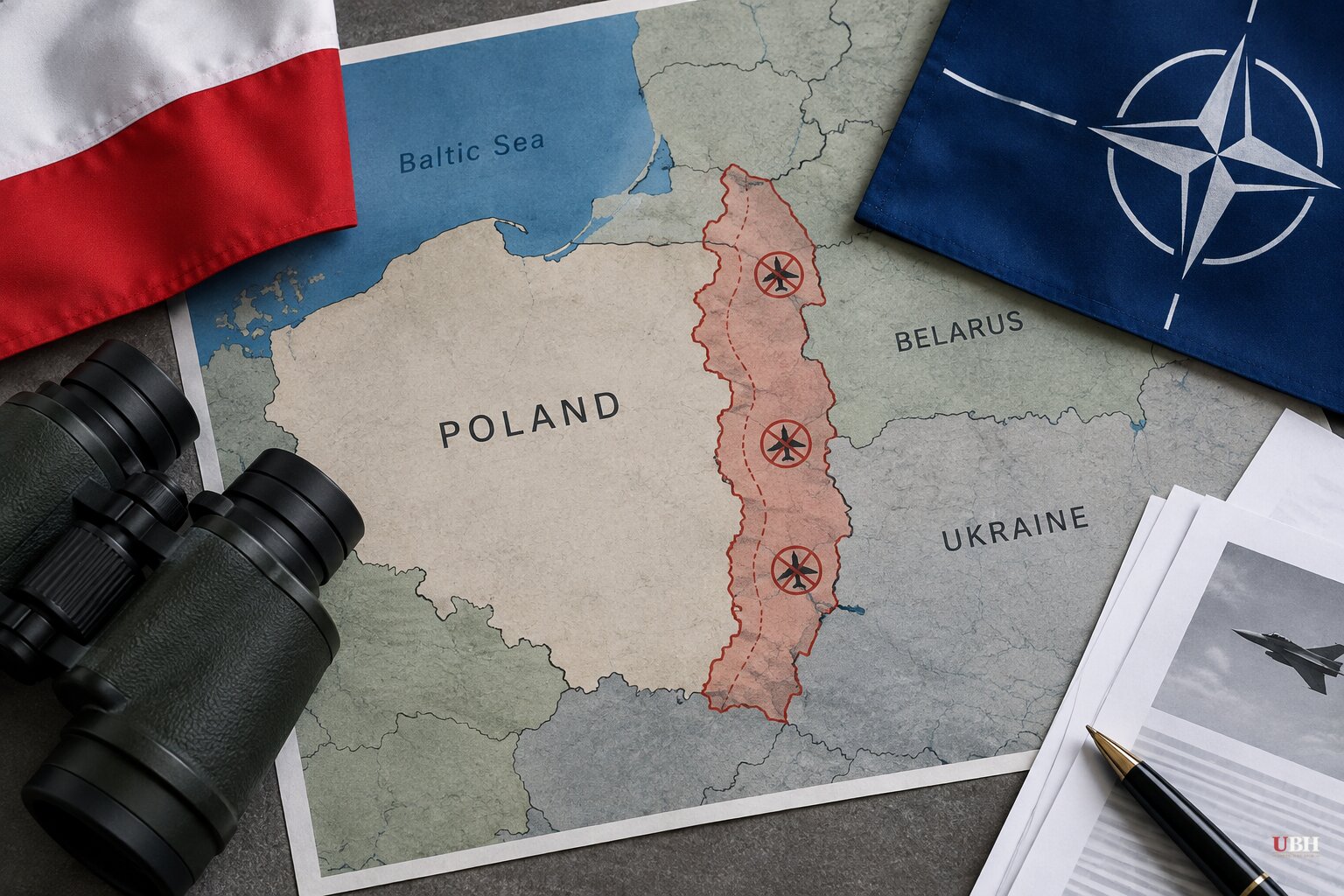
Since three Russian Kh-101 cruise missiles fell on Polish territory on Nov. 20 without causing casualties, Warsaw has moved on two fronts. One is a domestic restriction on its own airspace. The other is a push for NATO to engage Russian missiles over Ukraine. Only the first is moving quickly.
What Poland is building
Tomczyk told a press briefing on Nov. 25 that the government is drafting a regulation creating a restricted zone along the border with Ukraine. He described it as extending from roughly 12 kilometers to several dozen kilometers from the border. "It is a small zone," he said, calling it "an additional factor for the military."
The draft has been submitted to the Government Program Group and should be processed in the coming weeks. Tomczyk said he expects it to take effect "closer to the end of December or in early January." Its exact course has not been published.
The zone is on the Polish side of the border. Some commentary has framed it as NATO missiles hitting threats over Ukrainian territory. The zone does not do that. That is the separate proposal discussed below.
Radar, not eyeballs
The zone builds on a rules-of-engagement change Poland made roughly two months ago. NATO's peacetime standard requires visual identification before a foreign aircraft can be shot down. At the request of the operational commander, General Ireneusz Nowak, Polish pilots now use what Tomczyk calls "positive identification."
That means a pilot assembles a set of indicators, including radar data, allied intelligence, altitude and speed, and can engage without seeing the target. "In pre-war conditions, in critical conditions, and that is what we are living in, it stopped making sense," Tomczyk said of the visual requirement.
Entering the zone would not by itself justify opening fire, he said. It adds to the picture. "When a Polish fighter pilot knows that an aircraft is, for example, entering Polish airspace from Ukrainian territory, moving at a certain altitude and a certain speed, enters the no-fly zone and there is a radar image, that is the basis for shooting down such an object," he said.
Tomczyk added that Poland will urge the entire alliance to adopt the same principle along NATO's eastern flank. He said Poland pioneered the approach in this area and that the Baltic states have since followed.
The incidents behind it
Polish media outlet Interia Wydarzenia reported that the decision is tied to the recent incursions. On Nov. 20, during one of the heaviest Russian missile and drone barrages of the war, objects crashed in eastern Poland. Defense Minister Władysław Kosiniak-Kamysz first said two missiles and a drone had come down. The Lublin District Prosecutor's Office later confirmed all three recovered objects were Kh-101 cruise missiles.
Polish authorities said bad weather prevented the precision needed to shoot the missiles down. NATO Secretary General Mark Rutte said in Warsaw that allies gave Polish F-16s the support they needed. NATO has since sent an AWACS early-warning aircraft to Poland.
On the night of Nov. 23, a Russian jet-powered drone circled over eastern Poland for about eight minutes before turning back east. Poland's Operational Command authorized a shoot-down but held fire, citing the risk to civilians below.
The harder ask: intercepts over Ukraine
At a Nov. 23 meeting of NATO ambassadors in Brussels, Poland asked allies to consider shooting down Russian missiles over Ukraine if they are heading toward alliance territory, Bloomberg reported, citing people familiar with the talks. Some allies backed the idea. The discussion was preliminary and no decision was made.
Foreign Minister Radosław Sikorski said on Nov. 25 that shooting down Russian missiles over Ukraine at Kyiv's request could constitute an act of self-defense.
The pushback is coming from inside the alliance, and Polish officials say so themselves. Tomczyk said NATO was not supportive, citing the complications, and that earlier discussions had ruled such an arrangement out, according to Polish broadcaster RMF24. Kosiniak-Kamysz said Warsaw does not see enough resolve among allies to shoot down Russian drones and missiles over Ukraine. In his words, partners are more willing to discuss it but not ready to act, and one country cannot do it alone.
Poland has precedent for acting on its own territory. It shot down Russian drones that entered its airspace during the Sept. 10, 2025 attack on Ukraine, the first time a NATO member engaged Russian aerial targets since the full-scale invasion began. NATO then set up Eastern Sentry to add air defense on the eastern flank.
What comes next
Deputy Defense Minister Paweł Zalewski said further Polish proposals will be discussed when NATO foreign ministers meet next week. Poland is expected to press for more surveillance capability and more F-35s based in or near the country, according to NPR's reporting from Brussels.
Two things remain open. One is whether the border zone regulation clears the government on schedule and what its final boundaries are. The other is whether any ally will back intercepts over Ukraine, which Poland's own defense minister says it cannot do alone.
Sources used for this briefing
7 links from 7 independent newsrooms (syndicated copies of the same report count once)
These are the sources it draws on, linked so you can verify.
More coverage: Ukraine and Immigration


