
Unbiased headlines. Facts, not spin.
Unbiased Headlines is an independently owned news organization. We bring you the facts, not opinions, written fresh from 110+ named sources. Sources linked so you can verify it yourself.
 defense
Notable (6/10)
ESA's Hera Spacecraft Images Stadium-Sized Crater on Asteroid NASA Struck in 2022
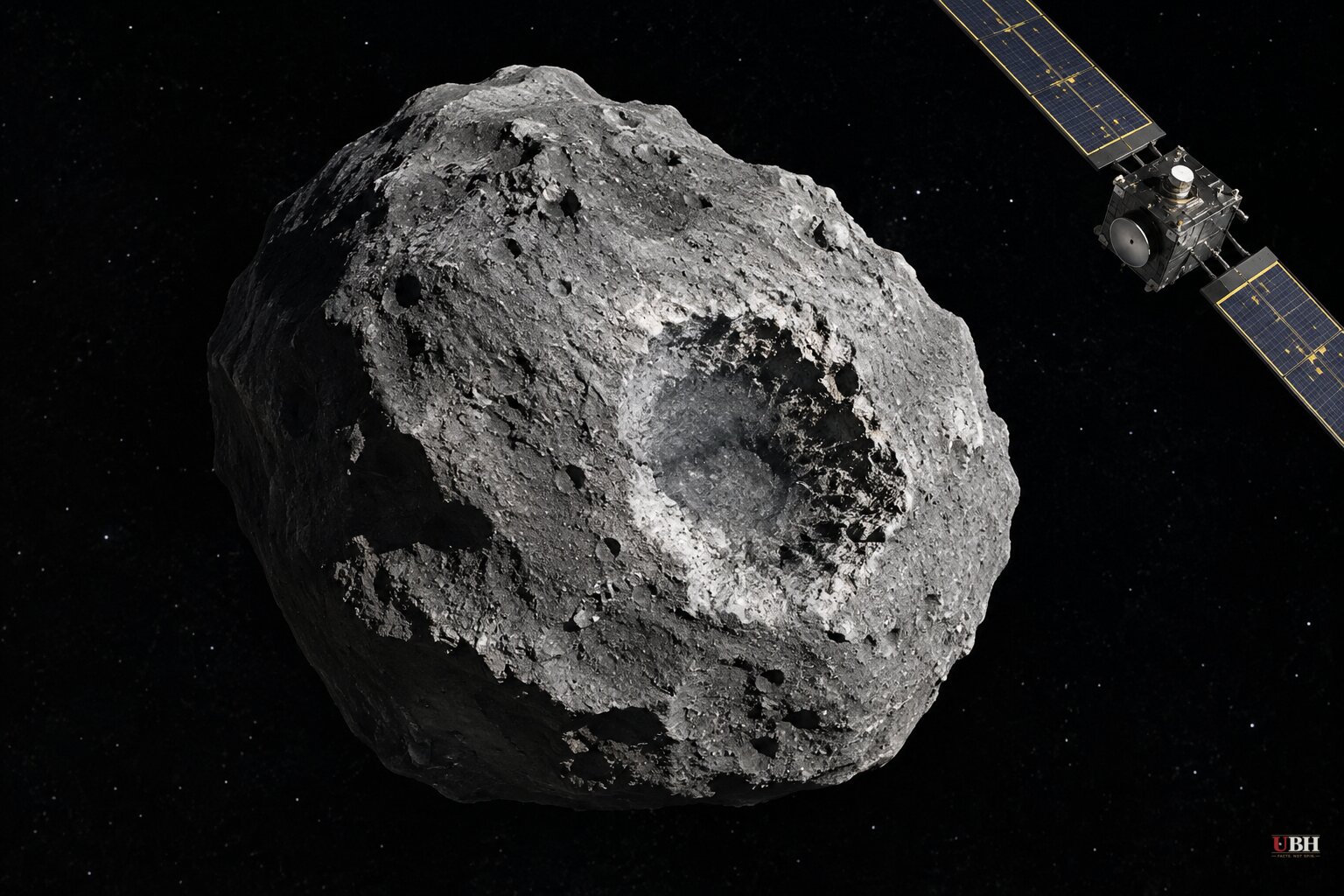
Four years after NASA slammed a spacecraft into an asteroid on purpose, the damage is now visible up close. The European Space Agency released the first images from its Hera probe on Wednesday, Nov. 25, and they show a crater roughly the size of a sports stadium.
The target was Dimorphos, a moonlet about 151 meters across that orbits a larger asteroid, Didymos, roughly 730 meters wide. Neither poses a threat to Earth. That was the point: it was a safe place to test whether a spacecraft could shove a space rock off its path.
What Hera found
The crater is not a small dent. "The face struck by DART has been flattened into an impact crater the size of a sports stadium, which extends across the asteroid's entire width," said Patrick Michel, Hera's principal investigator and a director of research at the CNRS Côte d'Azur observatory in France.
Michel said scientists had argued over whether Dimorphos had picked up a crater, changed shape, or stayed the same. "Much to our surprise, the answer turns out to be all three at once," he said.
Sabina Raducan, a planetary scientist on the Hera team, put it in plainer terms at a news briefing in Berlin. The crater is "almost as large as the body itself, which is really spectacular."
The rest of Dimorphos looks much as it did in DART's 2022 images, according to ESA. The boulder fields on its other regions appear unchanged.
A tumbling moonlet and a boulder swarm
The impact also changed how Dimorphos moves. Before DART, Raducan said, it behaved like our Moon and always showed the same face to Didymos.
Now it is moving chaotically. Raducan compared it to "a barrel that you throw down the stairs."
Hera also turned up something nobody predicted. "Another big surprise is that Hera is showing that the asteroids are surrounded by hundreds of orbiting boulders, just a few meters in size," said Michael Kueppers, ESA's Hera mission scientist.
The numbers behind DART
DART hit Dimorphos on Sept. 26, 2022, at more than 13,000 mph. The debris trail it threw off stretched about 6,200 miles and was visible from telescopes on Earth and in space.
Before the impact, Dimorphos took 11 hours and 55 minutes to circle Didymos. Afterward, ground-based telescopes showed that time had shrunk by about 33 minutes. NASA officials had said a change of 73 seconds or more would count as success.
So the deflection worked, and by a wide margin. What remained unknown was how the asteroid itself responded.
Why the mass matters
Hera launched on Oct. 7, 2024, and reached the pair earlier this month. It is surveying them from about 25 to 30 kilometers away. The ESA images were taken with Hera's Asteroid Framing Camera, its multi-spectral Hyperscout H and a Japanese-built thermal infrared imager.
A central goal is to weigh Dimorphos. Without its mass, scientists cannot say precisely how efficient DART's push was.
Prof. Simon Green, a planetary scientist on the Hera team, laid out the practical use. If a real threat appeared, he said, researchers could "measure its properties and say: 'Well, we need this mass of spacecraft, travelling at this speed, this early, in order to deflect it enough so that it misses the Earth.'"
Ian Carnelli, Hera's mission manager at ESA, framed the two missions as a pair. "NASA's DART mission demonstrated that we can change an asteroid's orbit," he said. "Hera is now revealing what happened to the asteroid itself." He added that combining them is "a decisive step towards making asteroid deflection a reliable tool for protecting our planet."
What comes next
ESA plans to move Hera closer to the asteroids in December for higher-resolution images of the impact site. In January, the spacecraft will release two shoebox-sized CubeSats.
Juventas, built by a Luxembourg-led team, will use radar to probe Dimorphos's interior and is expected to eventually land on the surface. Milani, built by an Italian-led team, will sample asteroid dust and surrounding material.
The open question is the mass number. Until Hera pins it down, the 33-minute shift is a single data point from one impact on one rubble-style target. Planners cannot yet say how large a spacecraft, at what speed and with how much warning, a real deflection would require.
Sources used for this briefing
7 links from 7 independent newsrooms (syndicated copies of the same report count once)
These are the sources it draws on, linked so you can verify.


