
Unbiased headlines. Facts, not spin.
Unbiased Headlines is an independently owned news organization. We bring you the facts, not opinions, written fresh from 110+ named sources. Sources linked so you can verify it yourself.
 defense
Major Story (7/10)
Event date: November 20, 2026 ·
Army Wants Helicopter Training Flights Near Reagan National Back as Soon as Dec. 1. FAA Says No Request Received
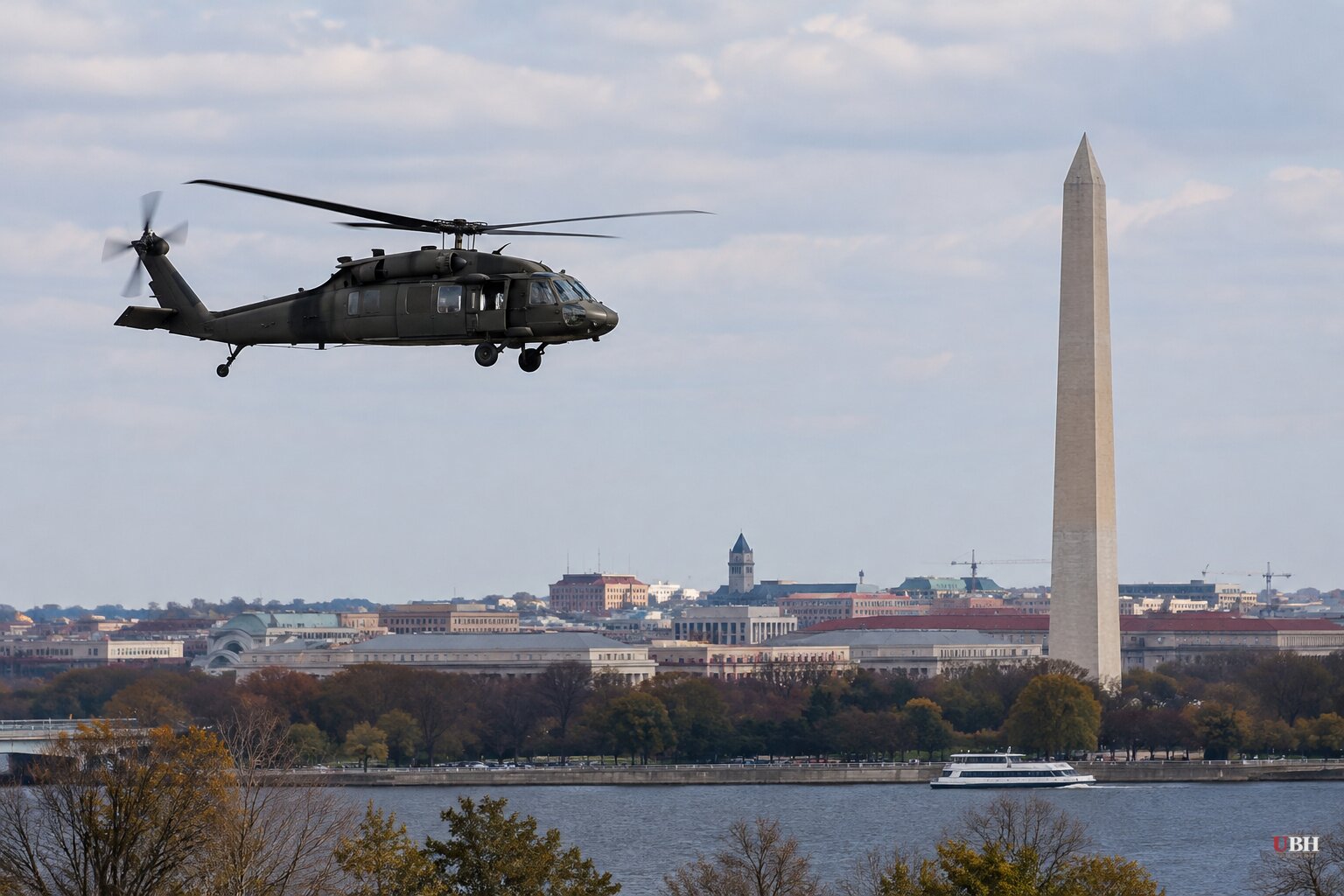
The U.S. Army wants to restart helicopter training flights near Ronald Reagan Washington National Airport, less than two years after an Army Black Hawk and an American Airlines regional jet collided there and killed 67 people.
NTSB Chair Jennifer Homendy has said the Army is aiming for as soon as Dec. 1, 2026. The Army has not confirmed a specific date. An Army spokesperson, who was not named, told Politico on Monday, Nov. 23, that "there is intent to resume flights," and acknowledged FAA approval would be required.
That approval has not been requested, the FAA says.
FAA: No formal request
An FAA spokesperson said the agency "has not received a formal request to resume military helicopter flights around Ronald Reagan Washington National Airport (DCA)." The spokesperson added: "Approval from the agency is required before any training in the area can restart."
Rep. Don Beyer, D-Va., whose district includes the airport, said Army officials briefed his office Monday. According to Beyer, the Army told his staff it has reached out to the FAA and is "awaiting a response." He said Army officials assured his office "that no flights will take place unless they are approved by the FAA."
Beyer said he has "grave concerns about the decision to resume training flights before the NTSB's safety recommendations have been fully implemented."
The two accounts do not line up neatly. The Army says it asked. The FAA says nothing formal has arrived. Neither has explained the gap.
Who was told
Politico reported, citing multiple people familiar with the matter, that the Army's initial outreach went only to the air traffic control tower at Reagan National. According to that reporting, it bypassed top federal aviation officials and any leadership-level safety review. The Army has not publicly responded to that description.
A Senate staffer who spoke anonymously said Army representatives met with some members of the Senate Armed Services Committee the day after crash victims' families lobbied on Capitol Hill for stronger safety rules. The Army asked for routes around the airport to be restored. Staff are still trying to determine whether the request covers Route 4.
Route 4 crossed the landing path the American Airlines jet was flying, and both the NTSB and the Army, in separate investigations, found that intersection to be a key factor in the crash.
What happened, and what changed
On Jan. 29, 2025, an Army UH-60L Black Hawk and a PSA Airlines CRJ700 operating as American Flight 5342 collided over the Potomac River on approach to Reagan National. All 64 people on the jet and all three soldiers on the helicopter died.
The NTSB found the FAA had placed Route 4 too close to the approach to Runway 33 and had failed to regularly review helicopter routes and safety data. Investigators also cited reliance on visual separation, ineffective visual separation by the helicopter crew, and a tower team under high workload. The board issued 50 safety recommendations.
The FAA permanently closed Route 4 between Hains Point and the Wilson Bridge in March 2025. In May 2025, it halted military helicopter training in the area after another Black Hawk flew so close to the airport that controllers had to reroute commercial flights. Two passenger jets aborted landings. All but the most critical helicopter flights have been banned since, and new rules keep helicopters and commercial jets out of the same airspace in certain areas near the airport.
An Army investigation report in May 2026 found that broken radio communications and instrumentation inaccuracies contributed to the crash. It did not assign individual responsibility.
Cantwell: wrong direction
Sen. Maria Cantwell, D-Wash., the top Democrat on the Senate Commerce Committee, said the FAA should not authorize a restart until safety measures are in place and a risk assessment is done. "Resuming Army helicopter training in crowded DCA airspace is exactly the wrong direction we should be headed," she said.
Beyer put it this way: "The path forward must prioritize safety."
The Army's position, as stated through its spokesperson and relayed by Beyer, is that it intends to resume flights only with FAA sign-off. No source provides the Army's stated reasons for wanting the routes back.
The legislation is stuck on the military
The timing collides with a congressional push. On Nov. 17, House Transportation Chairman Sam Graves, R-Mo., and Ranking Member Rick Larsen, D-Wash., joined Senate Commerce Chairman Ted Cruz, R-Texas, and Cantwell to announce an agreement in principle on civil aviation safety provisions.
The framework would require aircraft that must carry ADS-B Out, including helicopters, to also carry ADS-B In. That lets crews see nearby aircraft broadcasting their positions. The Air Line Pilots Association, led by Capt. Jason Ambrosi, welcomed the deal. "Pilots can't avoid what we can't see," Ambrosi said.
The Senate's ROTOR Act passed unanimously but fell one vote short of the two-thirds majority needed for expedited House passage in February. The House then passed its own ALERT Act in April. The two chambers are reconciling them.
Military provisions are still unsettled, with the House and Senate Armed Services committees involved. Cantwell warned against "a military loophole for routine or training operations in that immediate area." Sen. Jerry Moran, R-Kan., said at an aviation summit Nov. 19 that this "is not just a Reagan airport issue. It's an issue across the country." He added: "There has to be a better way of handling military aircraft than what we have seen at Reagan for a long time."
Cruz has said he is confident Congress can pass the bill before the 119th Congress ends in January.
Dec. 1 is five days away. The Army has not said whether a formal request has now gone to the FAA, and the agency has not said how it would rule. The FAA's decision, and whether the Armed Services committees close the military gap in the bill before the session ends, will determine whether Army helicopters return to the DCA corridor before the new rules exist.
Sources used for this briefing
6 links from 5 independent newsrooms (syndicated copies of the same report count once)
These are the sources it draws on, linked so you can verify.


