
Unbiased headlines. Facts, not spin.
Unbiased Headlines is an independently owned news organization. We bring you the facts, not opinions, written fresh from 110+ named sources. Sources linked so you can verify it yourself.
 defense
Notable (6/10)
Event date: November 23, 2026 ·
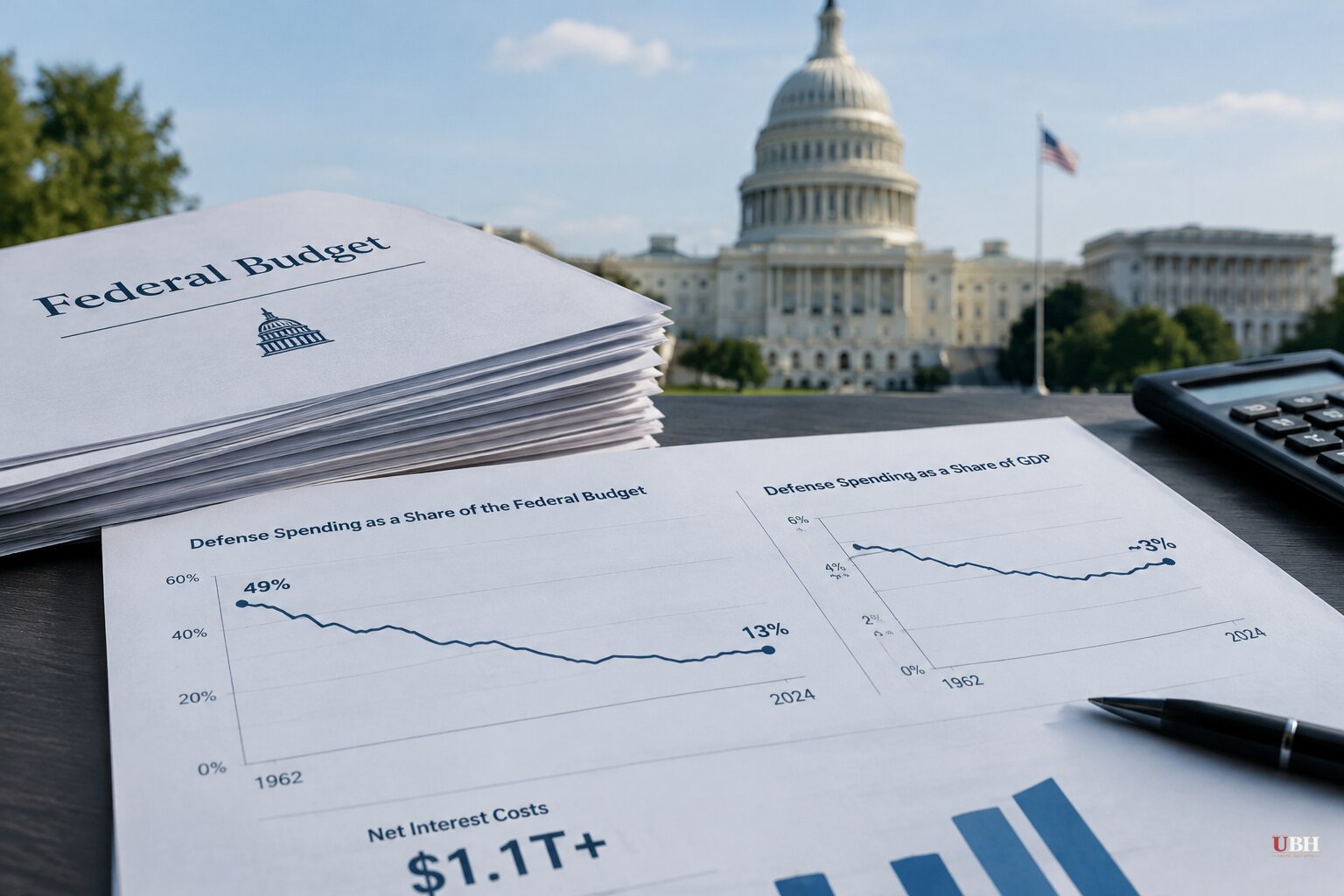
Defense Is 13% of the Federal Budget, Down From 49% in 1962, Brookings Says, as Net Interest Tops $1.1 Trillion
The Pentagon's slice of the federal pie keeps shrinking, and the numbers behind it are not close.
A Brookings Institution analysis by Jessica Riedl, titled "In a dangerous world, defense spending will be squeezed," finds that defense has dropped from roughly 49% of the federal budget in 1962 to 13% today. The analysis calls this "a dangerous moment" for U.S. defense spending to fall to its lowest level as a share of the economy since the 1930s.
The analysis puts defense at 2.8% of GDP in 2026 and expects it to hover around 3% through 2030.
The money is going somewhere else
The Congressional Budget Office's latest tally shows the U.S. spent $917 billion on defense in fiscal year 2026. That is up $48 billion, or 5.8%, from the year before.
Social Security, Medicare and Medicaid together cost nearly $3.5 trillion, up $217 billion, or 6.7%. The federal deficit came in at $1.9 trillion. Treasury data puts the national debt at $40.7 trillion.
Then there is interest. The CBO says Treasury paid $1.14 trillion in net interest on the public debt in FY2026, an increase of $114 billion, or 11.1%. That is more than the $917 billion spent on defense.
The Joint Economic Committee warned in an October report that interest payments could consume more than half of federal tax receipts by 2036. Committee chairman David Schweikert put it this way: under a higher-interest-rate scenario, "we could spend $23 trillion on interest alone over the next decade. That is spending not on Social Security, not on Medicare, not on national defense, but simply paying for yesterday's borrowing."
Brookings sees it getting worse
The Brookings projections run in one direction. The annual deficit is projected to climb from 6% of GDP to 14.2% over the next 30 years. Brookings says deficits of that size are not economically sustainable and that "something will have to give."
The current 6% deficit is already the largest in the Organization for Economic Co-operation and Development, Brookings says, and it is running despite relative peace and prosperity.
The retirement of 74 million baby boomers is set to push mandatory spending up another 2.4% of GDP over the next three decades, according to the analysis. Under a current-policy baseline, rising debt and interest rates are projected to add another 6.4% of GDP in interest costs.
Brookings also does not see an easy exit through entitlement reform. Any reduction in Social Security and Medicare benefits, the analysis says, "will likely face overwhelming bipartisan opposition" from voters and many lawmakers. Its advice to defense advocates is to "prepare to make the most of limited budgetary resources."
The threat side of the ledger
The pressure comes as China keeps building. Brookings notes the Biden administration's 2022 National Defense Strategy named China the "pacing challenge," yet defense spending has stayed near 3% of GDP since. A 2024 bipartisan commission found that "China is outpacing the United States and has largely negated the U.S. military advantage in the Western Pacific."
Brookings also points to the U.S. being at war in the Middle East, while Europe is mired in its deadliest land war since World War II.
A separate Maritime Executive analysis, written by David Vallance of the Lowy Institute, argues that U.S. military supremacy in Asia is over. It cites China's Type 55 cruisers at $850 million to $920 million each, against $2.7 billion for an Arleigh Burke-class destroyer. It also says the PLA's budget has grown by nearly 1,000% from 2000 to 2026.
The same analysis says the U.S. Department of Defense assessed in 2025 that the PLA intends to build six additional aircraft carriers by 2035, one every 20 months. By contrast, the second Ford-class carrier was laid down in 2015 and will be commissioned in 2027.
The Center for Strategic and International Studies estimates the PLA could launch its first nuclear-powered carrier, the Type 004, as early as next year. China also secured access to an airfield in Laos in October, its first such facility in Southeast Asia, according to the Maritime Executive analysis.
The counterpoint on spending totals
The raw dollar comparison still favors Washington. Even the Maritime Executive piece concedes that the U.S. spends nearly three times as much as China on its military and will still operate more aircraft carriers than China by 2035.
Its argument is about efficiency and geography: American security commitments are far more expansive, while China's short-to-medium-term focus is the Indo-Pacific. The analysis asks whether the U.S. could marshal all its available military power against China in a major regional conflict "without compromising its security interests elsewhere."
That is a question about how the money is spent as much as how much is spent. A military budget that grew $48 billion in a year is not a frozen one. A shipbuilding gap measured in cost per hull and years per carrier points at procurement, not just toplines.
What comes next
Brookings says the newly elected Congress controls the purse strings and faces difficult fiscal choices that will persist into the next presidential administration.
The near-term markers are concrete. The Type 004 could be launched as early as next year, and the second Ford-class carrier is scheduled to be commissioned in 2027. Whether the defense line grows faster than the $1.14 trillion interest line in the next budget is the open question Congress has yet to answer.
Sources used for this briefing
7 links from 5 independent newsrooms (syndicated copies of the same report count once)
These are the sources it draws on, linked so you can verify.


