
Unbiased headlines. Facts, not spin.
Unbiased Headlines is an independently owned news organization. We bring you the facts, not opinions, written fresh from 110+ named sources. Sources linked so you can verify it yourself.
 defense
Major Story (7/10)
Army Detonates 68 Drums of Lead Azide in Iowa; EPA Reports No Airborne Lead Detected, Soil Sampling Still to Come
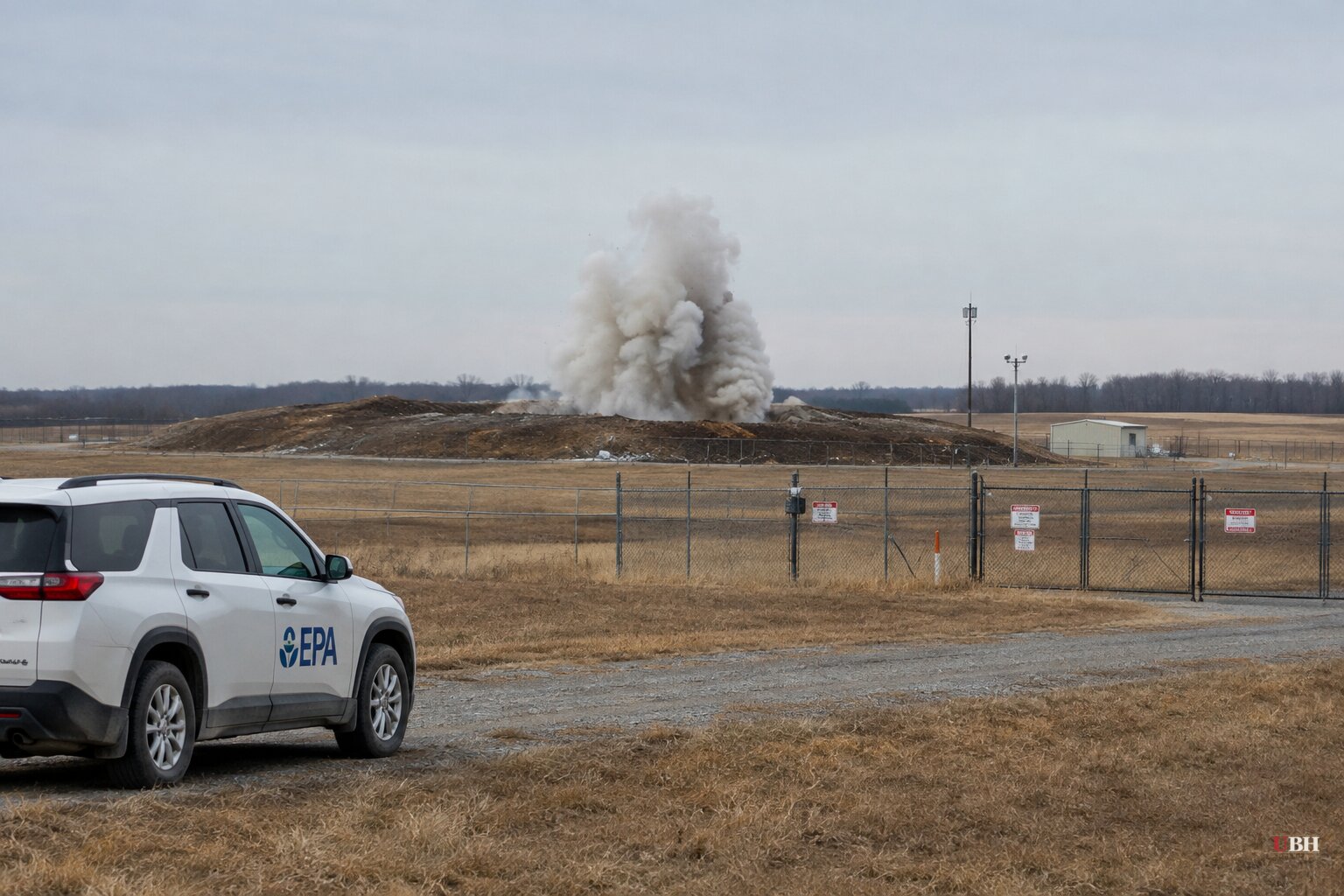
The Army carried out its planned detonation of 68 drums of degraded lead azide at the Iowa Army Ammunition Plant in Middletown at about 9 a.m. Central today, Nov. 25. The first official readings are in. Air monitors show no airborne lead. Soil and deposition results are not.
What officials are saying after the blast
The EPA, which approved the Army's permit, said its monitors were reporting "ZERO detection of airborne lead throughout the region." EPA Administrator Lee Zeldin told CNN the blast "caved inward perfectly" and that the Army's mitigation drove the force into the ground rather than the air.
Acting Army Secretary Adam Telle said the detonation "exceeded all expectations" and called it a "HUGE success." He added: "The threat of an uncontrolled spontaneous detonation has been eliminated."
President Trump said on social media that early reports showed the Army's mitigation efforts had "far exceeded expectations." He gave no further detail.
Iowa Gov. Kim Reynolds said initial feedback from state experts and federal partners was that the detonation was successful. She said state agencies would keep monitoring.
What happened on the ground
The material was blown up in two simultaneous detonations in earth-covered containers. A KWQC crew filming from Danville, about 4 miles north of the plant, captured two bursts of gray and white smoke that appeared to dissipate after roughly 30 seconds. Reporter Cyle Dickens said he felt the shock wave cross a farm field.
Linda Ross, who lives about a mile southwest of the site, described "two short boom boom sounds." She said her windows did not shake and she saw no plume. Still, she called it "unnerving" and said her household would stay inside.
Before the blast, the Army surrounded the containers with sand-and-lime fill, set up water cannons and misters, and covered the container tops with fire-suppressant foam. Federal officials also described two-story sand-filled barriers, water walls built from eight 16,000-gallon tanks, and gel blocks to absorb the blast.
The part that is not settled
Zero airborne detection is an early reading. It is not a soil result. The Army's own pre-blast modeling showed airborne lead traveling about 100 miles southwest of the plant and dust deposition covering roughly 200 square miles in that direction. That modeling suggested the plume would take several hours to disperse.
Independent experts have said it will take time to determine how much lead was deposited and what risks nearby communities face. Researchers and government workers collected air and soil samples before the blast to serve as baselines. The EPA is expected to conduct lead sampling in the affected area now that the detonation is done.
Lead does not break down in the environment. The EPA says exposure in children can cause brain and nervous system damage, learning and behavioral problems and lower IQ. In adults it can reduce kidney function and cause heart problems. In pregnant women it can raise the risk of early birth, low birth weight, miscarriage or stillbirth.
Iowa farmer Doug Seyb, interviewed by CBS News, said birth defects in livestock could signal toxicity in the weeks ahead. That is a farmer's concern about what to watch for. No such effects have been reported.
The Army's case, and its critics
The Army has said the choice was never detonation versus nothing. Assistant Secretary of the Army Jordan Gillis said the options were "a spontaneous, uncontrolled detonation of dangerous material or a controlled detonation where we could choose the time and place to optimize the conditions."
Telle said the Army consulted "every expert within the federal government and every expert we could find outside the federal government." Officials said chemical neutralization was ruled out because the drums had deteriorated rapidly over eight months, leaving crystallized lead azide on the outside of the barrels and lids. The Army's environmental assessment said neutralization would require handling the unstable containers for seven to 22 days with no guarantee of success.
A panel of federal appeals judges, which had initially stayed the Army's permit, ultimately let the plan proceed. The panel wrote that it was "mindful of the very real risks presented by the Army's planned detonation."
Critics focused on process as much as chemistry. Elected officials slammed the Army over communication failures before the blast. The Army has said it knew of the hazardous condition of the lead azide since March, but Iowans were largely unaware until last week. Environmental groups filed an emergency court challenge. Farmer and restaurant owner Mollie Engelhart wrote in a commentary that regulators punish microscopic contamination by private businesses while the government plans to blow up nearly five tons of lead azide near the Mississippi River.
The timeline
The detonation was first planned for Friday, Nov. 20, then pushed to Monday and Tuesday before landing on today. On Monday, Trump said he ordered the Army to hold off until the court lifted its stay and Governor-elect Rob Sand, a Democrat, signed off. The court cleared the Army this week. Reynolds had declared a disaster emergency in Des Moines, Lee and Van Buren counties.
Evacuations were recommended for Middletown and a 5-mile cone southwest of the plant. Soldiers went door to door Tuesday afternoon, and FEMA is providing short-term hotel lodging for evacuees through Friday. Evacuees are to be notified by phone when it is safe to return. Health officials in northeast Missouri advised residents 5 to 20 miles southwest of the plant to shelter indoors until an all-clear.
What comes next
The next key step is the EPA's post-blast lead sampling. Those results, compared against the baseline samples, will show whether any lead settled on farmland and homes southwest of the plant. The all-clear for evacuees and Missouri residents depends on them. Questions also remain about how the material reached what has been called a "catastrophically hazardous condition," which the Army has not yet fully answered.
Sources used for this briefing
8 links from 8 independent newsrooms (syndicated copies of the same report count once)
These are the sources it draws on, linked so you can verify.


