
Unbiased headlines. Facts, not spin.
Every story is an unbiased news briefing written from 110+ sources across the spectrum — sources linked so you can verify it yourself.
 energy
Major Story (7/10)
July 1, 2026 at 04:52 PM
energy
Major Story (7/10)
July 1, 2026 at 04:52 PM
PJM Grid Pushes Toward 2006 Demand Record as Heat Dome Holds Over Eastern U.S.
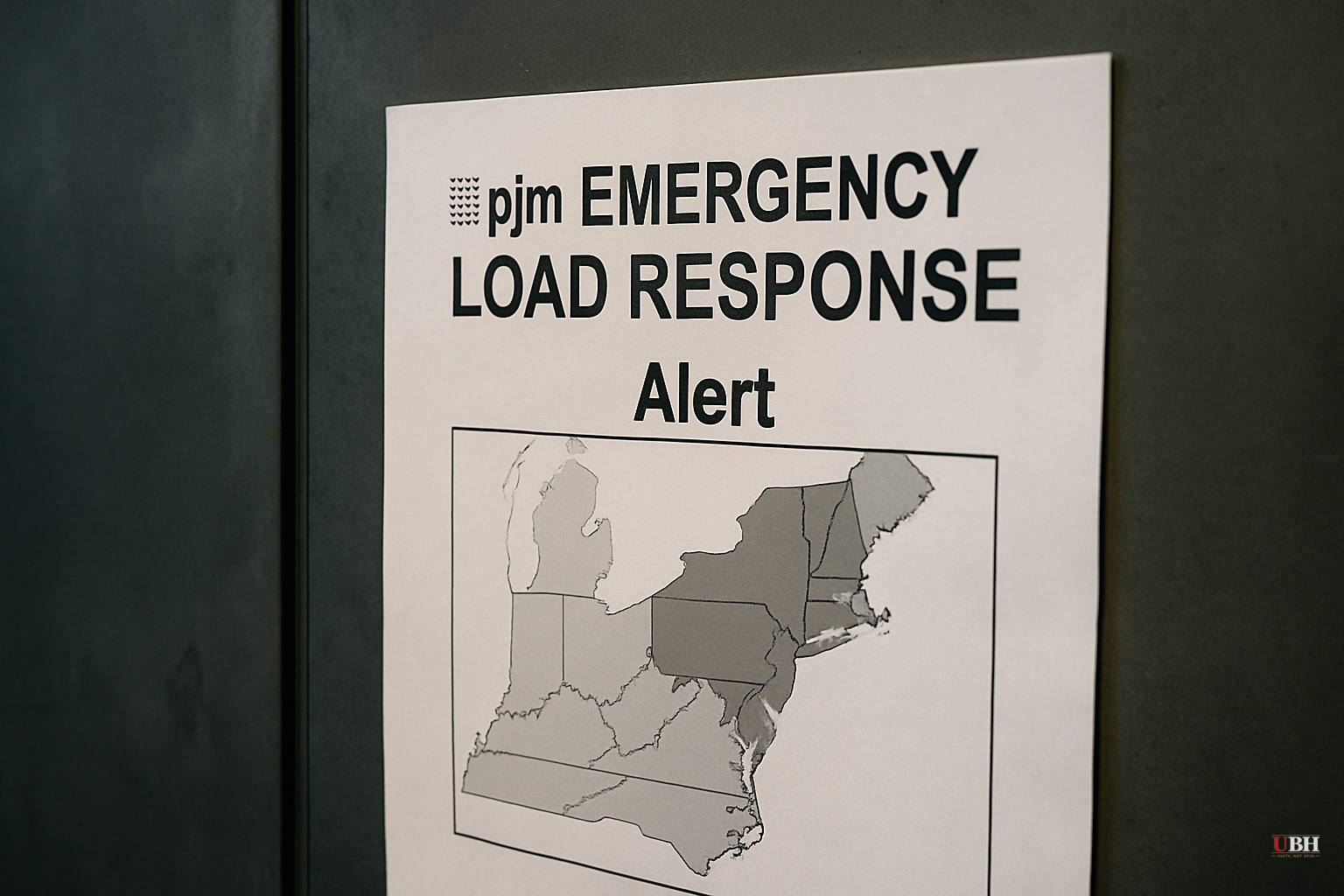
After the DOE issued two emergency orders directing PJM to dispatch specific generating units, the largest U.S. power grid has been running under a systemwide Hot Weather Alert through July 3.
What PJM Is Facing
PJM Interconnection serves 67 million people across 13 states and Washington, D.C. The grid operator's own forecast puts peak demand as high as 165 gigawatts on Thursday — a projection, not yet a recorded figure. The all-time PJM record is 165.563 GW, set in August 2006. Thursday's projected load would also exceed PJM's prior peak forecast for this entire summer.
Bloomberg's temperature forecast for the Washington, D.C., metro area has maximum readings pushing into the low triple digits Thursday through Saturday.
Natural gas, nuclear, and coal currently make up the dominant generation mix keeping the grid running. Renewables are present but not carrying the load during a sustained high-demand event like this.
The Emergency Framework
DOE's first emergency order directed PJM to dispatch specified generating units and operate them as needed to maintain reliability. A second order was also issued, requiring that PJM, working with transmission owners and electric distribution companies, use backup generation as a last resort before or during a Level 3 energy emergency — the grid equivalent of a five-alarm fire.
Rolling blackouts remain a risk, not a certainty. The emergency declarations are designed precisely to prevent that outcome by marshaling every available megawatt before demand peaks.
The Strongest Counterargument
Critics of fossil fuel reliance will note that natural gas and coal dominating the emergency generation mix is itself a contributing factor to the climate conditions driving more severe heat events. In a grid emergency measured in hours, the generating capacity that exists right now is what keeps hospitals and nursing homes online. Transitioning the grid faster is a legitimate policy debate. It does not change the operational reality on the ground this week.
Why the Mortality Numbers Matter Here
The European data published in the Lancet Countdown 2025 Report, cited by ZeroHedge via Statista, puts heat-related mortality in Europe at 5.5 deaths per 100,000 people per year between 2012 and 2021. That is almost double the annual rate observed in the prior period.
The Americas recorded 2.1 per 100,000 annually over the same period, lower than Europe but also trending upward. Asia-Pacific recorded 3.4 per 100,000 annually over the same period.
Europe's outsized numbers are partly structural. Temperate regions historically never built for heat: lower air conditioning penetration, older building stock, and less institutional knowledge of heat management. An aging population compounds the problem, since elderly people are disproportionately vulnerable to heat-related illness.
Hotter regions — Sub-Saharan Africa, North Africa, the Middle East, and South and Southeast Asia — actually see higher absolute rates (between 9 and 14 per 100,000 annually), but those rates have changed by at most 10 percent since the 1990s. Those populations have adapted, culturally and infrastructurally, to sustained heat in ways temperate regions have not.
The United States sits at a crossroads. Air conditioning penetration is high relative to Europe, which is a key reason American heat mortality numbers look better. But that protection is grid-dependent. A major blackout during a heat dome is not a minor inconvenience. It is a direct mortality event, concentrated among the elderly, the very young, and people without resources to leave or find cool shelter.
What Thursday's Forecast Actually Tests
If PJM demand reaches or exceeds 165.563 GW on Thursday, it will set a new all-time record for the largest power grid in the United States, nearly two decades after the previous one. If it falls short, the emergency infrastructure will have done its job.
PJM's Hot Weather Alert remains in effect through July 3. Whether backup generation gets dispatched under the Level 3 emergency threshold is the specific, unresolved question that will be answered before the week is out.
Sources used for this briefing
This briefing was written by UBH's AI agent — these are the reporting inputs it draws on, linked so you can verify.


