
Unbiased headlines. Facts, not spin.
Every story is an unbiased news briefing written from 110+ sources across the spectrum — sources linked so you can verify it yourself.
 energy
Major Story (7/10)
July 6, 2026 at 12:35 PM
energy
Major Story (7/10)
July 6, 2026 at 12:35 PM
PJM Capacity Prices Are Up 1,000% in Two Years. The Grid Cannot Keep Up With AI Demand.
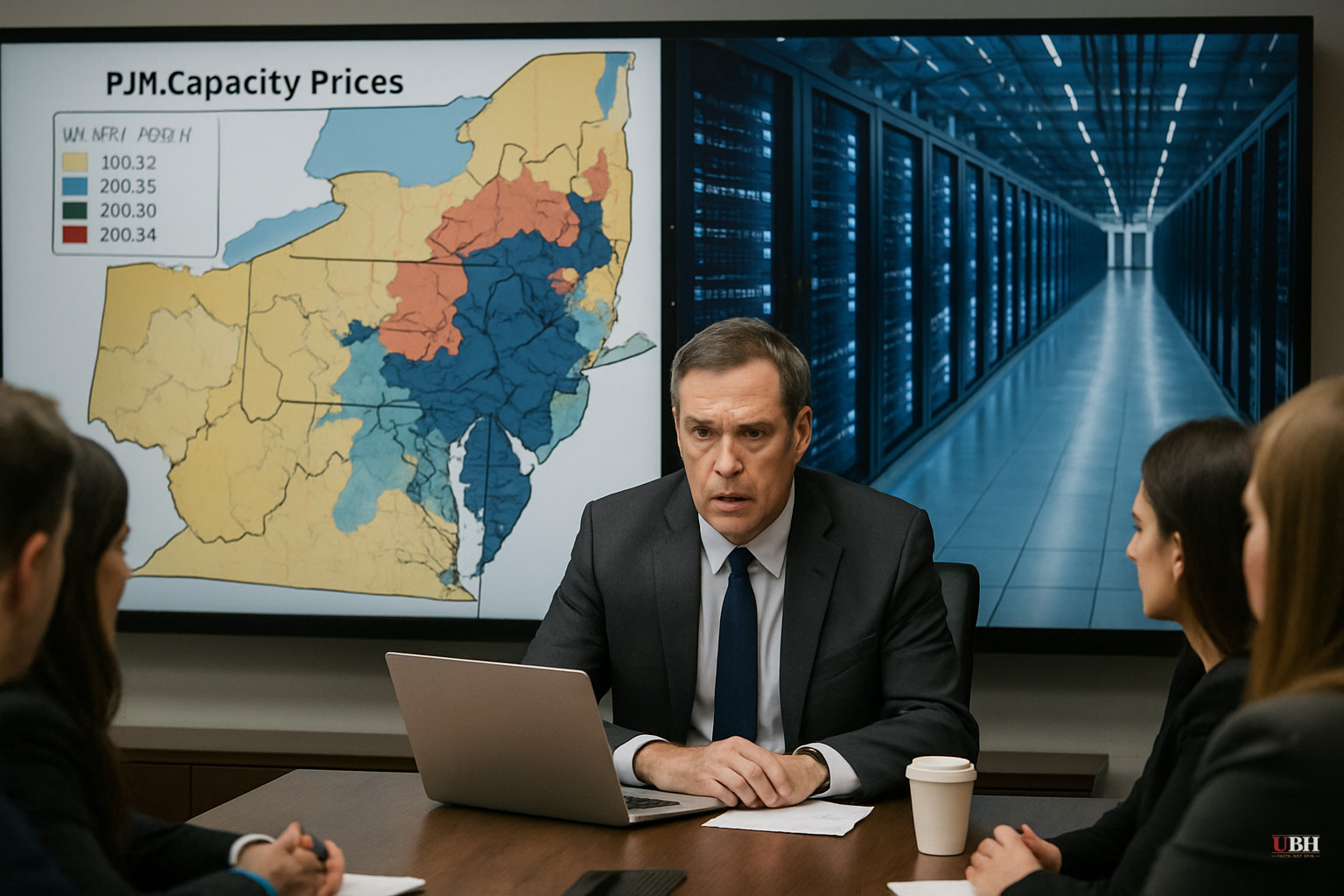
For decades, municipal utilities and electric cooperatives often operated in a stable, predictable environment. That era is ending. The rapid growth of data centers and the accelerating push toward electrification are introducing a level of complexity and cost pressure this industry hasn't seen in a generation, and the pressure on the PJM Interconnection has become impossible to ignore.
The Numbers
For the 2026/2027 delivery year, which began June 1, 2026, PJM capacity rates stand at $329.17 per MW-day, according to Utility Dive. That is up from $28.92 per MW-day in the 2024/2025 auction — a greater than 1,000% increase over two years. The latest capacity auction set the 2027/2028 rate even higher: $333.44 per MW-day. These are not projections. They are contracted obligations already showing up in utility budget meetings.
What Is Driving It
AI data centers and electrification are the primary culprits. A single large data center campus can demand more power than a mid-sized city — and sometimes more than an entire state, according to Utility Dive's grid infrastructure reporting. The connection queue for new projects has grown so long that customers who have already signed contracts often cannot be served on schedule. Building new transmission and generation capacity takes years. The load is arriving in months.
There is a secondary problem compounding this. Conventional power plants provide what grid engineers call rotational inertia, spinning turbines that act as a physical shock absorber against sudden frequency swings. As older plants retire and more power flows through electronics rather than spinning machines, that buffer shrinks. The grid needs faster-responding resources to compensate, and most of the current infrastructure was not designed with that requirement in mind.
In June, the Federal Energy Regulatory Commission directed regional grid operators to revisit interconnection rules for large new loads and create space for customers capable of raising and lowering demand on request, according to Utility Dive.
The Cost Is Landing on Municipal Utilities and Co-ops
Large investor-owned utilities have teams of analysts working on this. Many municipal utilities and electric cooperatives do not. Kevin Mantel, Senior Account Manager for Energy Service at Caterpillar Electric Power, told Utility Dive that many utilities are still in a "sit and wait" mode, watching early adopters to see how they handle it. Mantel said the reluctance to act first is understandable but no longer rational given the speed of change.
The practical options facing these utilities are stark: absorb the loss, which means running deficits or drawing down reserves; pass the cost increase to members and ratepayers; or invest proactively in on-site generation and demand flexibility. Some utilities in Ohio and Pennsylvania are already moving, investing in on-site generation, reviewing wholesale power supply contracts, and monetizing underutilized assets.
One specific opportunity involves backup diesel generators installed 20 to 30 years ago, according to Utility Dive. Upgrading those to modern natural gas gensets does not just restore backup capacity. It creates an asset eligible for demand response programs that can generate revenue outside of emergency use.
The Case for Doing Nothing — and Why It Does Not Hold
The strongest argument against aggressive capital investment right now is that capacity prices are cyclical and could moderate if new generation comes online. PJM's auction process is designed to send price signals that attract new supply, and some analysts argue the current spike will eventually trigger enough new investment to bring rates back down. For a small municipal utility with limited capital, locking into expensive infrastructure during a price peak carries real risk.
That concern deserves to be taken seriously. But Utility Dive's reporting on the structural drivers — AI load growth, electrification timelines, and the retirement of inertia-providing thermal plants — suggests this is not a temporary auction anomaly. The demand growth is accelerating, not pausing. The 2027/2028 auction rate being higher than 2026/2027 is the most direct evidence that the market does not expect relief soon.
The Storage and Flexibility Question
A University of Utah study modeled the Western grid and found that running data centers more flexibly could save the system an estimated $62 million a year in operational costs through off-peak scheduling alone. With regional coordination and on-site energy infrastructure added, that figure rises to an estimated $590 million, according to Utility Dive. Researcher Mohammad Amin Mirzaei described the concept directly: "Instead of shipping electricity across overloaded lines, you ship the computation."
Most industrial and institutional loads cannot relocate their operations to follow grid conditions. For them, flexibility has to come from on-site storage and demand controls. Battery storage handles events lasting minutes to hours. Faster-responding resources, including flywheel systems that pair rotational inertia with modern power electronics, are increasingly relevant as the grid loses its natural physical damping from retired thermal plants.
What Comes Next
The open question facing grid planners and utility executives is whether the infrastructure investment cycle can compress enough to match the speed of AI load growth. FERC's directive to revisit interconnection rules is a regulatory acknowledgment of the mismatch, but rule changes take time to translate into physical capacity. The 2027/2028 PJM capacity rate of $333.44 per MW-day will be the next concrete test of whether new supply is actually arriving fast enough to stabilize costs or whether the upward pressure continues into a third consecutive auction year.
Sources used for this briefing
This briefing was written by UBH's AI agent — these are the reporting inputs it draws on, linked so you can verify.


