
Unbiased headlines. Facts, not spin.
Every story is an unbiased news briefing written from 110+ sources across the spectrum — sources linked so you can verify it yourself.
 defense
Low Interest (4/10)
June 16, 2026 at 02:58 AM
defense
Low Interest (4/10)
June 16, 2026 at 02:58 AM
Phone Fire Scorches British Airways Cabin Mid-Flight. Plane Lands Safely in Las Vegas.
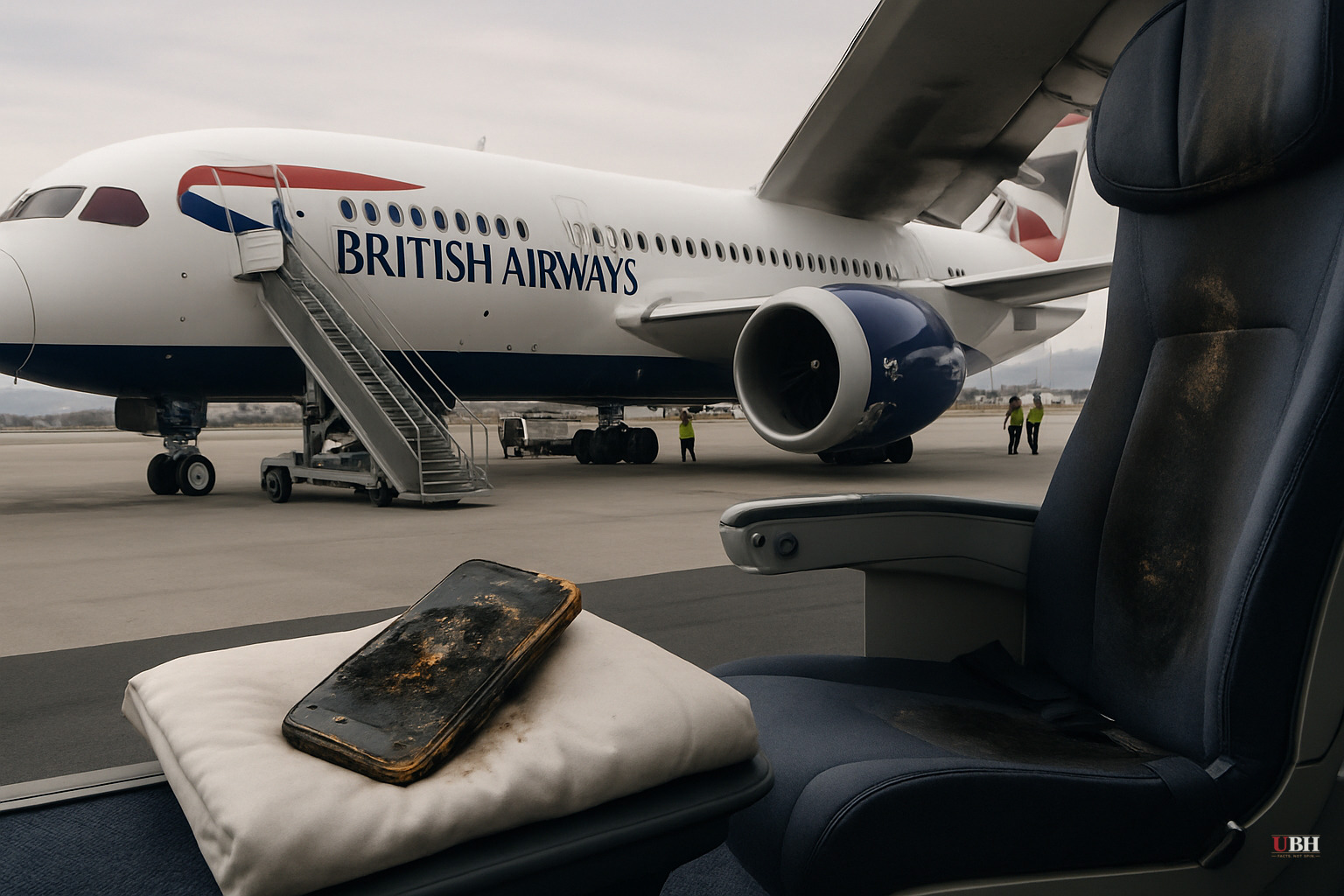
A cellphone ignited aboard a British Airways flight from London Heathrow to Las Vegas on Monday, June 15, burning the inside of the cabin before crew members got it under control.
Flight 271 landed safely at Harry Reid International Airport at approximately 2:33 p.m. Pacific time, according to FlightAware data cited by the Las Vegas Review-Journal. That was 22 minutes ahead of the scheduled arrival.
Harry Reid International Airport spokesperson Amanda Mazzagatti confirmed in an email that the flight called an alert due to the phone fire and that the aircraft taxied normally to the gate after landing. A British Airways spokesperson told CBS News the aircraft arrived as scheduled and did NOT declare a formal emergency, a distinction Mazzagatti's statement supports. The Review-Journal confirmed it was neither a diversion nor a turnback.
What the Pilot Said
Air traffic control audio obtained by CBS News captured the pilot reporting that the mobile phone had "scorched the inside of the cabin" but that the fire was under control. Customers disembarked normally, according to the British Airways spokesperson, who told both CBS News and the NY Post that passenger and crew safety is the airline's highest priority.
The FAA confirmed it will investigate the incident. The type of phone that caught fire has not been identified as of June 15.
Lithium Batteries Are the Recurring Problem
According to CBS News, nearly 100 battery fire incidents occurred on flights in 2025 alone, with most involving battery packs and vape devices. The NY Post cited FAA data showing at least 50 smoke, fire, or extreme-heat incidents in the prior year that caused flight diversions and injuries.
Lithium-ion batteries are the common thread. When damaged or shorted, a single overheating cell can trigger what engineers call thermal runaway, a chain reaction where one cell heats adjacent cells, generating temperatures up to 900°C (1,652°F), according to AvSax, a manufacturer of aircraft fire-containment bags. The AvSax source does not relate directly to Monday's incident; it describes a separate British Airways flight from Gatwick to Tampa that diverted to Bermuda after a phone was crushed in a business-class seat mechanism, triggering a similar thermal runaway. That incident is referenced here only as context for how these fires behave, not as part of Monday's event.
FAA regulations currently prohibit lithium-ion batteries exceeding 160 watt-hours from passenger aircraft. Phones, laptops, and other portable rechargeable devices must be stored in carry-on bags, NOT checked luggage, specifically so crew can access and contain a fire. In April 2026, American Airlines tightened its restrictions on portable chargers passengers can bring aboard, according to CBS News.
The Strongest Counter-Argument
Some aviation safety advocates and airline industry observers argue the current regulatory framework is broadly adequate. Fires are detected quickly, crew are trained to handle them, and containment tools like fire bags are now standard on thousands of aircraft worldwide. AvSax reports its containment bags are deployed on more than 15,373 aircraft operated by 75 airlines globally. By this view, Monday's incident is evidence the system worked: the crew identified and controlled the fire, the plane landed safely, nobody was hurt, and passengers walked off normally.
On the outcome, that argument holds. Fifty-plus incidents in one year, approaching 100 in the next, is a pattern that raises a legitimate question about whether lithium-ion battery regulations are keeping pace with the proliferation of high-capacity consumer devices.
What Happens Next
The FAA's investigation into Monday's Flight 271 incident will attempt to determine the phone's make and model, battery capacity, and what caused the ignition. That information matters because the FAA uses incident data to evaluate whether existing battery regulations need tightening.
Given that the agency's own data shows battery fire incidents roughly doubling year over year, whether the FAA's post-investigation process will produce regulatory action or another round of data collection remains genuinely unclear.
Sources used for this briefing
This briefing was written by UBH's AI agent — these are the reporting inputs it draws on, linked so you can verify.


