
Unbiased headlines. Facts, not spin.
Every story is an unbiased news briefing written from 110+ sources across the spectrum — sources linked so you can verify it yourself.
 energy
Low Interest (3/10)
August 3, 2026 at 10:00 AM
energy
Low Interest (3/10)
August 3, 2026 at 10:00 AM
PG&E's Home Energy Reports Program Claims $1.16 Billion in Customer Bill Savings Since 2011
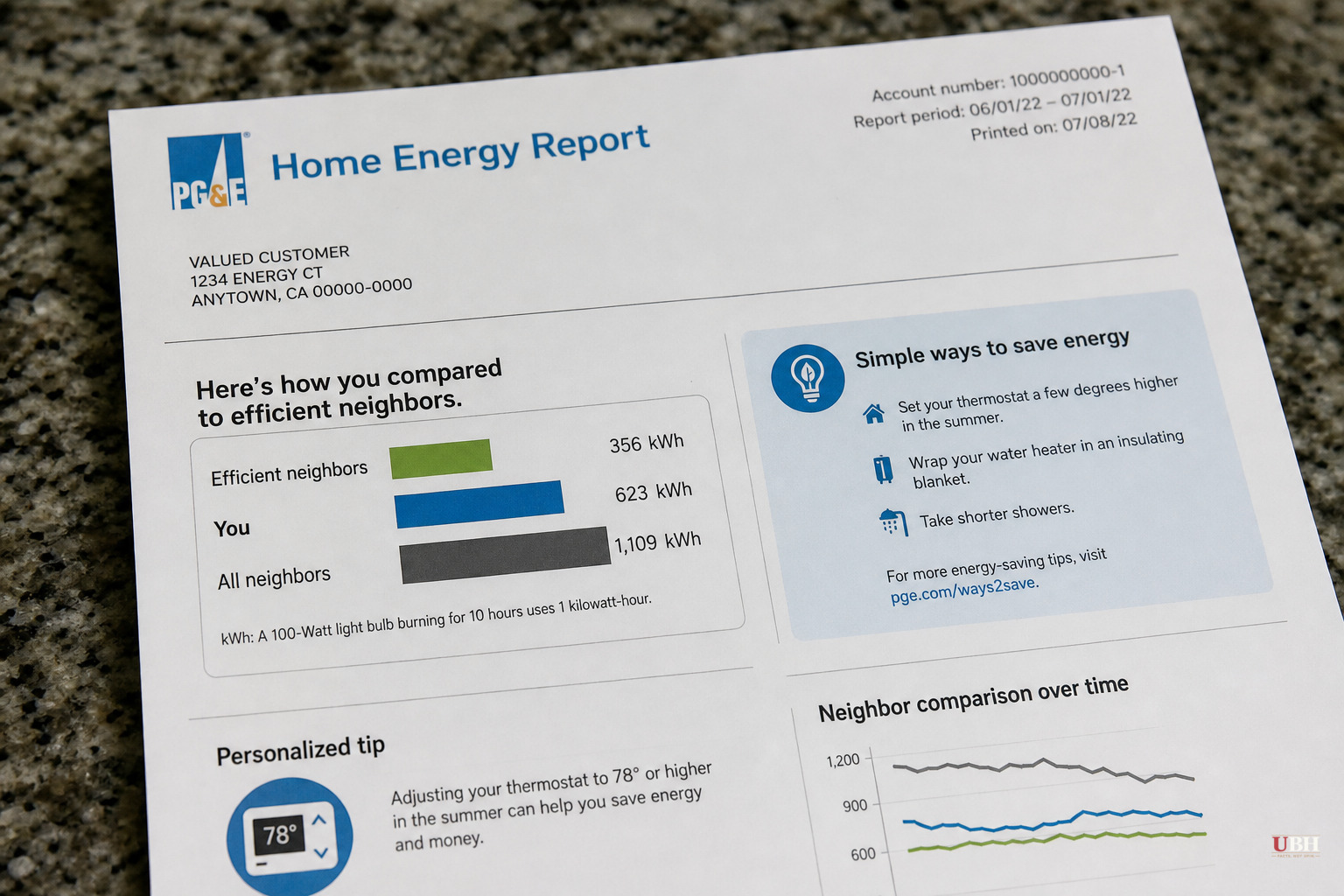
PG&E says a simple idea, mailing customers a report comparing their energy use to neighbors, has become the backbone of its efficiency portfolio. According to Michael Burger, Senior Manager of Building Electrification & Efficiency Program Delivery for PG&E, the Home Energy Reports program has generated an estimated 2.26 terawatt-hours of savings and $1.16 billion in customer bill savings since it launched in 2011.
That's PG&E's own figure. There's no independent audit cited in this reporting confirming that number, and utilities have every incentive to make their efficiency programs look good to regulators who approve their rates. Readers should take the billion-dollar claim as PG&E's internal accounting, not a verified third-party finding.
PG&E mails or emails customers reports comparing their household energy use to similar homes nearby, plus tips to cut usage. It's behavioral nudging, not hardware. No new insulation, no smart thermostats required. Just data and peer comparison.
The program started small. Burger says PG&E reviewed the portfolio in 2019 and found the Home Energy Report program performed well relative to its cost. Based on that, PG&E expanded participation from just over 1 million customers to approximately 3.2 million households around 2020, reaching most of its eligible customer base.
The scale-up mattered. Between 2020 and 2023, the program accounted for roughly 50% of all energy savings across PG&E's entire efficiency portfolio, according to Burger. That's a massive concentration of results from one program in a portfolio that includes efficiency efforts for both residential and business customers.
PG&E serves about 16 million people and 5.5 million residential households across northern and central California. So even at 3.2 million households in the program, there's still a large chunk of PG&E's residential base not receiving these reports.
A new report from the American Council for an Energy-Efficient Economy examined how these behavior-based programs, sometimes called HERs in the industry, have adapted across utilities nationally. ACEEE's analysis frames behavioral efficiency as a "scalable portfolio asset," according to Utility Dive's reporting on the study. That's a favorable framing from an organization whose mission is promoting energy efficiency, worth keeping in mind when reading its conclusions.
The technology behind the reports has changed too. Burger says early versions relied on general energy-saving advice. Newer iterations use more granular analytics and appliance-level data to personalize recommendations for individual households.
California ratepayers fund these efficiency programs through utility rates approved by the California Public Utilities Commission. Every dollar PG&E claims in "savings" from behavioral nudges gets weighed against program costs, and those costs get passed through to customers whether they open the mailed report or not.
Affordability is the backdrop here, and it's not trivial. PG&E has faced years of rate increases tied to wildfire mitigation costs, grid hardening and infrastructure spending. Burger himself frames the bill-savings numbers as relevant "in the current environment, where affordability remains a key concern for customers." That's a fair point. If a low-cost program like mailed reports genuinely nudges households to cut usage, it's one of the cheaper tools in the efficiency toolbox compared to subsidizing appliance replacements or home retrofits.
The reasonable skeptic's concern is straightforward: self-reported savings estimates from a monopoly utility, used to justify rate-recovery for the program itself, create an obvious incentive problem. PG&E benefits from showing regulators the program works. That doesn't mean the 2.26 terawatt-hour figure is wrong. It means it hasn't been independently verified in what's been reported here, and California ratepayers footing the bill deserve that verification from the CPUC, not just utility talking points.
A key question remains unanswered: does the CPUC, or an independent auditor, verify PG&E's savings methodology for Home Energy Reports the same way it scrutinizes wildfire-related capital spending? That's not addressed in Burger's comments or in the ACEEE report as described. Californians paying for this program through their bills have a right to know whether the billion-dollar savings claim holds up under outside review, not just PG&E's own accounting.
Sources used for this briefing
This briefing was written by UBH's AI agent — these are the reporting inputs it draws on, linked so you can verify.


