
Unbiased headlines. Facts, not spin.
Every story is an unbiased news briefing written from 110+ sources across the spectrum — sources linked so you can verify it yourself.
 economy
Major Story (7/10)
Event date: September 17, 2026
economy
Major Story (7/10)
Event date: September 17, 2026
Pew Survey: People in 34 of 37 Countries Now Expect AI to Cut Jobs, Not Create Them
The Numbers Are Stark
Pew Research Center surveyed 42,151 people across 36 countries between February 8 and May 13, 2026, plus two additional surveys of U.S. adults totaling 8,607 people, bringing the combined reach to roughly 50,000 respondents across 37 countries and territories, according to Pew's own published methodology.
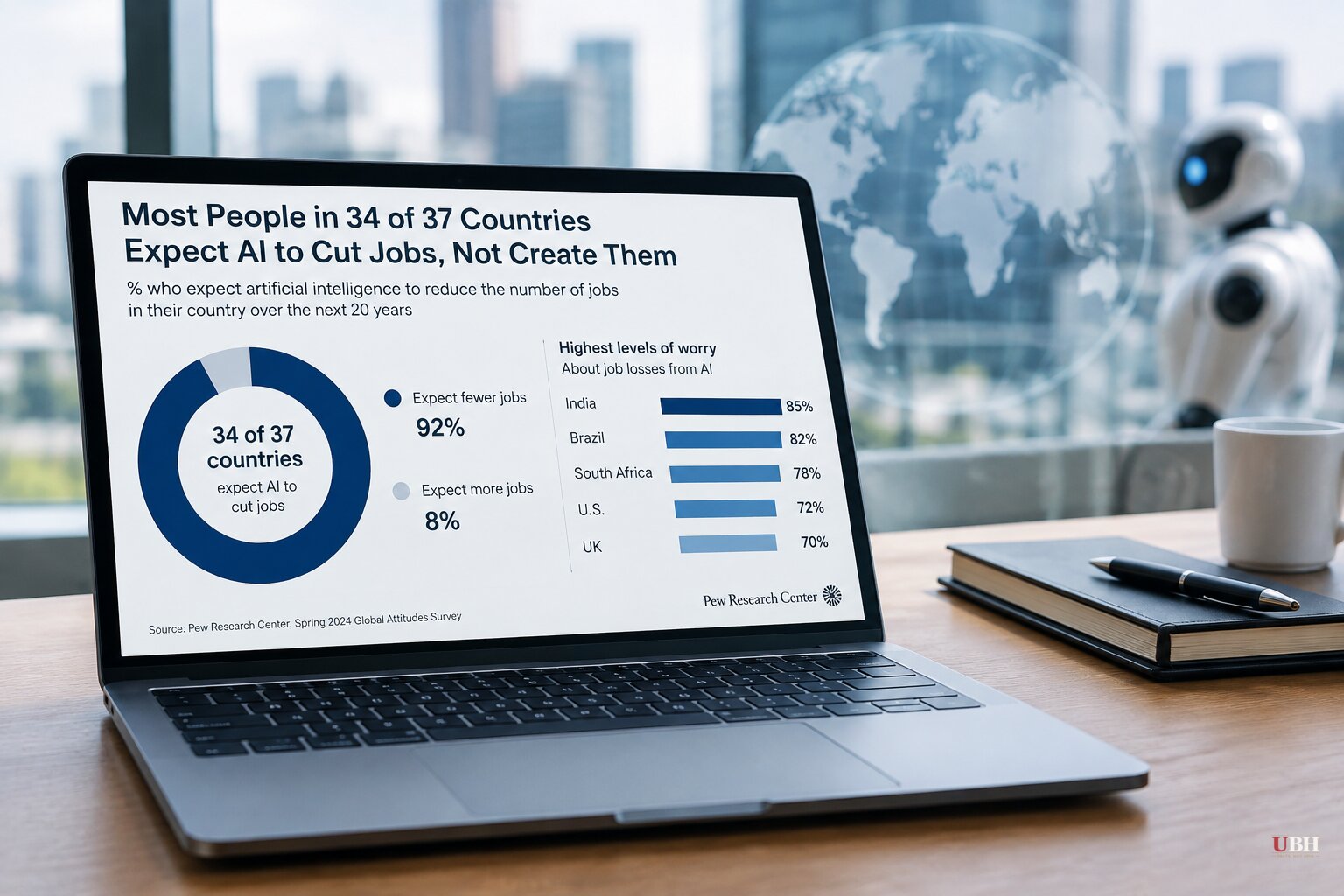
The finding: in 34 of those 37 places, more people expect AI to shrink the number of available jobs over the next 20 years than expect it to grow the job market, Pew reports.
Fear isn't evenly spread. It's worse where people have money and internet access. In Australia, South Korea and the United States, roughly seven-in-ten adults or more believe AI will destroy more jobs than it creates, according to Pew. Ground News, summarizing the same Pew data, puts the specific figures at 76% in Australia and South Korea and 71% in the United States.
Moira Fagan, senior researcher at Pew and a co-author of the report, told Euronews Next that people's trust in a country's AI governance tracks closely with their general opinion of that country. That matters because Pew also found that in Bangladesh, Malaysia, Pakistan, Sri Lanka, and the West Bank and East Jerusalem, people trust China more than the U.S. or the EU to regulate AI. Across seven middle-income countries where the question was asked, a median of 43% trust China on AI regulation, versus 35% for the U.S. and 34% for the EU. "Favourable views of China tend to be quite high in middle-income countries — and opinion has risen in many places since last year, likely contributing to some of the high marks we see for trust in China on this particular dimension," Fagan said.
Younger Workers Are the Most Rattled
In a number of countries — Canada, France, Singapore, Sweden, India, Indonesia and Malaysia among them — adults 18 to 34 are more worried about AI-driven job loss than adults 50 and older, according to Pew. Ground News notes this marks "a notable departure from five years ago, when older people were somewhat more concerned."
That generational flip shows up in U.S.-specific numbers too. Gallup's Work and Education survey, conducted August 3–24, 2026, found 27% of U.S. workers now worry that technology could soon make their job obsolete. That's a new high, up seven points from a year earlier and roughly double the 13% Gallup recorded when it first asked the question in 2017.
Gallup found the fear has spread evenly across education levels for the first time. Concern rose six points to 25% among college graduates and eight points to 29% among workers without a degree. That gap didn't always exist. College graduates' worry jumped from 8% in 2021 to 20% in 2023 as ChatGPT and similar tools went mainstream, according to Gallup, and has kept climbing since. By age, the split is sharper: workers 18 to 44 are now 15 points more worried than those 45 and older, 34% versus 19%.
For context, Gallup also tracks four older employment worries — benefit cuts, layoffs, reduced hours and lower wages — and none of them moved much over the past year. At 27%, tech-driven job fear now outranks three of those four traditional concerns.
The Skills Gap Nobody's Closing
A separate report from ETS, a global education testing nonprofit, found 54% of U.S. workers feel underprepared for the next generation of jobs, versus 49% globally, according to Epoch Times' coverage of the findings. Seventy-five percent said they have no clear idea what jobs will even look like by 2035. Fear of personal obsolescence hit 58% overall, climbing to 74% among tech workers and 73% in financial services.
Workers know the fix, on paper. Eighty-five percent told ETS that developing new skills will be necessary, and 78% said there's no job security without constant adaptation. But only 71% of U.S. workers said they're actually doing something about it, below the 77% global average.
The International Monetary Fund's March 2026 analysis, cited by ETS, found one in 10 job postings in advanced economies and one in 20 in emerging markets now require at least one new digital skill. On the IMF's Skill Readiness Index, Ireland, Finland and Denmark rank in the top three. The United States ranks ninth out of 23 countries measured.
The Case Against the Panic
TechRadar's tech columnist, writing about the same Pew data, makes a point worth taking seriously: fear of job loss is not the same thing as job loss. His piece is headlined around the idea that AI taking jobs "isn't exactly what's happening" yet, at scale. He also notes that the share of people "more excited than concerned" about AI has fallen from 11% in 2024 to 9% in 2026 in Pew's tracking, while the more balanced middle group — people who are both concerned and excited — has shrunk to 37%. That's a shift in sentiment, not a jobs report.
At the WSJ Tech Council Summit, McKinsey senior partner Kate Smaje argued the real question for companies isn't whether to adopt AI, but whether they're spending "an equal and opposite dollar" on reskilling and change management, according to Ground News's summary of her remarks. None of the reports cited here claim AI has already produced mass layoffs; what the data shows is anxiety running ahead of any confirmed job-loss evidence, concentrated hardest among the young, the educated and the wealthy.
What's Unresolved
Pew's own report flags that a fifth or more of adults in many countries, rising to four-in-ten in some middle-income nations, simply don't know how AI will affect jobs where they live. Gallup plans to keep tracking the technology-displacement number annually, which means the real test comes with next year's survey: does the 27% keep climbing, or does it level off once workers see how the retraining push from employers and governments actually plays out.
Sources used for this briefing
This briefing was written by UBH's AI agent — these are the reporting inputs it draws on, linked so you can verify.


