
Unbiased headlines. Facts, not spin.
Every story is an unbiased news briefing written from 110+ sources across the spectrum — sources linked so you can verify it yourself.
 economy
Notable (6/10)
Event date: September 9, 2026
economy
Notable (6/10)
Event date: September 9, 2026
McClatchy Slashes 90+ Newsroom Jobs Nationwide, Guts Sacramento Bee and Miami Herald
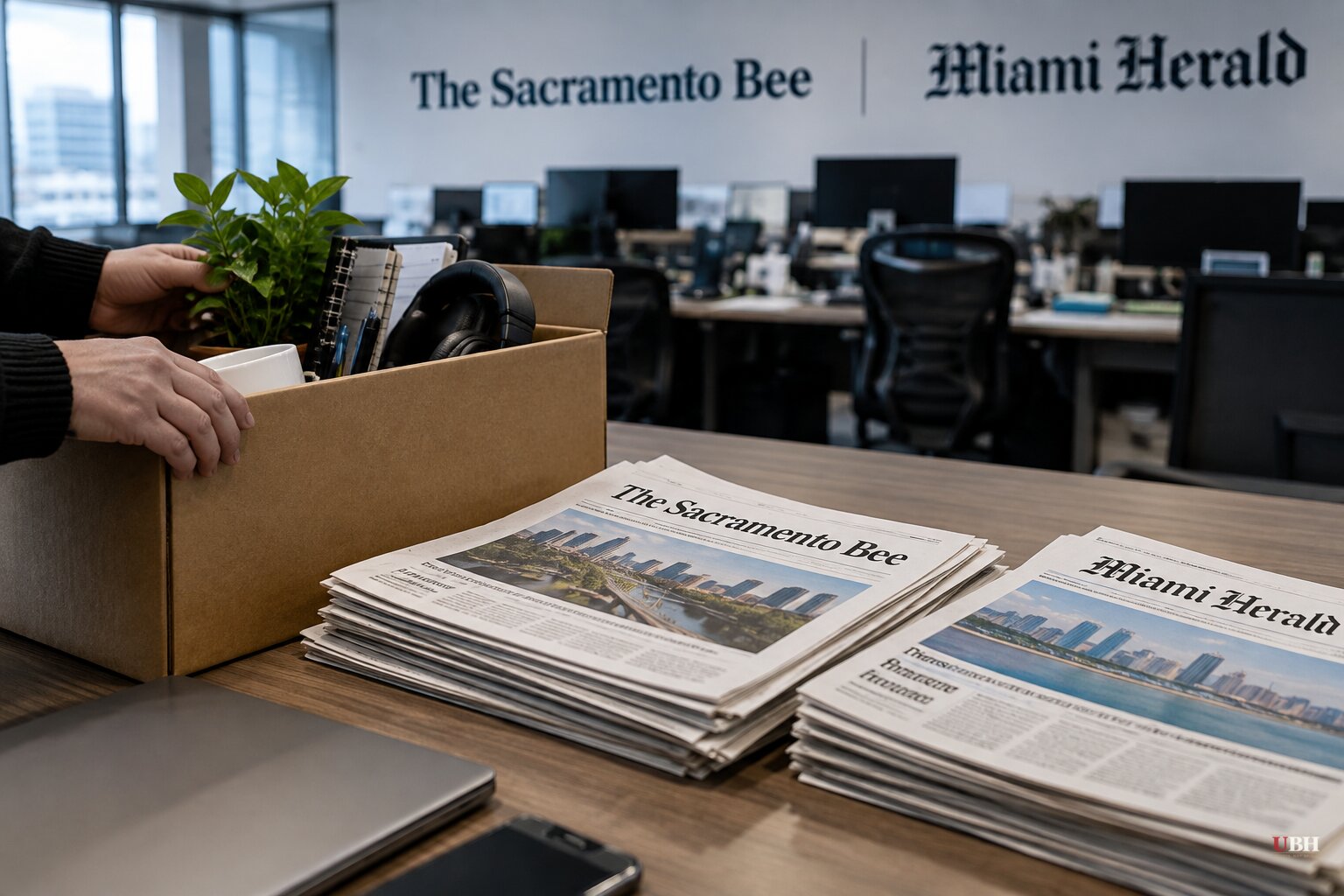
McClatchy, the newspaper chain that traces back to California's Gold Rush, laid off more than 90 union journalists across at least 13 papers in eight states earlier this month, according to estimates from the unions representing those workers cited by Poynter. Some newsrooms lost upwards of 40% of their staff in a single day.
The cuts hit the company's California papers hard. The Sacramento Bee eliminated its entire sports department, including 38-year veteran high school sports reporter Joe Davidson, Sacramento Kings beat writer Jason Anderson, and senior reporter Chris Biderman, according to SFGate. The Bee's entire opinion section was also cut, save for the editor, wiping out Pulitzer Prize-winning columnist Tom Phillip, opinion writer Robin Epley, op-eds editor Hannah Holzer, and 24-year veteran Cathie Anderson, according to CapRadio. Investigative reporter Joe Rubin, who broke stories on alleged bribery attempts tied to local elections, was also let go. In total, the Bee lost between 10 and 13 people, according to CapRadio and Poynter.
The Fresno Bee cut seven journalists, including multiple accountability reporters and the last remaining employee of its bilingual publication, Vida en el Valle, according to Poynter and SFGate. The Modesto Bee laid off three of its 12-person newsroom, according to Poynter and the LA Times.
The Miami Herald took the biggest hit. Poynter reported 20 layoffs plus 10 eliminated vacant positions, while a report from tomorrowspublisher.today put the total newsroom reduction at 32 jobs, including the entire writing staff of the Spanish-language El Nuevo Herald. Deputy investigations editor Carol Marbin Miller told Poynter the paper lost its city of Miami and city of Miami Beach beats, and told the Associated Press, as reported by tomorrowspublisher.today, that the paper is losing its City Hall beat, its only female photographer, its audience team, its video producer, and all reporters covering Broward County. Marbin Miller, who joined the Herald in 2000 when the newsroom had roughly 300 journalists, said it will now have fewer than 50. "Right now we are circling the drain, and that scares the hell out of me," she told Poynter.
The Charlotte Observer's only data reporter announced the cut on Bluesky, according to Poynter; the paper lost nearly a quarter of its newsroom, per The Charlotte Ledger as cited by Poynter. The Kansas City Star and Fort Worth Star-Telegram were also affected, per tomorrowspublisher.today.
McClatchy's official line is that this is business optimization, not punishment. In a notice to the Pacific Media Workers Guild obtained by Poynter, the company said it is "reshaping its newsroom structure to more closely align resources with changing subscriber interests" and insisted the cuts are "not a reflection of the individuals' performance." Greg Farmer, McClatchy's executive vice president of local news, said in an internal memo, as reported by tomorrowspublisher.today, that the company spent five years trying to sustain local reporting investment but concluded "the status quo no longer works."
Unions aren't buying the framing. The Pacific Northwest Newspaper Guild said McClatchy "decided that short-term profits for a hedge fund matter more than the wellbeing of the communities that its newspapers are supposed to serve," calling that "a model that is destined to fail," per Poynter. Pacific Media Workers Guild executive officer Michael Applegate told Poynter the company made a "major investment in AI" while simultaneously making a "major disinvestment in jobs." A private company has every right to reallocate capital toward AI tools it believes will keep it solvent, but cutting the accountability reporters who cover city hall is a choice with consequences. Those consequences land on readers in Fresno and Miami who now have fewer people watching their local government.
McClatchy has been shrinking for two decades. It went from a peak of 16,800 employees in 2006 to 3,500 by the end of 2018, according to the Los Angeles Times, before filing for bankruptcy in 2020 under the weight of debt from its purchase of Knight-Ridder. Chatham Asset Management won the bankruptcy auction, wiping out much of that debt but taking control of the chain. The company closed its Washington, D.C. bureau last year and sold two Georgia newspapers this year, according to Poynter and The Bold News.
Staff reductions are showing up across the industry. USA Today has also announced staff reductions, and the Associated Press has shifted some production work overseas while laying off U.S.-based journalists, according to tomorrowspublisher.today.
California lawmakers are trying to respond with Assembly Bill 2222, which would create refundable tax credits for local news organizations based on how many journalists they employ. It passed both chambers of the legislature and is backed by the California News Publishers Association, whose members include the Los Angeles Times. Gov. Gavin Newsom is weighing whether to sign it.
There's a legitimate case for the bill: local statehouse and city-hall coverage is disappearing, and once a community loses its only investigative reporter, as Fresno and Miami just did, there's often no one left to catch the next bribery scandal or budget scam. Some groups opposing AB 2222 are raising a fair objection: why should California taxpayers subsidize a private industry, especially one now owned by a hedge fund that just cut roughly 30% of its unionized workforce? Handing government money to news organizations, even through a headcount-based tax credit, invites questions about whether the state should have any financial stake in who covers it. Newsom has not said which way he's leaning, and no signing date has been announced.
Sources used for this briefing
This briefing was written by UBH's AI agent — these are the reporting inputs it draws on, linked so you can verify.


