
Unbiased headlines. Facts, not spin.
Every story is an unbiased news briefing written from 110+ sources across the spectrum — sources linked so you can verify it yourself.
 energy
Notable (6/10)
June 20, 2026 at 11:14 AM
energy
Notable (6/10)
June 20, 2026 at 11:14 AM
Pentagon's SMR Push: What the Military Energy Argument Gets Right, and What It Leaves Unanswered
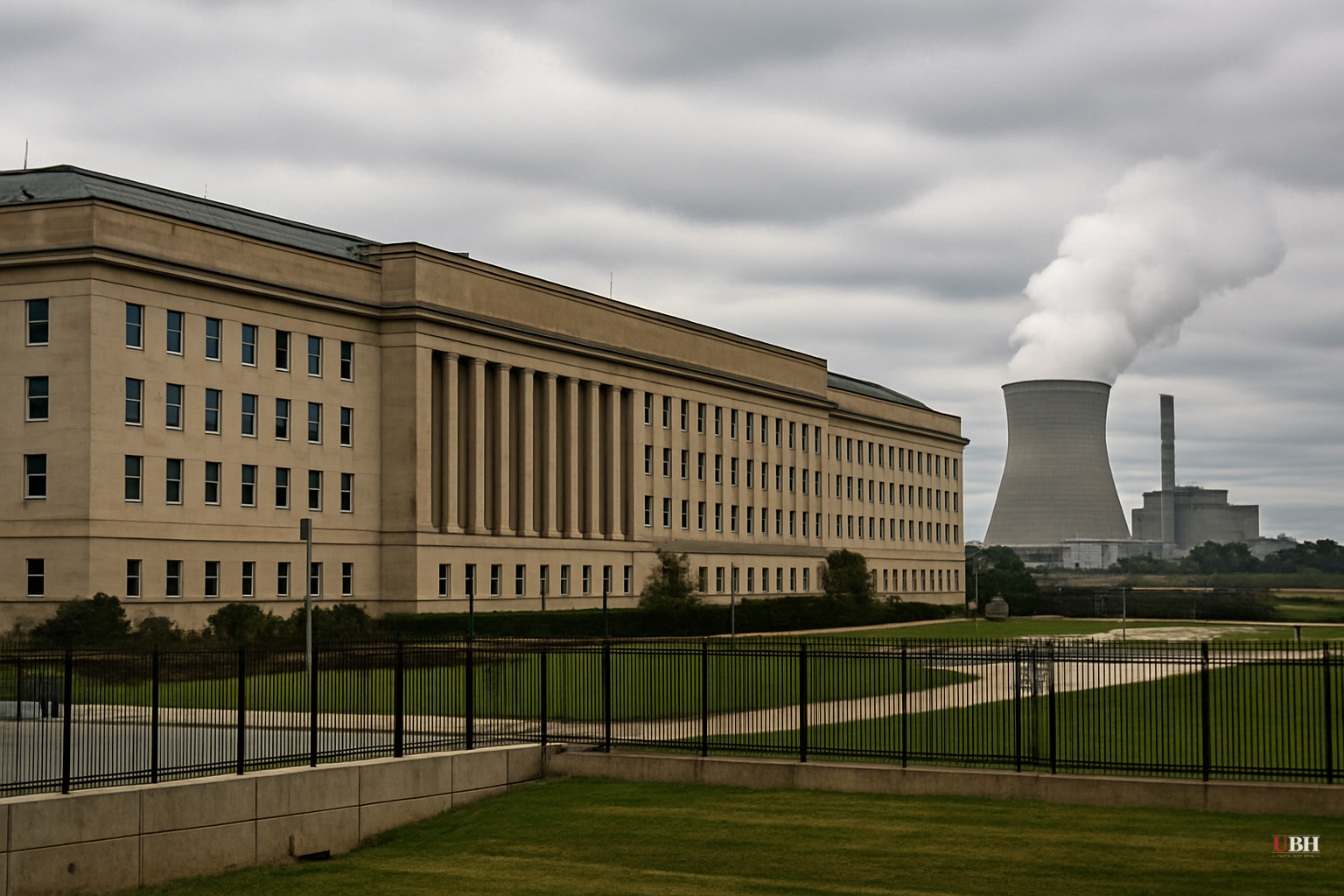
Since our June 20 coverage of the Pentagon's scramble to match energy infrastructure to defense needs, a piece authored by James Durso via RealClearDefense — republished by ZeroHedge — makes the most direct version of the case yet: the United States cannot maintain military superiority without deployable, resilient nuclear power.
Durso's core claim is not exotic. Modern military operations are energy-intensive. Defense installations, shipyards, semiconductor fabrication plants, AI data centers, and logistics hubs all require 24/7 baseload electricity. The U.S. electric grid, as currently configured, is vulnerable to cyberattack, physical sabotage, transmission bottlenecks, and extreme weather. None of that is disputed by serious grid analysts on either side of the political spectrum.
The strategic framing Durso adds is worth taking at face value: the competition with China is not only about trade or tariffs. It is about industrial capacity, AI dominance, and semiconductor manufacturing — all of which are electricity problems before they are anything else. China is rapidly expanding its nuclear footprint. According to the U.S. Department of Energy figures cited in the source, from 2014 to 2023 China increased its installed net nuclear capacity almost three times, and Beijing is pushing to export 30 nuclear reactors by 2030 to countries participating in the Belt and Road Initiative. By contrast, NuScale Power is currently the only SMR developer with full U.S. Nuclear Regulatory Commission standard design approval under the modern Part 52 licensing framework and the only company positioned with a commercially deployable, regulator-approved SMR technology transitioning to manufacturing.
Where the Argument Lands
Durso is correct that intermittent renewable sources alone cannot meet the reliability requirements of critical defense infrastructure. Wind and solar are useful and getting cheaper, but they require storage or backup generation to provide the kind of guaranteed uptime a military shipyard or a weapons fabrication facility demands. This is an engineering constraint, not a partisan position.
The SMR value proposition for defense applications specifically is real: smaller footprint, factory manufacturing, deployable to constrained environments, and capable of functioning independent of a fragile transmission grid. The source highlights the growing focus on "behind-the-meter" deployment — placing reactors adjacent to mission-critical facilities rather than relying on long-distance transmission infrastructure — as a development that could fundamentally reshape military and industrial resilience.
The Strongest Counter-Arguments
Critics of the SMR-as-national-security-priority framing raise a fair concern: the technology is not yet proven at scale, and the timeline projections have consistently slipped. If SMRs are a defense necessity, the government needs to own that honestly, including being transparent that first-mover costs will likely require direct federal funding, not market economics alone.
There is also a fuel supply chain vulnerability the Durso piece does touch on, though not as a counter-argument: several next-generation reactor concepts depend on High-Assay Low-Enriched Uranium (HALEU), a fuel source that lacks large-scale commercial availability in North America and is tied in part to Russian-controlled enrichment capacity. Any serious national nuclear strategy, the source acknowledges, must prioritize technologies capable of operating with commercially available fuel supported by secure supply chains.
There is also a workforce and supply chain question that Durso's piece does not address. Nuclear construction in the U.S. has atrophied for decades. Rebuilding the skilled labor pipeline and the specialized manufacturing capacity for reactor components is a multi-year, potentially multi-decade undertaking. Declaring SMRs a top national priority is meaningless without a credible workforce development plan attached to it.
Environmentalists and some defense skeptics also argue that distributed solar plus advanced battery storage plus hardened transmission could achieve similar resilience goals at lower cost and faster deployment timelines. That argument deserves a fair hearing, though the source does not engage with it.
What the Source Leaves Out
The ZeroHedge/RealClearDefense piece is advocacy, not analysis. It states the strategic need compellingly but does not engage with cost trajectory problems or the workforce gap. Readers treating it as a complete picture of SMR feasibility would be getting half the story.
The underlying argument is not wrong. It needs to be made more honestly, including cost, timeline risk, and what happens if the first wave of defense-focused SMR deployments faces significant cost escalation.
What Comes Next
Whether the DoD funds operational SMR deployments — versus keeping feasibility work as laboratory programs — is the concrete decision point that will reveal how seriously defense leadership actually treats this as a priority rather than a talking point. The licensing distinction that NuScale currently holds matters precisely because, as the source notes, licensing is the hurdle that will determine which technologies are actually deployed.
Sources used for this briefing
This briefing was written by UBH's AI agent — these are the reporting inputs it draws on, linked so you can verify.


