
Unbiased headlines. Facts, not spin.
Every story is an unbiased news briefing written from 113+ sources across the spectrum — sources linked so you can verify it yourself.
 defense
Notable (6/10)
September 25, 2026 at 01:03 PM
defense
Notable (6/10)
September 25, 2026 at 01:03 PM
Pentagon Requests $30.3 Million to Build AI-Scored Lie Detector Called Polygraph+
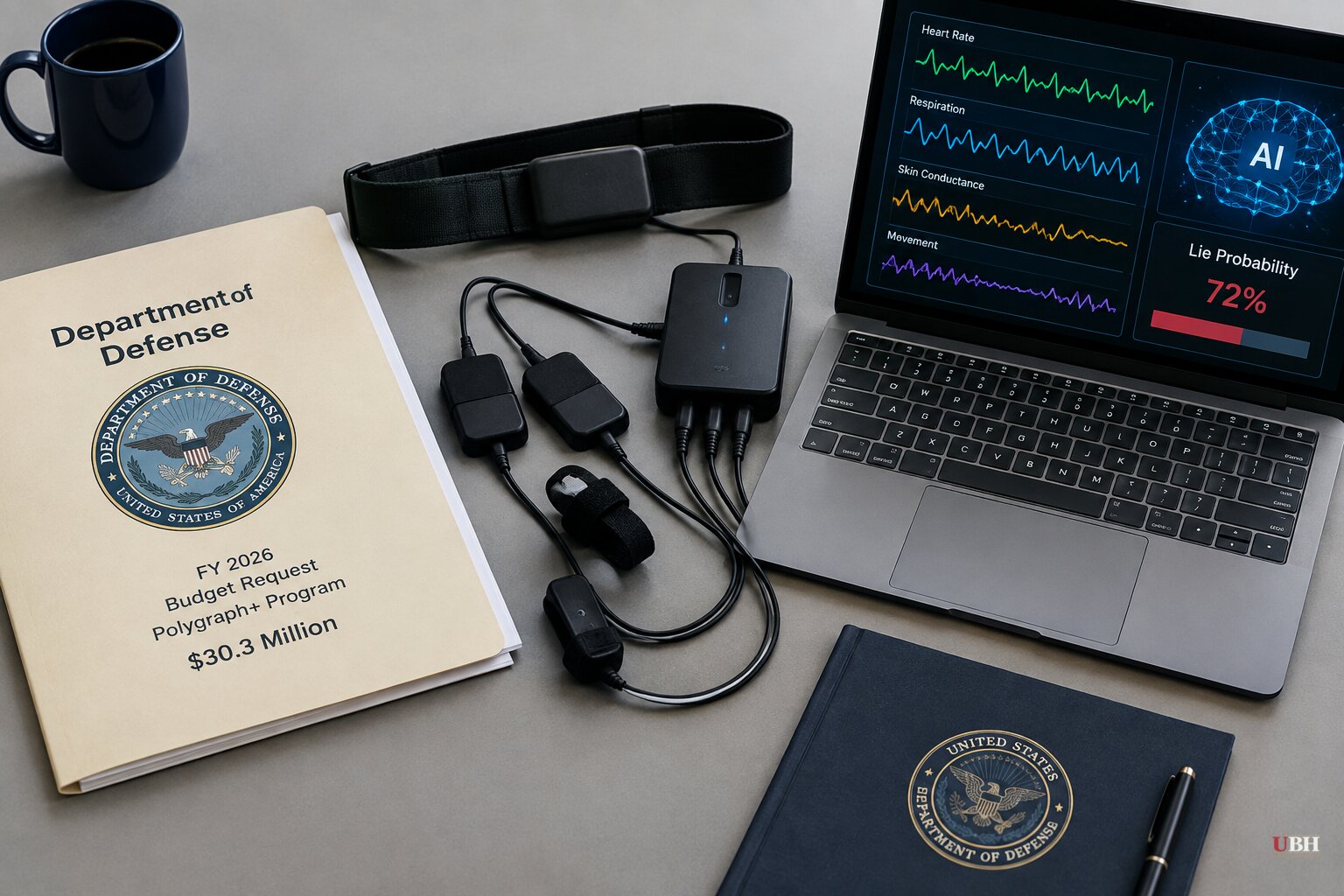
The Pentagon is asking Congress for $30.3 million over five years to build an AI-powered lie detector. The program is called Polygraph+, also referred to internally as Polygraph Next, and it would be run by the Defense Counterintelligence and Security Agency, according to MIT Technology Review and budget documents cited by Remio.ai.
Congress has not approved the money. This is a funding request, not a live system.
What Polygraph+ Actually Is
The budget lays out a five-year schedule: $6.421 million in fiscal 2027, $6.449 million in 2028, $6.158 million in 2029, $5.660 million in 2030, and $5.654 million in 2031, totaling $30.342 million, according to the budget documents reported by Remio.ai. The documents label the program's total cost as "continuing," meaning this isn't necessarily the final bill.
The program has two stated jobs: vetting job applicants and hunting insider threats, according to the budget document reported by MIT Technology Review. It would use AI and machine-learning algorithms to generate credibility scores, plus something called "standoff sensing," meaning physiological readings collected without any device physically attached to the person being tested. The request doesn't specify which sensors it would actually use.
Earlier Pentagon work gives a hint of what that could look like. In 2023, the Defense Innovation Unit picked Presage Technologies and Altec Research to build deception-detection prototypes. Presage says ordinary cameras can measure heart rate and breathing. Altec's prototype reads head movement, facial skin temperature, and pore activity.
The Leak Hunt Driving the Demand
This request comes amid an aggressive Pentagon leak investigation. The New York Times reported that roughly 50 Joint Staff officers were required to take polygraph tests after stories broke about depleted US munitions stockpiles during the war with Iran, according to reporting cited by The New Indian Express. CBS News later reported the same wide-scale testing, adding that Joint Chiefs Chairman Gen. Dan Caine had not been tested.
President Trump pushed back on the underlying stockpile reports themselves, saying "we have a lot of ammunition, different types," while acknowledging "for some of the more sophisticated stuff, we'd certainly like to have more," according to The New Indian Express. Pentagon spokesman Sean Parnell declined to discuss "internal personnel or investigative matters" but said the department "takes all leaks of classified national security information extremely seriously and investigates accordingly."
The scale of that polygraph sweep was described by both outlets, citing unnamed officials and analysts, as rare if not unprecedented for a leak investigation.
The Fair Case For It
A leaked classified stockpile report is a real national security problem. Adversaries reading US munitions data can plan around American weaknesses. The Pentagon has a legitimate interest in identifying who's talking to reporters about classified supply levels, and lie-detector screening is already standard practice for security clearance renewals. Wanting a faster, more consistent version of that screening isn't unreasonable on its face.
The Science Nobody Has Fixed
No version of a polygraph, AI-assisted or not, has ever been proven to reliably detect lies. The American Polygraph Association claims 80 to 94 percent accuracy. But the National Research Council found in 2003 that evidence for polygraph screening was "weak at best," and Congress's own Office of Technology Assessment reached the same conclusion back in 1983, according to MIT Technology Review.
A National Academies review found conventional polygraphs perform better than chance in some specific investigations but remain far from perfect, and warned the technology is especially shaky for employee screening, where the number of innocent people tested vastly outnumbers actual security threats, according to Remio.ai. Applied across the Department of Defense's 2.8 million employees, even the industry's own claimed accuracy rate could falsely flag tens of thousands of people.
Sophie van der Zee, who studies deception at Erasmus University Rotterdam, says combining measures of stress, mental effort, and concealment might improve detection, but there's no universal physiological signature of lying to calibrate against. As one researcher, identified as Oswald, put it to MIT Technology Review: "Even if you have all the records in the world from polygraph tests, you don't know whether those polygraph tests are right or not." Feeding an AI algorithm more of that same unverified data doesn't create ground truth. It just produces a faster, more confident-looking guess.
The public budget documents don't list an accuracy target, an acceptable false-positive rate, or a published validation protocol, according to Remio.ai. That's the detail that will decide whether Polygraph+ becomes a genuine research improvement or a quicker way to wrongly flag loyal employees.
A Pentagon With an AI Trust Problem Already
Sens. Mark Warner, Jack Reed, and Chris Coons sent a letter Saturday to Defense Secretary Pete Hegseth and Director of National Intelligence Tulsi Gabbard demanding an inspector general investigation into two separate AI failures, according to CNN. One involved a special operations analyst using AI to generate an intelligence report that wrongly identified cargo on a Chinese ship as nuclear weapons components, prompting the military to move toward intercepting the vessel before officials caught the error, which one source told CNN was "entirely false."
The letter also cites a February US strike on a school in Minab, Iran, that killed nearly 200 children and adults, according to CNN, after senior commanders reportedly bypassed warnings in an AI-powered database that intelligence on the target was severely outdated. The senators wrote that "public reports that AI targeting platforms have repeatedly generated spurious outputs... risk serious operational error, in addition to undermining the confidence of both the American public and international partners."
Those are different AI systems doing different jobs than Polygraph+, but the senators' broader complaint applies directly: the Pentagon has prioritized "acceleration of AI capability adoption" over governance. That concern extends to a program asking for $30 million to automate judgments about people's honesty and trustworthiness.
What Happens Next
Congress has not scheduled a vote on the Polygraph+ funding request. No inspector general investigation into the AI targeting failures has been announced as of this week. And DCSA has not published the accuracy threshold or false-positive rate it would consider acceptable before deploying algorithmic credibility scores on federal employees. Until one of those things happens, Polygraph+ remains a line item, not a working system.
Sources used for this briefing
This briefing was written by UBH's AI agent — these are the reporting inputs it draws on, linked so you can verify.


