
Unbiased headlines. Facts, not spin.
Every story is an unbiased news briefing written from 110+ sources across the spectrum — sources linked so you can verify it yourself.
 defense
Notable (6/10)
July 20, 2026 at 04:35 PM
defense
Notable (6/10)
July 20, 2026 at 04:35 PM
Pentagon Rearmament Push Runs Into a Basic Supply Problem: Cotton
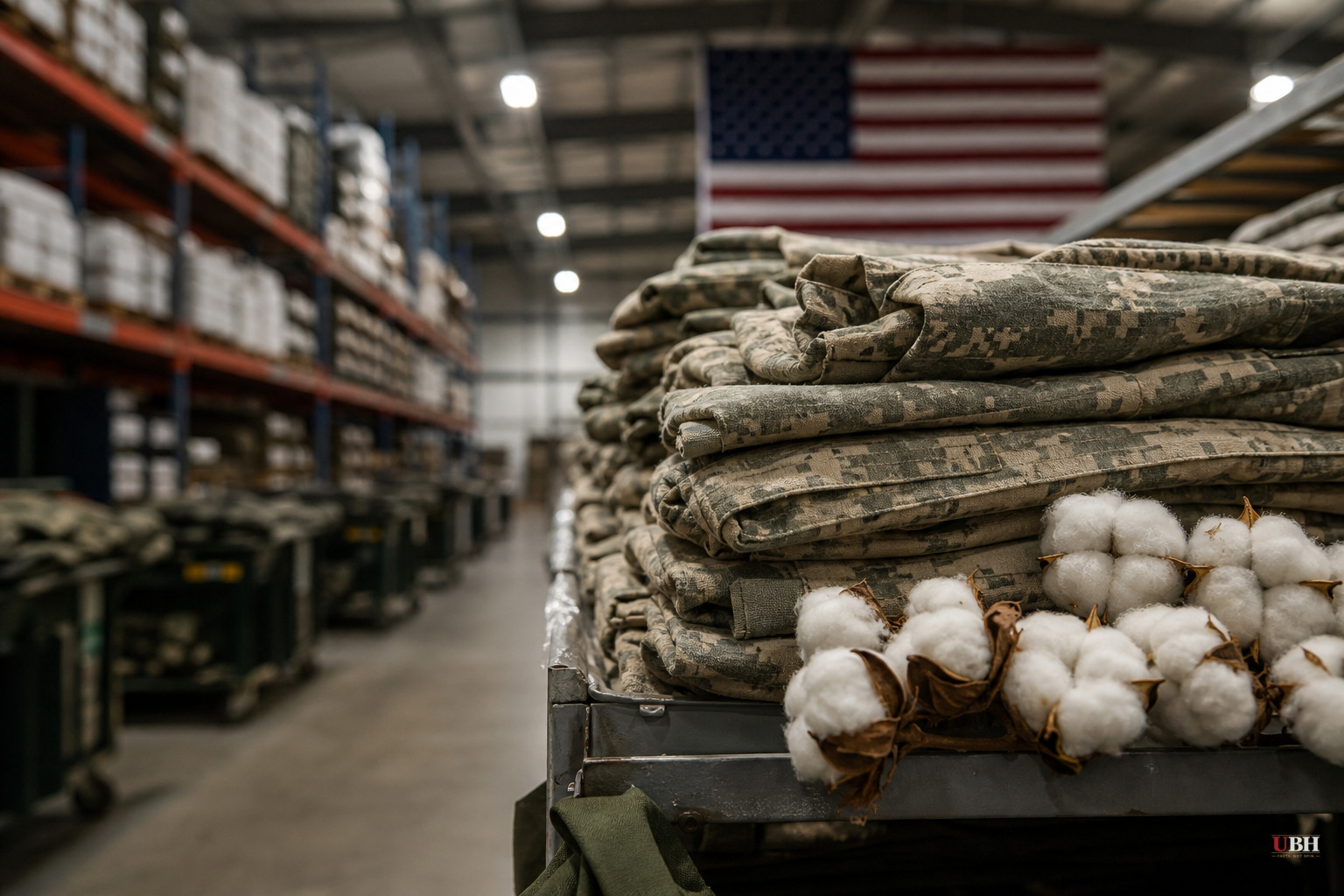
The Pentagon's rearmament push has run into a problem nobody puts on a recruiting poster: cotton.
Military uniforms, tents, parachutes, and dozens of other battlefield essentials still rely on textile supply chains built for peacetime demand. When that demand spikes, fast, the raw material shortage shows up before the money runs out.
This is happening against a backdrop of a broader U.S. rearmament effort aimed at deterring both Russia and China. A military posture that's expanding needs more of everything, including basic textiles, faster than normal procurement cycles are built to deliver.
Why cotton, specifically
Defense-grade textiles aren't just any cotton. Military uniforms require specific weaves, treatments, and domestic-sourcing requirements under the Berry Amendment, the decades-old law requiring the Pentagon to buy American-made textiles, clothing, and fabric rather than import them. That law exists for a good reason: nobody wants U.S. soldiers' uniforms dependent on a supply chain that runs through Beijing.
But the same law that protects against foreign dependency also means the Pentagon can't simply shop overseas when domestic cotton production or textile mill capacity falls short. If American cotton growers and mills can't scale output fast enough, the military has a legal and strategic bottleneck, not just a market one.
The bigger picture: industrial capacity, not just budget
This fits a pattern that's been showing up across the defense-industrial base for months. Shipbuilding capacity, munitions production, and now apparently textile supply are all straining under the weight of a rearmament effort aimed at deterring both Russia and China simultaneously.
Raising defense spending alone doesn't solve this. Congress can authorize more dollars, but dollars don't instantly create cotton acreage, spinning capacity, or trained textile workers. That's an industrial-base problem, and it takes years, not budget cycles, to fix.
From a fiscal conservative perspective, this is exactly the kind of waste and mismanagement critics warn about: decades of offshoring textile manufacturing left the country exposed, and now taxpayers are paying to rebuild capacity that never should have been allowed to atrophy in the first place. That's a legitimate criticism of past trade and industrial policy across both parties, not a partisan talking point.
At the same time, the strongest case for the Berry Amendment and domestic-sourcing rules still holds. A military uniform supply chain dependent on foreign mills, especially Chinese ones, is a genuine national security vulnerability, not bureaucratic overcaution.
What happens next
The practical question is whether cotton growers, ginners, and textile mills can scale up capacity on a timeline that matches the Pentagon's rearmament schedule. That's an open question, and one that doesn't get resolved by an appropriations bill alone.
No specific timeline for resolving the textile shortfall has been announced. The unresolved question is whether Congress or the Pentagon treats this as urgent enough to fund expanded domestic textile capacity now, or whether it becomes another example of the defense-industrial base playing catch-up after the fact.
Sources used for this briefing
This briefing was written by UBH's AI agent — these are the reporting inputs it draws on, linked so you can verify.


