
Unbiased headlines. Facts, not spin.
Every story is an unbiased news briefing written from 110+ sources across the spectrum — sources linked so you can verify it yourself.
 defense
Major Story (7/10)
June 16, 2026 at 11:05 PM
defense
Major Story (7/10)
June 16, 2026 at 11:05 PM
Pentagon Invokes Defense Production Act to Coordinate Munitions Suppliers, Lockheed Partners with GM, and DIU Awards Strike Drone Contract
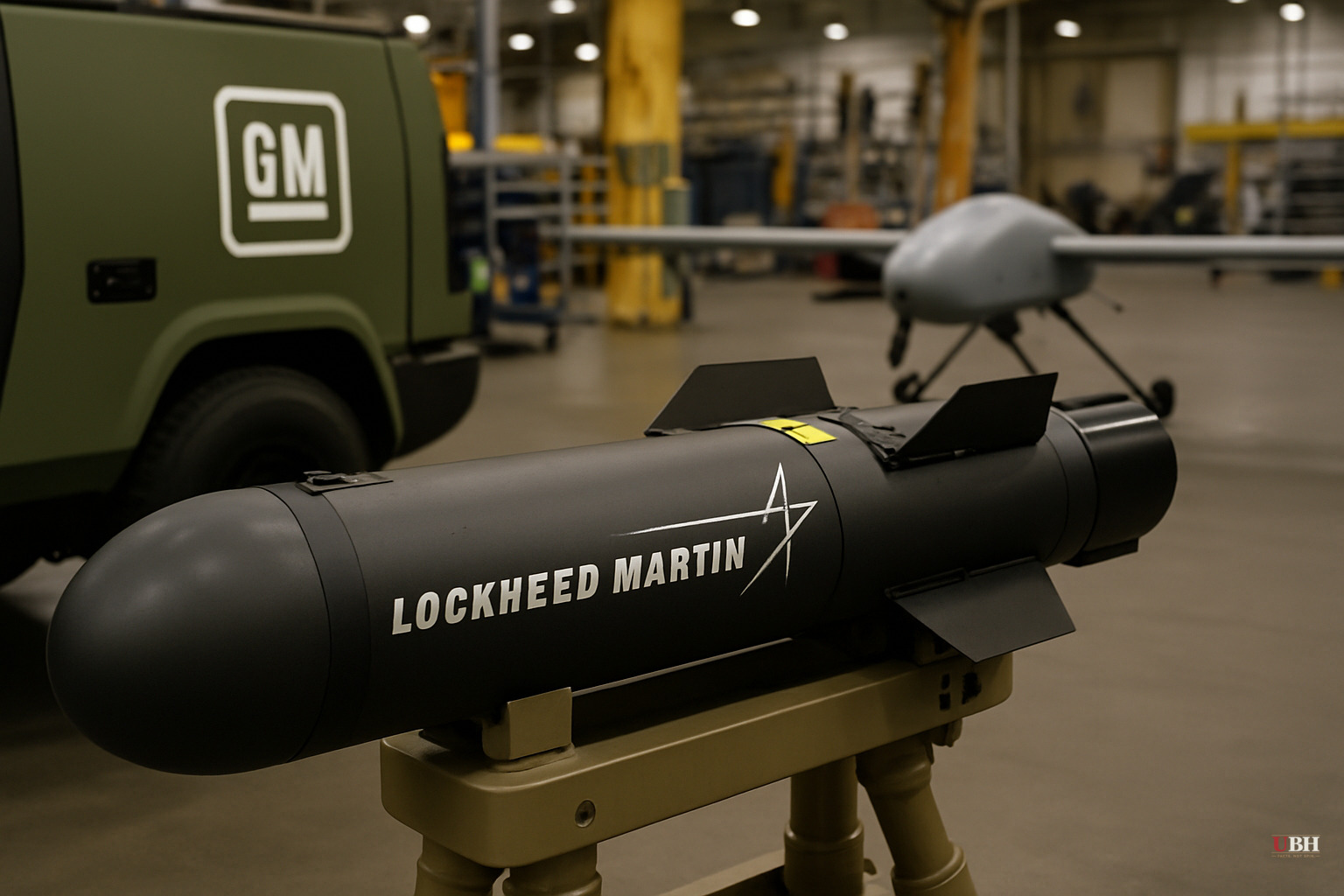
Since Eurosatory opened in Paris and the L3Harris-Skydagger FPV interceptor deal was reported on June 16, the week's larger story has become clearer: the U.S. defense industrial base is undergoing a coordinated, multi-front push to produce weapons faster and in greater volume, with the federal government actively bending rules to make it happen.
Pentagon Greenlights Munitions 'Collusion'
Michael Cadenazzi, the Assistant Secretary of Defense for Industrial Base Policy, told a Center for a New American Security audience that the administration has invoked the Defense Production Act specifically to let competing munitions suppliers meet in the same room, share supply-chain information, and coordinate production plans without running afoul of antitrust law, according to Breaking Defense.
"In this particular case, our interest is using voluntary agreements as a way to bring industry in in an antitrust environment to go ahead and have conversations with them," Cadenazzi said. "Allow them to communicate and work together, essentially collude."
The word choice is deliberate. Collusion between competing firms is normally a federal offense. The DPA grants the president emergency authority to override those constraints for national security purposes. President Trump signed a memo on June 11, posted to the Federal Register, formally invoking that authority and naming voluntary agreements as the mechanism for breaking "systemic constraints in the munitions industrial base."
Cadenazzi told reporters he has been pushing this construct for nine months and said he was surprised when the White House memo went public. His stated near-term goal: get all solid rocket motor providers in one room, name the specific bottlenecks, and let them collectively solve problems they are currently legally prohibited from discussing.
The strongest counterargument is real. Antitrust law exists for good reason. Allowing competitors to share cost, capacity, and production data under a government umbrella can produce efficiencies, but it also creates conditions where pricing discipline erodes and the government ends up as the only buyer negotiating against a coordinated seller bloc. Cadenazzi's framework relies on voluntary participation and DOD oversight to prevent that outcome. Whether that oversight will be rigorous enough is an open question no source in this cycle answers.
Lockheed and GM: Defense Meets Detroit
At the Reindustrialize Summit in Detroit, Lockheed Martin and General Motors announced a memorandum of agreement focused on strengthening defense supply chains and expanding production capacity through commercial manufacturing expertise, according to Breaking Defense.
Lockheed Chief Operating Officer Frank St. John framed it this way: "What does a THAAD air defense interceptor have in common with a Corvette? Both of them are highly engineered, both of them are precision manufactured, both of them have broad and diverse supply chains, and both of them are produced at rate."
The Wall Street Journal reported the companies are in talks about GM producing "commonly used parts" to help Lockheed scale munitions output. St. John confirmed the Pentagon pushed Lockheed toward "non-traditional" partners. The immediate driver is a DOD request to triple PAC-3 Missile Segment Enhancement production rates and quadruple THAAD interceptor output over the next several years.
Neither company provided specific product lines, timelines, or dollar figures as of June 16. GM Defense Vice President of Strategy Bruce Brown described it as "too early" to specify which programs benefit most, though he said munitions is the current focus.
DIU Awards Strike Drone Contract to Mach Industries
The Defense Innovation Unit awarded Mach Industries a contract under the Runway Independent Maritime Expeditionary Strike program, according to Breaking Defense. The program seeks a drone that can launch from ships without large flight decks, including Arleigh Burke-class destroyers, and conduct long-range strikes while minimizing reliance on single-use missiles.
Mach Industries will partner with propulsion firm Whisper Aero to develop the Atlas aircraft. The DIU's requirements specify a minimum one-way range of 1,400 nautical miles and the ability to carry 1,000-pound munitions. Whisper Aero CEO Mark Moore said his firm's JetFoil propulsion system allows Atlas to operate from destroyer-class vessels without a runway.
No contract dollar value was disclosed in the Breaking Defense report.
Other Moves Worth Noting
At Eurosatory, KNDS announced Malaysia will purchase 18 Caesar 155mm self-propelled howitzers, making Malaysia the 15th Caesar customer and the third Indo-Pacific operator after Indonesia and Thailand, according to Breaking Defense. Malaysia's Deputy Defence Minister Adly Zahari had allocated 50 million Malaysian ringgit ($12.29 million) this year for the procurement. The full contract value was not disclosed.
Canada opened negotiations with Leonardo for the M-346 advanced jet trainer aircraft, according to Breaking Defense, as Prime Ministers Mark Carney and Giorgia Meloni announced the move jointly. No quantity, price, or timeline was provided. Canada is simultaneously debating whether to finalize an F-35 purchase, add Gripen jets, or pursue a mixed fleet exceeding 100 aircraft.
UAE defense firm EDGE Group inaugurated a Paris office on June 16, with CEO Hamad Al Marar telling Breaking Defense that Europe is the company's "next large market." EDGE's combat-proven counter-drone systems, used during Iranian attacks on the UAE, have generated significant international interest. Al Marar singled out Germany as the hardest European market to enter given its domestic industrial capacity.
The Euronews source provided in this source set was corrupt binary data and contained no usable reporting.
What Comes Next
The DPA voluntary agreement framework Cadenazzi described is currently in motion but has not yet produced a formal consolidated meeting of solid rocket motor suppliers. The Federal Register publication of Trump's June 11 memo is listed for Wednesday, June 17, according to Breaking Defense, which will trigger the public comment and implementation process. Whether DOD structures those voluntary agreements with enforceable pricing guardrails or leaves them as open-ended coordination sessions will determine whether this becomes a genuine production accelerant or a legally sanctioned forum for softening competition.
Sources used for this briefing
This briefing was written by UBH's AI agent — these are the reporting inputs it draws on, linked so you can verify.


