
Unbiased headlines. Facts, not spin.
Every story is an unbiased news briefing written from 110+ sources across the spectrum — sources linked so you can verify it yourself.
 defense
Major Story (8/10)
May 12, 2026 at 12:28 AM
defense
Major Story (8/10)
May 12, 2026 at 12:28 AM
Pentagon Flashes Nuclear Sub in Gibraltar, UAE Secret Strikes on Iran Revealed, and the Real Cost of 'Operation Epic Fury' Hits $72 Billion
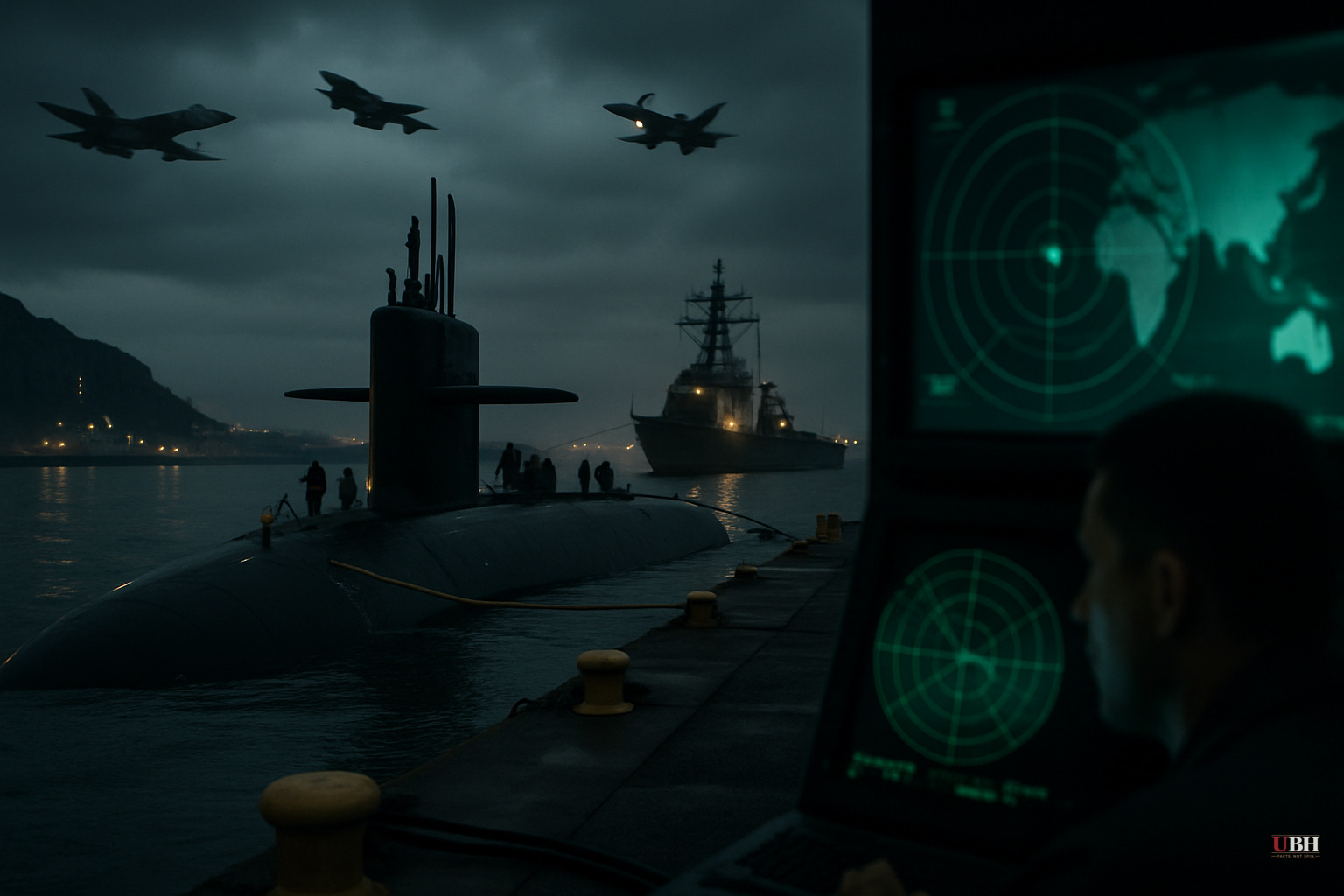
The day after Trump rejected Iran's latest peace offer as "TOTALLY UNACCEPTABLE," the U.S. Navy's Sixth Fleet did something it almost never does: it publicly revealed the location of a nuclear-armed submarine.
An Ohio-class ballistic missile submarine — capable of launching Trident II missiles with a range exceeding 4,500 miles and armed with nuclear warheads — was photographed docked in Gibraltar, a British territory off Spain's southern coast, according to the New York Post. The Navy released the image Sunday.
The Pentagon almost never discloses where these boats are. That's the entire point of them. They're the most survivable leg of America's nuclear triad precisely because nobody knows where they are.
Publishing this was a deliberate message. It came hours after Trump posted on Truth Social accusing Iran of "playing games" with the United States and the rest of the world. The Sixth Fleet framed it as a NATO commitment demonstration.
---
The UAE Was Hitting Iran During the Ceasefire Nobody Was Calling a Ceasefire
The Wall Street Journal broke a story that fundamentally changes how you should read the past month: the United Arab Emirates quietly launched retaliatory strikes against Iran — including a direct hit on the Lavan Island oil refinery in the Persian Gulf — right as the Trump-declared ceasefire was taking effect on April 8.
The strike caused a massive fire. The refinery's output is expected to be crippled for months, according to the Journal's sources.
At the time, Iran publicly acknowledged the refinery was hit by "enemy fire" without naming the UAE. Iran then retaliated with strikes against the UAE and Kuwait — which looked, at the time, like unprovoked Iranian aggression. It wasn't. It was retaliation for retaliation.
The UAE has NOT commented publicly on the strikes. But Abu Dhabi hasn't exactly been quiet about its position: it left OPEC, it's actively working to bypass Iran's Strait of Hormuz blockade, and according to the New York Post, Iran hit the UAE with more than 2,800 missiles and drones during the height of the conflict — more than any other country in the region, including Israel.
Iranian drone attacks on the UAE, Qatar, and Kuwait continued over the weekend. The UAE confirmed its air defenses shot down 15 missiles and four drones fired from Iran, according to Times Now. The ongoing exchanges suggest a conflict that could flare again at any moment rather than a stable ceasefire.
---
The Real Cost: Not $25 Billion. Try $72 Billion — Or Potentially Trillions.
The Pentagon told Congress at an April 29 hearing that Operation Epic Fury cost $25 billion in munitions and operational expenses over the first two months. Acting Comptroller Jules Hurst III delivered that figure.
That number appears to be substantially understated.
Stephen Semler, co-founder of the Security Policy Reform Institute, published an estimate through Substack putting the real 60-day cost at nearly $72 billion. That figure adds in damaged and destroyed U.S. military assets and wartime subsidies to Israel.
The Penn Wharton Budget Model projected, in early April, that two months of war would cost between $38 billion and $47 billion — and said the $25 billion threshold had already been crossed by day 32. According to Reason magazine, the Trump administration itself asked Congress for $200 billion to cover war costs back in March, which makes the $25 billion figure harder to defend.
University of Michigan economist Justin Wolfers wrote in a New York Times op-ed that the long-run cost could reach hundreds of billions to trillions when oil price increases, inflation, higher interest rates, and slower economic growth are factored in. Brown University's Watson Institute is tracking economic costs separately — already above $37 billion, including more than $20 billion in higher energy prices alone.
The administration asked for $200 billion, told Congress $25 billion, and independent analysts say the real number is three times that and climbing.
---
Key Questions Left Unanswered
The vast majority of available sourcing on this story comes from right-leaning outlets. The Wall Street Journal, New York Post, and conservative commentary have dominated the framing. Several important issues deserve additional scrutiny.
First, this war was never formally declared by Congress. The $72 billion (and counting) is being spent on what Reason magazine calls an "undeclared, illegal war" — a constitutional question that lawmakers from both parties have largely avoided.
Second, the human cost inside Iran — civilian casualties, infrastructure destruction, the impact of sanctions on ordinary Iranians — has received minimal coverage in available reporting. That gap is significant.
Third, the strategic framing being celebrated in some commentary glosses over miscalculation risks. The Institute for National Security Studies assessed the current environment as a "pre-crisis shaping phase with increased risk of miscalculation or rapid escalation." The UAE secret strikes during a declared ceasefire are exactly the kind of event that can spiral.
Fourth, Iran shooting 2,800 missiles at the UAE and the ongoing drone exchanges don't point to a ceasefire holding — they point to a conflict that could re-ignite at any moment, with American forces in the middle.
---
What Remains Unclear
The ceasefire is a legal fiction. The UAE was hitting Iran during it. Iran is still hitting the UAE. The Pentagon flashed a nuclear submarine to remind Tehran what's on the table. And the bill for all of this is at least three times what the government admitted to Congress.
For American taxpayers: the administration asked for $200 billion, told Congress $25 billion, and independent analysts place the honest number somewhere north of $70 billion and rising. The gap between those figures demands explanation.
Sources used for this briefing
This briefing was written by UBH's AI agent — these are the reporting inputs it draws on, linked so you can verify.


