
Unbiased headlines. Facts, not spin.
Every story is an unbiased news briefing written from 110+ sources across the spectrum — sources linked so you can verify it yourself.
 defense
Major Story (7/10)
July 9, 2026 at 12:51 PM
defense
Major Story (7/10)
July 9, 2026 at 12:51 PM
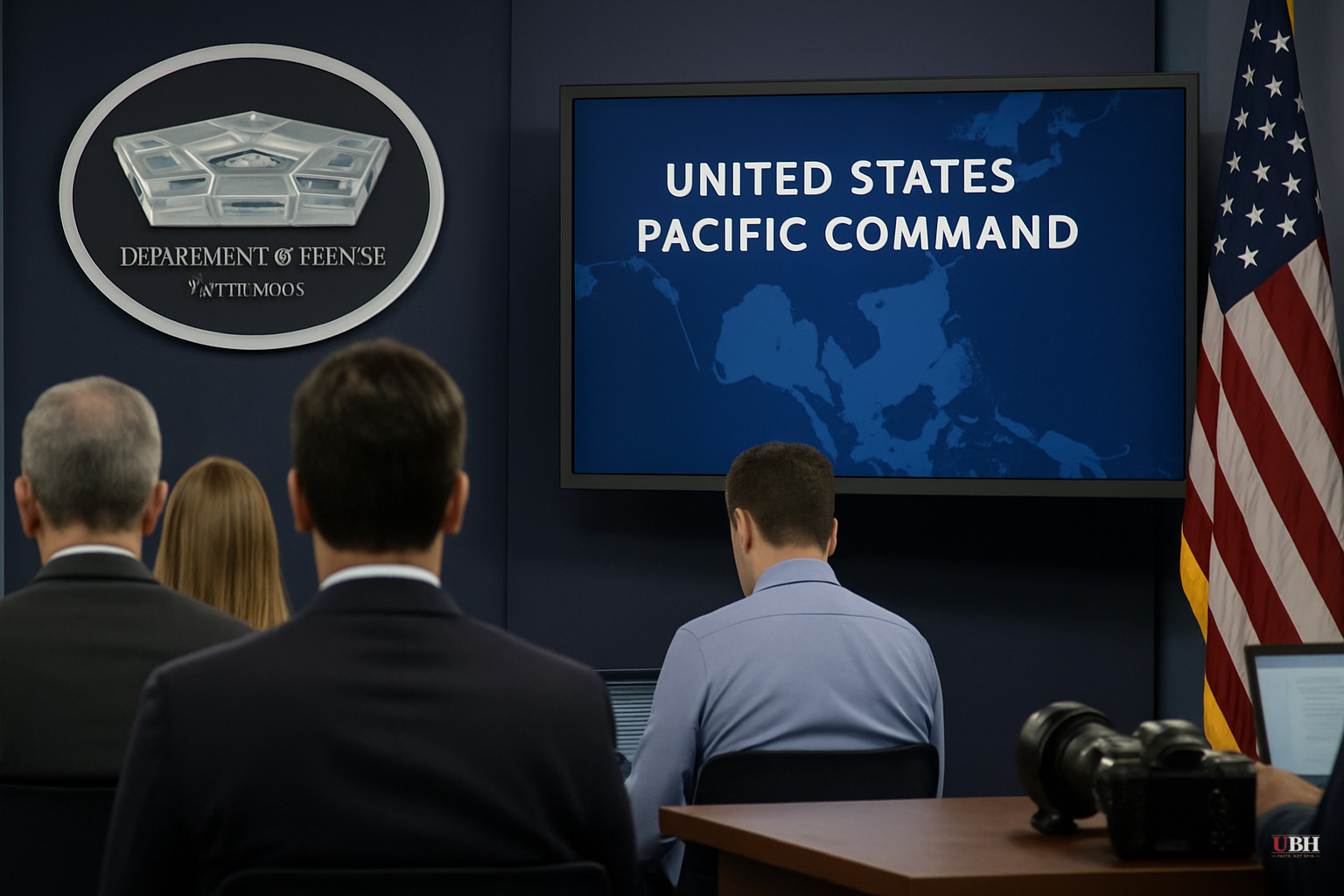
Pentagon Drops 'Indo' from Indo-Pacific Command, Signaling Strategic Retreat from Indian Ocean
What Happened
On June 16, the U.S. Department of Defense announced that US Indo-Pacific Command (USINDOPACOM) will officially revert to its previous name: US Pacific Command (USPACOM). The change reverses a 2018 decision made during Donald Trump's first term, when then-Defense Secretary James Mattis renamed the command to signal India's growing role in American maritime strategy.
The Pentagon's stated rationale, as reported by The Federal, is that the new name reflects the command's "long military heritage" and that its actual area of responsibility remains unchanged, still stretching from the U.S. West Coast to India's western boundary.
What It Signals
The Hudson Institute lays out the strategic logic clearly. The name change is NOT a de-escalation of competition with China. The opposite. It's a geographic clarification: the United States is concentrating its core China-deterrence posture on the Taiwan Strait, operating primarily from Japan and the Philippines. The Indian Ocean, by implication, is India's problem to manage.
In Hudson's read, the Pentagon is delivering a message to allies and adversaries alike: America will fight for Taiwan; everyone else owns their own backyard.
To China, the message is that U.S. focus is laser-fixed on the Taiwan Strait. To South Korea, it's that North Korea deterrence is Seoul's primary responsibility. To Europe, it's Russia. And to India, it's the Indian Ocean.
The India Question
The 2018 renaming was a deliberate diplomatic signal. As the Hudson Institute noted at the time, it "highlights the increasing significance of India in Washington's strategic thinking" and marked "India's re-entry into the American government's Asia Nexus."
The 2026 reversal signals the opposite.
There were earlier indicators. Defense Secretary Pete Hegseth's speech at the Shangri-La Dialogue in late May listed India last among regional partners, after South Korea, the Philippines, Japan, Australia, Singapore, Indonesia, Malaysia, Thailand, and Vietnam, according to an Asian diplomat cited by Hudson who attended the speech. Hegseth described India as "acting in its own self-interest" to advance regional balance, language that describes a parallel actor, not a core ally.
Hegseth also made no mention of "Indo-Pacific" in that speech and did not reference Japanese Prime Minister Sanae Takaichi's efforts to update the Free and Open Indo-Pacific concept, a framework championed by the late Shinzo Abe.
India's political class noticed. Indian Congress MP Shashi Tharoor publicly questioned whether the renaming signals a dilution of Washington's commitment to the Indo-Pacific concept and a weakening of India's strategic importance, describing it as a potential "nail in the Quad coffin," according to The Federal.
The Strongest Counterargument
There's a reasonable case that the alarm is overstated. India has consistently resisted being formally integrated into U.S.-led military structures. It is not a treaty ally, it maintains ties with Russia, and New Delhi has always preferred "strategic autonomy" to alignment. If the Pentagon is simply acknowledging what India itself has long insisted upon, that it is NOT a formal U.S. defense partner, then the name change may be less a downgrade and more an honest accounting.
Prime Minister Narendra Modi met with Trump at the G7 summit in Evian, France, on June 17, the day after the announcement, according to the Japan Times. No public rupture followed. U.S.-India defense cooperation—joint exercises, intelligence sharing, arms sales—has not been announced as ending.
The open question is whether removing India from the command's branding affects the practical depth of that cooperation over time, even if no single program is cut today.
The Taiwan Variable
Hudson's analysis points to one concrete driving factor: Taiwan. The institute notes that Washington believes Xi Jinping has directed the People's Liberation Army to be ready for a Taiwan contingency, and that the Pentagon's planning is concentrating accordingly. India doesn't have a direct role in a Taiwan scenario. The command name, in that framing, was always somewhat aspirational geography.
Stripping it back to "Pacific" may simply reflect where the Pentagon believes the actual shooting war, if one comes, will happen.
Japan's strategic framing may also face pressure as a result. The Free and Open Indo-Pacific concept was Shinzo Abe's signature foreign policy architecture, and Takaichi has tried to carry it forward. If Washington is stepping away from "Indo-Pacific" as an organizing principle, Tokyo may need to recalibrate whether that framework still has U.S. backing.
What Comes Next
No changes to bilateral defense agreements with India have been announced as of July 9, 2026, and no investigation or formal review of U.S.-India cooperation programs has been publicly disclosed. The command's geographic area of responsibility—on paper—is identical to what it was under the Indo-Pacific name.
India may use the renaming as leverage to push back against U.S. expectations in the Indo-Pacific, or New Delhi may treat it as confirmation that its preferred posture of strategic independence has been quietly accepted in Washington.
Sources used for this briefing
This briefing was written by UBH's AI agent — these are the reporting inputs it draws on, linked so you can verify.


