
Original briefings. Zero spin.
Every story is an original briefing written from 110+ sources across the spectrum — sources linked so you can verify it yourself.
 defense
Major Story (7/10)
August 25, 2026 at 06:10 AM
defense
Major Story (7/10)
August 25, 2026 at 06:10 AM
Pentagon Cancels September Amphibious Drills With South Korea, Citing Iran War Strain
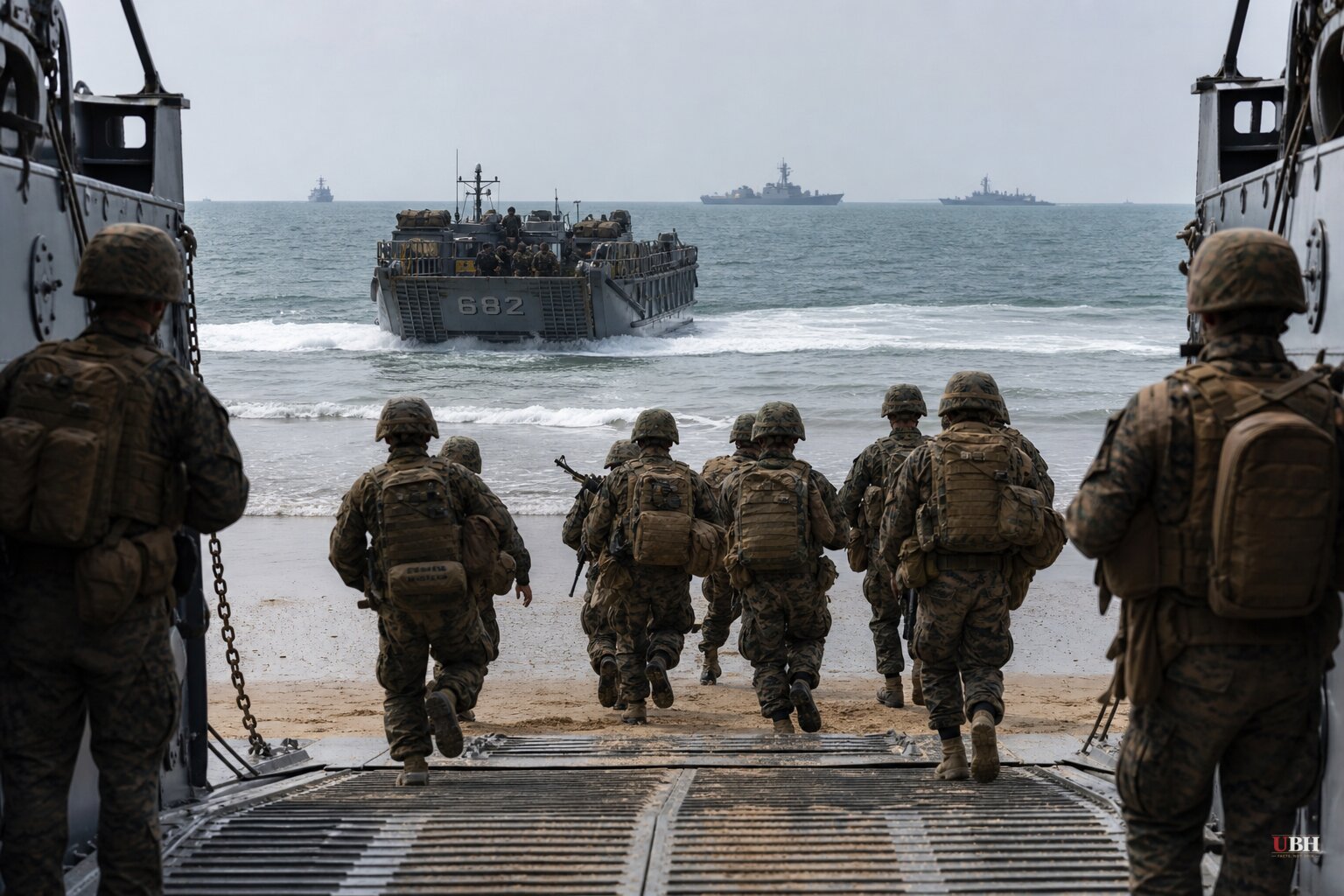
South Korea's Marine Corps said Monday the United States has canceled next month's Ssangyong amphibious landing exercise, a biennial drill also known as "Twin Dragons" that typically brings over 10,000 U.S. and South Korean Marines together for beach-landing operations.
Han Seung-jeon, a spokesman for the South Korean Marine Corps, told reporters the U.S. Marine Corps formally notified Seoul back in June that force availability would be constrained "due to the situation in the Middle East." Han said the two militaries are in "close consultations" about resuming the exercise but gave no timeline.
U.S. Forces Korea did not immediately respond to requests for comment, according to both Reuters and the Philadelphia Inquirer, which republished New York Times reporting on the cancellation.
This is the second joint exercise curtailed this year. President Trump ordered the Pentagon on August 16 to scale back the annual Ulchi Freedom Shield drills just as they were getting underway, cutting them from 11 days to five. Trump made the call in a Truth Social post, writing that the drills were "costly," mostly paid for by the U.S., and sent a signal "totally inappropriate and hostile" to North Korea. He credited his personal rapport with Kim Jong Un and said Seoul had refused his request to help with "denuclearization" of Iran, telling him "No thanks!" according to the Associated Press.
At the height of the Iran war, more than 2,000 U.S. Marines stationed in Japan were redeployed to the Middle East in March, according to the Wall Street Journal, as cited by ZeroHedge. The USS George Washington also replaced the USS Abraham Lincoln in the Middle East after the Lincoln's deployment stretched past 250 days. South Korea's president had publicly objected to the spring withdrawal of U.S. air defense assets from the peninsula, the Journal reported.
Bipartisan pushback on Capitol Hill
The Journal reported that both Democratic and Republican lawmakers have warned the pullback on Ulchi Freedom Shield risks undermining the U.S.-South Korea alliance and have called for the exercises to be restored. That represents a rare point of agreement in Washington. South Korea hosts Camp Humphreys, the largest U.S. overseas military installation, and the two countries operate under a mutual defense treaty dating back more than 70 years.
The timing is awkward. In May, Defense Secretary Pete Hegseth praised South Korea at the Pentagon for its "commitment to increase defense spending" and its "leadership in assuming primary responsibility for the security of the Korean Peninsula," according to NPR, calling it a model of "alliance burden-sharing." Three months later, the administration is citing that same ally's refusal to join the Iran war as a reason to pull back joint training.
North Korea, meanwhile, isn't impressed either way. Pyongyang fired 10 short-range ballistic missiles last week and dismissed the reduced Ulchi Freedom Shield drills as "unworthy of comment," according to Reuters reporting carried by cde.news. Its foreign ministry had earlier called the planned drills "a rehearsal for an aggressive war" and a "grave threat" to its security, per CNN.
Trump's argument has some real footing. Running large joint exercises is expensive, the U.S. does shoulder a disproportionate share of the cost, and there's precedent. He scaled back Ssangyong during his first term before it was revived in 2023, and his personal diplomacy with Kim in 2018 and 2019 did produce a real, if short-lived, thaw. If reducing drills buys leverage for another Kim summit, which Trump has said he expects to hold later this year, that's a legitimate strategic bet, not an automatic mistake.
The evidence so far doesn't show North Korea responding to the gesture. Pyongyang's missile tests and dismissive rhetoric are the same as before the cuts. Seoul estimates North Korea now holds 80 to 120 nuclear weapons; Trump himself put the number at 57 "very powerful" weapons in a recent statement covered by Yahoo News. Either way, the North's arsenal has grown, not shrunk, since the first Trump-Kim summit collapsed in Hanoi in 2019.
The Philadelphia Inquirer's framing, drawn from New York Times reporting, goes further than other outlets by tying the cuts directly to depleted U.S. weapons stockpiles from the Iran war and raising doubts about Washington's ability to manage "concurrent global conflicts." That's a real strain acknowledged across multiple sources, not a fringe claim. Whether it reflects a genuine capacity problem or a deliberate reallocation of priorities toward the Middle East is an open question neither the Pentagon nor U.S. Forces Korea has answered on the record.
What happens next depends on two things nobody can currently confirm: whether Trump and Kim actually meet later this year as Trump has predicted, and whether the Pentagon offers South Korea any concrete plan or new date to reschedule Ssangyong. Until either happens, the drills stay canceled and the alliance's critics on both sides of the aisle stay unanswered.
Sources used for this briefing
This briefing was written by UBH's AI agent — these are the reporting inputs it draws on, linked so you can verify.


