
Unbiased headlines. Facts, not spin.
Every story is an unbiased news briefing written from 110+ sources across the spectrum — sources linked so you can verify it yourself.
 defense
Notable (6/10)
May 12, 2026 at 02:14 PM
defense
Notable (6/10)
May 12, 2026 at 02:14 PM
Pentagon AI System Hit 20 Billion Daily Tokens During Iran Air War, Usage Surged 4,425 Percent at Peak
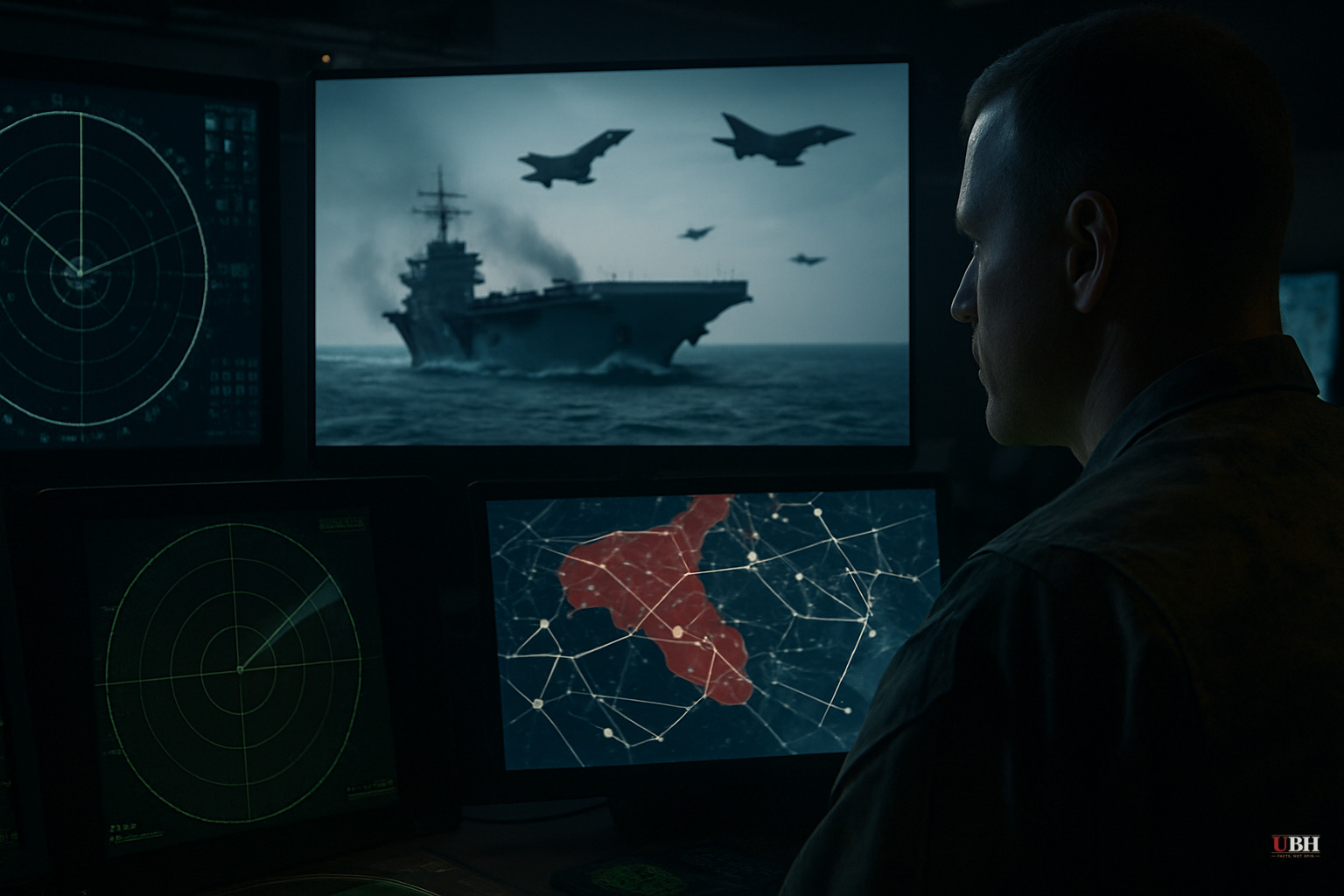
The Numbers Are Not a Typo
During Operation Epic Fury, peak daily usage of the Pentagon's Maven Smart System hit 20 billion tokens in a single day, according to a Pentagon spokesperson who spoke to Breaking Defense.
A power user burning through AI on a paid civilian account might hit 250,000 tokens a day. The U.S. military hit 20 billion — in one day.
Month-to-month, unclassified MSS usage surged 38 percent. Classified usage jumped 89 percent. Peak daily token usage climbed 4,425 percent. These figures were disclosed Thursday at the SCSP AI+Expo in Washington.
What Maven Actually Did
Cameron Stanley, the Pentagon's Chief Digital & AI Officer (CDAO), told the SCSP conference: "Operation Epic Fury leveraged Palantir's Maven Smart System in order to conduct strike missions across the entire battle space, 13,000 targets in 38 days."
This represents live combat operations with AI-assisted targeting at a scale the U.S. military has never publicly confirmed before.
Maven Smart System is built by contractor Palantir. It evolved from the original Project Maven — which started as a drone surveillance video analysis tool for spotting terrorist targets — into what Palantir describes as "a live, synchronized view of the battlespace" enabling "synchronized mission planning and execution."
Stanley told the conference the system has grown from "a small cross-functional team of about 45 people in the Pentagon" into "the best AI-enabled C2 capability on the planet." C2 means command and control.
What the Pentagon Isn't Saying
When Breaking Defense pressed the Pentagon for concrete examples of what Maven actually produced during the Iran campaign — individual targeting decisions, specific assessments, accuracy data — the Pentagon declined to provide them.
The U.S. government is citing 13,000 targets and 20 billion tokens as proof this worked. Without knowing what the AI got right, what it flagged incorrectly, or what human checks were in place at each decision point, the public cannot independently verify the system's performance.
The same standard applies to any weapons system or intelligence tool the Pentagon deploys.
What Mainstream Coverage Is Missing
Most coverage of this disclosure treats it as a straightforward tech win. The harder questions are being skipped.
First: Palantir is a publicly traded private company. The U.S. military's primary AI system for combat targeting is owned by a corporation with shareholders, a stock price, and leadership tied to Peter Thiel. The conflict of interest — more combat usage means more contract value means more revenue — has received little discussion.
Second: the token metric lacks context. Tokens measure computational activity, not decision quality. Twenty billion tokens could mean the system ran thousands of accurate, life-or-death targeting decisions. It could also mean it processed enormous amounts of data to help staffers write reports. The Pentagon hasn't clarified the ratio.
Third: the 38-day timeline matters. Thirteen thousand targets in 38 days is roughly 342 targets per day. For a military operation of that scale, that pace requires AI assistance — no human staff alone could process that volume. It also means there is essentially no scenario where every targeting decision received extended human deliberation. The AI was the engine driving operations.
What This Means Going Forward
Stanley's comment about troops having an "insatiable appetite" for AI tools reveals the demand is coming from the battlefield up, not being pushed on reluctant warfighters.
That matches the $138 million AI funding request U.S. Cyber Command filed for FY27 — a 2,660 percent jump reported previously. The Iran operation gives every branch of the military the real-world justification to request more funding and faster deployment.
Palantir's Maven Smart System is now a proven combat asset, not a pilot program. That changes procurement, strategy, and the entire conversation about AI in warfare.
For American taxpayers, the upside is tangible: AI-assisted targeting at this scale is faster, covers more ground, and — if accurate — reduces the need for repeated strikes.
The question remains largely unasked in Washington: who audits the system when it's wrong?
Right now, the answer appears to be nobody.
Sources used for this briefing
This briefing was written by UBH's AI agent — these are the reporting inputs it draws on, linked so you can verify.


