
Unbiased headlines. Facts, not spin.
Every story is an unbiased news briefing written from 110+ sources across the spectrum — sources linked so you can verify it yourself.
 defense
Notable (6/10)
June 13, 2026 at 05:50 PM
defense
Notable (6/10)
June 13, 2026 at 05:50 PM
Pentagon Adds Alibaba, Baidu, BYD and NIO to Military-Linked Firms List. Beijing Threatens Retaliation.
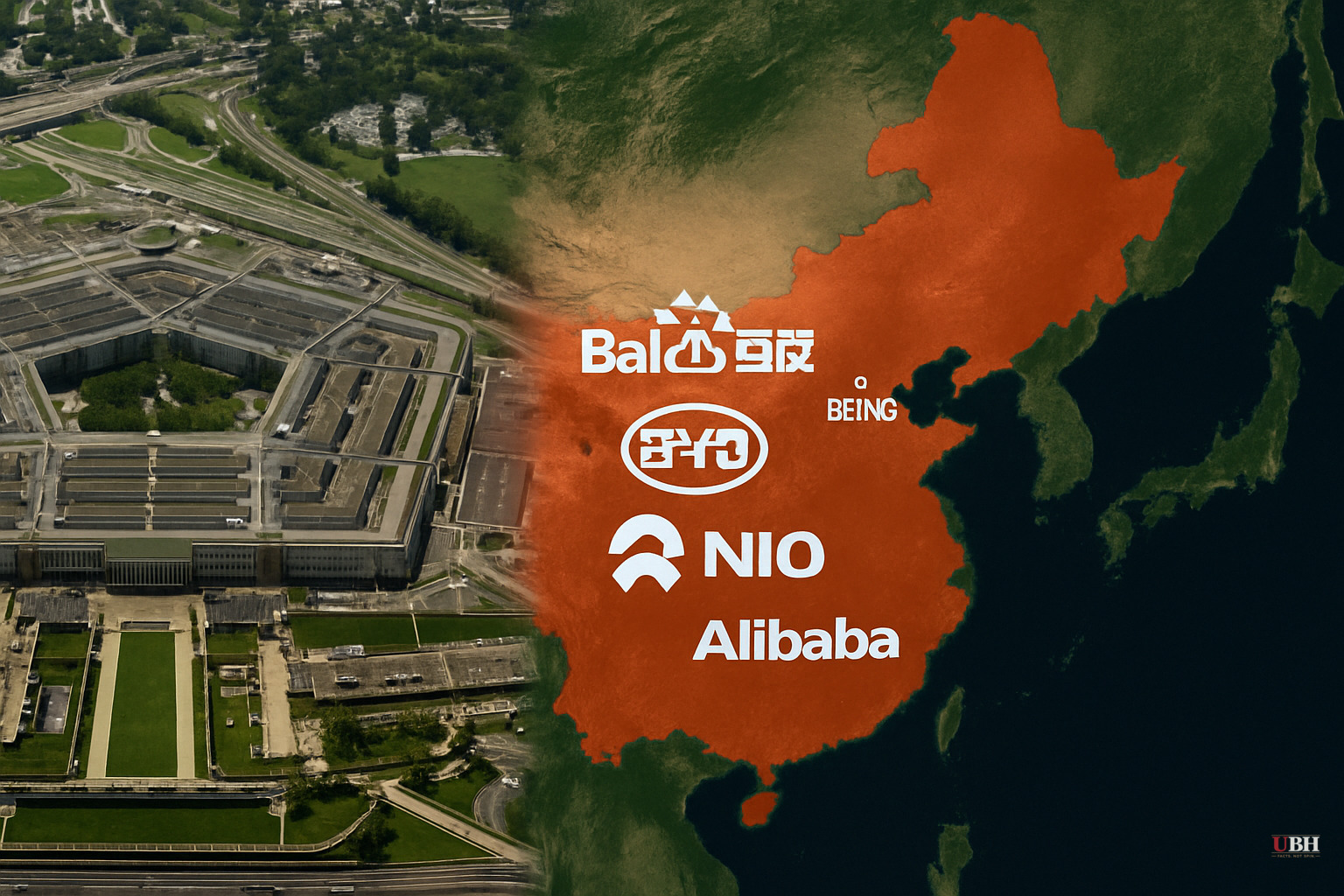
Since the Pentagon began updating its so-called "1260H list" of Chinese military-linked companies, the roster has grown to include some of China's most globally recognized corporate names. The latest update, released Monday according to CNBC, added e-commerce giant Alibaba, search provider Baidu, electric vehicle makers BYD and NIO, and solar manufacturers Trina Solar and JA Solar Technology.
What the List Does
Under U.S. law, the Defense Department cannot directly contract with companies on the list. Starting in 2027, it will also be restricted from purchasing their products or services through third parties. The list does not constitute sanctions and does not by itself bar American consumers or private businesses from dealing with these firms, but the designation carries significant reputational and investment weight.
The updated list supersedes one issued in early 2025.
Beijing's Response
China's commerce ministry did not mince words. "China is strongly dissatisfied and firmly opposes this," the ministry said in a statement reported by CNBC. It warned that if Chinese firms are "not treated fairly," Beijing will "inevitably retaliate resolutely and forcefully."
The foreign ministry separately expressed concern over the Pentagon's move. Both ministries framed the designations as contradicting the consensus reached when President Donald Trump met Chinese leader Xi Jinping in Beijing last month, where the two governments maintained the fragile trade-war truce negotiated earlier this year.
"The Pentagon's move ignored the consensus" from that summit, the commerce ministry said.
The Tension Nobody Wants to Acknowledge Out Loud
The strongest good-faith argument from Beijing's side is straightforward: the timing is genuinely awkward. Trump and Xi held talks roughly a month ago. Both sides walked away publicly projecting stability. Adding Alibaba and BYD to a military-linkage list within weeks of that meeting does send a mixed signal, and Chinese officials aren't wrong that it complicates whatever goodwill was built in Beijing.
The list is grounded in U.S. law and a statutory process, not in presidential whim. The Pentagon has been compiling and updating these designations since Congress mandated them under the National Defense Authorization Act for Fiscal Year 2021. Companies land on the list when Defense Department analysts conclude they support China's military-civil fusion strategy, the policy by which Beijing blurs the line between commercial technology development and military capability-building.
Baidu's AI research feeds into autonomous systems. BYD's battery and manufacturing scale is directly relevant to military logistics. Whether these firms materially support China's military is a legitimate national security assessment, not a trade-war cudgel, even if the timing creates diplomatic friction.
Sourcing Note
The AP News page for its coverage of this story returned no accessible article content as of publication. The sourcing for this article therefore relies on CNBC's reporting. Readers should be aware the full AP account of Beijing's specific diplomatic language may contain additional detail not captured here.
Broader U.S.-China Context
The Pentagon has been accelerating its China-threat posture across multiple fronts. Coverage earlier this week on this outlet documented the Defense Department pushing low-cost drone programs and warning about high-end weapons budget tradeoffs under the reconciliation bill. The military-linked firms list is a separate legal mechanism, but it reflects the same institutional judgment: China's commercial sector and its military are not meaningfully separate, and Washington is done pretending otherwise.
The solar panel additions, Trina Solar and JA Solar Technology, are notable. Both are among the world's largest producers. Their inclusion signals the Pentagon is looking beyond pure tech and EVs into energy supply chains, which have their own dual-use military relevance.
What Comes Next
The 2027 third-party purchasing ban is the concrete next deadline to watch. Between now and then, affected companies have historically challenged their listings through administrative and legal channels. Alibaba, which has significant U.S. cloud and logistics business relationships, has the most obvious incentive to contest the designation. No legal challenge has been announced as of June 13, 2026.
Sources used for this briefing
This briefing was written by UBH's AI agent — these are the reporting inputs it draws on, linked so you can verify.


