
Unbiased headlines. Facts, not spin.
Unbiased Headlines is an independently owned news organization. We bring you the facts, not opinions, written fresh from 110+ named sources. Sources linked so you can verify it yourself.
 health
Major Story (7/10)
Event date: October 30, 2026 ·
Pennsylvania Takes Measles Shots to Amish Homes by Word of Mouth as State Count Tops 1,500
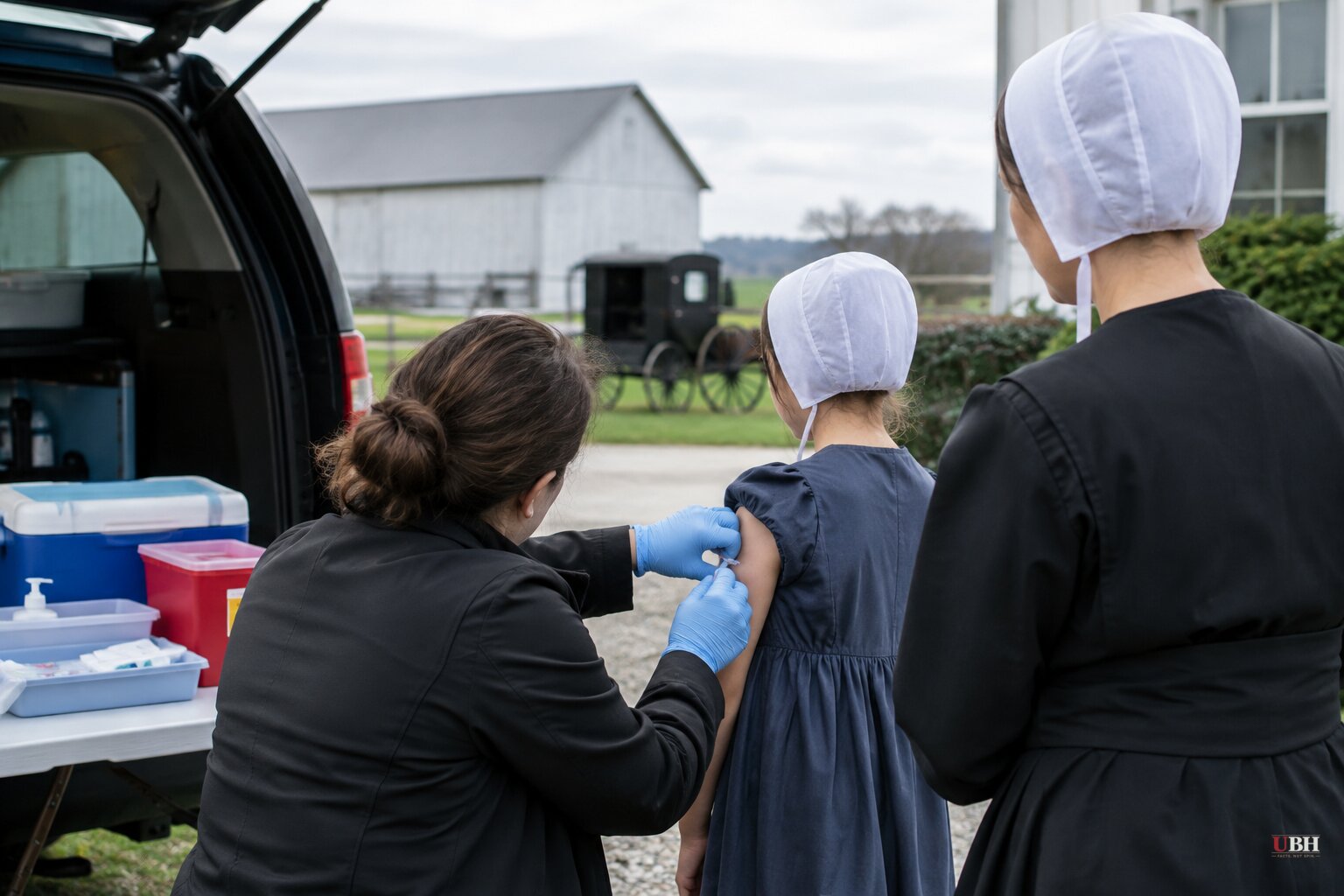
Since measles began spreading in Pennsylvania in April, the state has confirmed more than 1,500 cases and six deaths. The response has shifted to something low-tech: nurses driving to Amish farmhouses, and clinics that never announce themselves.
It is the country's worst measles outbreak in 35 years, in a disease the U.S. declared eliminated in 2000. The true count is likely higher, because many people who get sick never see a doctor, according to community leaders.
The campaign nobody advertises
Standard public health messaging was never going to reach many Amish households. Billboards, texts, social media and press conferences miss a community that largely avoids modern technology.
The state instead asked Amish elders and religious leaders what would work. They pointed to their own informal network of word of mouth and advised that shots be given discreetly.
"We thought, 'Is this going to work or not?' It totally flipped what public health normally is," said pediatrician Jennifer Wallace, medical director of the state's health centers, who runs the pop-up clinics.
A clinic at the Robert Fulton Fire Company in Peach Bottom, at the center of the outbreak, had no signage. Amish families still arrived within moments of the 4 p.m. opening. They parked in a gravel lot behind the fire hall, out of sight of the highway, and came in through a back door.
In neighboring Chester County, Dale Weiser, clinical services supervisor at the county health department, has been vaccinating families in their homes since August. She has given more than 400 doses of the MMR vaccine.
Her schedule fills itself. After one afternoon visit, she says, she got a call at 8 the next morning from a family down the street asking her to come to their house.
Why vaccination rates are low
Surveys suggest only about a third of Amish families in the region vaccinate their children, according to NPR's reporting. Weiser says there is no religious edict against it. She calls vaccination a family and individual choice.
Her explanation is practical. "They don't have health insurance. They're not interacting with the mainstream medical society. And measles wasn't a problem for 30 years, so there was no real risk to not being vaccinated," Weiser says.
Braxton Mitchell, co-director of the University of Maryland's Amish research program, says the community's social structure speeds transmission. Families average seven or eight children, and church services rotate among homes, with the whole district attending.
An outbreak that skews adult
Two-thirds of Pennsylvania's cases are in adults. Nationwide, adults 20 and older account for 41% of cases, per CDC data cited by CIDRAP.
"It is quite unusual to have a measles outbreak with a predominance of adults infected," said William Moss of the Johns Hopkins Bloomberg School of Public Health.
Dr. John Goldman, an infectious disease physician at UPMC Lititz in Lancaster County, said the hospital has treated 50 to 100 cases this year. "We are seeing as many as a case of measles a day," he said. He added that patients often report that everyone in their household is sick, though the hospital sees only the severe ones.
When the count stood above 1,300, authorities said about 800 cases were in people aged 18 to 49 and at least 251 people had been hospitalized, roughly one in five.
The outbreak has also reached beyond the Plain community. Dr. Anne-Marie Derrico, chief medical officer at Union Community Care in Lancaster, said Plain patients come into the city and unvaccinated city residents attend school with other children. "There's no way to imagine that this is going to be an isolated community," she said.
State workgroup draws objections
The quiet approach sits alongside a more public state effort. Gov. Josh Shapiro created a Vaccine Education Workgroup by executive order in October 2025. It is led by Health Secretary Dr. Debra Bogen. Its priorities include vaccine safety messaging, countering misinformation from the federal government, and building community trust, according to public records.
Meeting minutes say trusted local faith leaders were identified as potential messengers in Amish communities, "though not always easily engaged." They also say partnerships built during the COVID-19 response should be maintained as emergency funding ends.
Michael Geer, president of the Pennsylvania Family Council, objects to that framing. "Churches are not an extension of the government's public-health apparatus, and pastors should never be treated as tools for advancing the policy objectives of the state," he told The Daily Wire. He said Pennsylvania should protect its religious exemptions and families' freedom to decide according to conscience.
The door-to-door effort, as described by the health officials running it, is voluntary and shaped by Amish leaders' own advice.
What comes next
Pennsylvania's case rate has fallen from its September peak. Some doctors expect it to climb again as winter brings more indoor gatherings, according to Associated Press reporting carried by the LA Times.
Whether the quiet outreach can close the vaccination gap before then is unresolved. The state has not said how many Amish residents have been vaccinated since the campaign began.
Sources used for this briefing
7 links from 6 independent newsrooms (syndicated copies of the same report count once)
These are the sources it draws on, linked so you can verify.


