
Unbiased headlines. Facts, not spin.
Every story is an unbiased news briefing written from 110+ sources across the spectrum — sources linked so you can verify it yourself.
 energy
Major Story (7/10)
July 15, 2026 at 09:38 PM
energy
Major Story (7/10)
July 15, 2026 at 09:38 PM
Pennsylvania Now Forces Data Centers to Report Power and Water Use as PJM Comes Up 6.8 Gigawatts Short Again
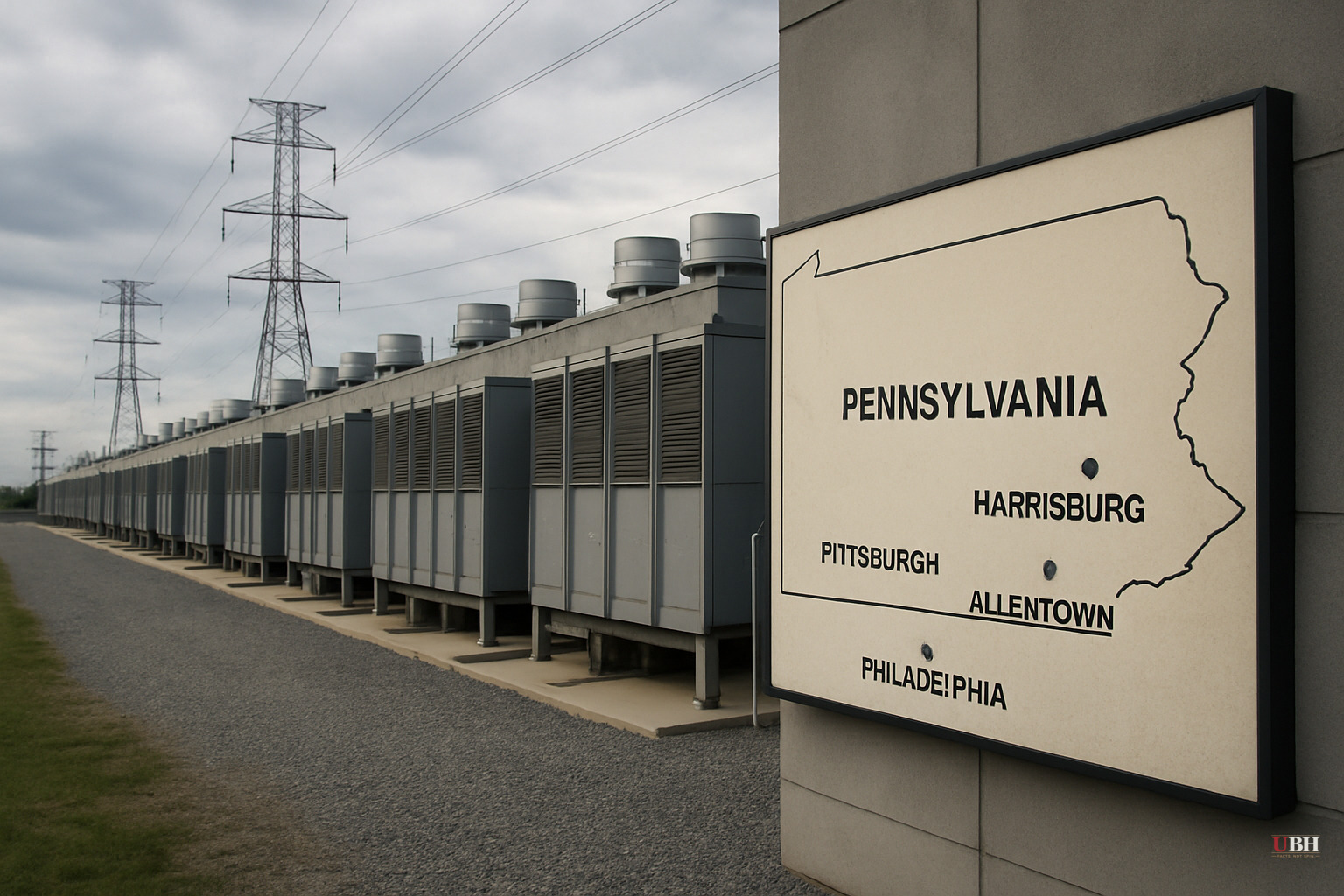
Pennsylvania Governor Josh Shapiro signed a budget Sunday that requires data centers operating in the state to report their exact power and water usage to regulators every year, according to ZeroHedge citing reporting from Utility Dive. Miss the deadline and the fine is $10,000 a day until the report gets filed.
The provision started as House Bill 1924, sponsored by state Sen. Gene Yaw, a Republican, and got folded into Pennsylvania's 2026-2027 budget. It requires data centers to disclose their peak hourly load, total energy consumption from the prior year, projected demand for the coming year, and any steps they've taken to generate their own power or offset grid strain.
The bill's text doesn't mince words about why lawmakers wanted this. "The current process by which utilities submit information to PJM lacks transparency for policymakers, regulators and stakeholders," the legislation states, adding that the Pennsylvania Public Utility Commission needs oversight "to ensure accuracy and transparency of load-forecast inputs."
Utilities feed demand forecasts into PJM Interconnection, the regional grid operator covering 67 million people across 13 states and Washington, D.C., and those forecasts drive billion-dollar decisions about what gets built and who pays for it. If state regulators can't see the actual numbers behind those forecasts, they're negotiating blind while ratepayers foot the bill.
The law also directs Pennsylvania's Department of Environmental Protection to publish an annual report tracking aggregate data center energy and water consumption statewide, along with environmental impacts and recommendations.
Why this landed now
Data center growth in Pennsylvania isn't hypothetical. PPL Electric, one of the state's major utilities, reported in May that its "advanced" stage data center pipeline jumped 12% in three months, from 25.2 gigawatts to 28.3 gigawatts expected online by 2034. That's an enormous, fast-moving load showing up on one utility's books.
The state's move arrives days after PJM announced its capacity auction for the 2028-2029 delivery year fell 6.8 gigawatts short of the reliability target it needs to guarantee power during demand spikes, according to OilPrice.com. That's the equivalent of roughly seven nuclear reactors' worth of committed capacity missing.
This is the third straight year PJM's auction has come up short, and the last two auctions marked the first time in the grid operator's history that the entire footprint failed to hit its reliability requirement. PJM now plans to ask the Federal Energy Regulatory Commission for approval to hold an emergency "Backstop Procurement" in September, aimed at getting hyperscale tech companies to help cover the gap they're creating.
The auction cleared at $325 per megawatt-day, the price ceiling set by a collar PJM negotiated with the governors of all 13 member states and FERC. Without that cap, Utility Dive reported the price would have hit nearly $555/MW-day system-wide and $777/MW-day in the ComEd zone covering northern Illinois, pushing total auction costs to $29.7 billion instead of the actual $16.4 billion.
Aurora Energy Research's Julia Hoos didn't sugarcoat what that means. "The outcome demonstrates that the current system doesn't work to bring online new capacity or stimulate demand response, the two things we need the most," she told Utility Dive. She warned the temporary price cap and backstop auction, sold as one-off fixes, are turning into permanent crutches. "We're well on our way to facing an intervention doom loop."
Unison Energy's Peter Cavan flagged the real-world cost: a 10-megawatt industrial customer's monthly capacity charge is on track to jump from around $6,000 in 2024 to roughly $70,000 by 2028.
The other side of the ledger
Tech companies and grid operators have a reasonable counter-argument. Data centers are following the rules as written, bidding for power like any other large customer, and state-by-state reporting mandates could slow investment in a sector already racing China on AI infrastructure. Slower buildout means fewer jobs and less tax revenue for states like Pennsylvania that are actively courting these projects.
There's also a genuine institutional design question raised by Jeanine Johnson, a former PJM board member, in Utility Dive. PJM's governance and planning processes were built for a slower-moving grid, not one where a single data center can add gigawatts of demand within two years while transmission upgrades take a decade. She argues flexibility, demand response, behind-the-meter batteries, and smart interconnection could close that gap faster than new plants. FERC has a technical conference on PJM governance scheduled for July 23 to dig into exactly that.
Sunrun is already testing one version of that idea, piloting a program that would let AI companies tap distributed home solar and battery capacity from its 1.1 million existing customers instead of waiting years for a traditional data center interconnection. The company hasn't disclosed spending or enrollment numbers, and it's still in the pilot phase.
PJM's shortfall is real, its price cap is masking the true cost, and Pennsylvania just became the latest state betting that forcing data centers to show their books is the fastest lever available. Whether other PJM states follow Pennsylvania's reporting mandate, and whether FERC's July 23 conference produces actual governance reform, are the two questions that will decide if this is a fix or a stopgap.
Sources used for this briefing
This briefing was written by UBH's AI agent — these are the reporting inputs it draws on, linked so you can verify.


