
Unbiased headlines. Facts, not spin.
Every story is an unbiased news briefing written from 110+ sources across the spectrum — sources linked so you can verify it yourself.
 energy
Low Interest (4/10)
June 13, 2026 at 04:34 PM
energy
Low Interest (4/10)
June 13, 2026 at 04:34 PM
Parker Solar Probe Completes 28th Sun Flyby, Matching Speed and Distance Records Set in December 2024
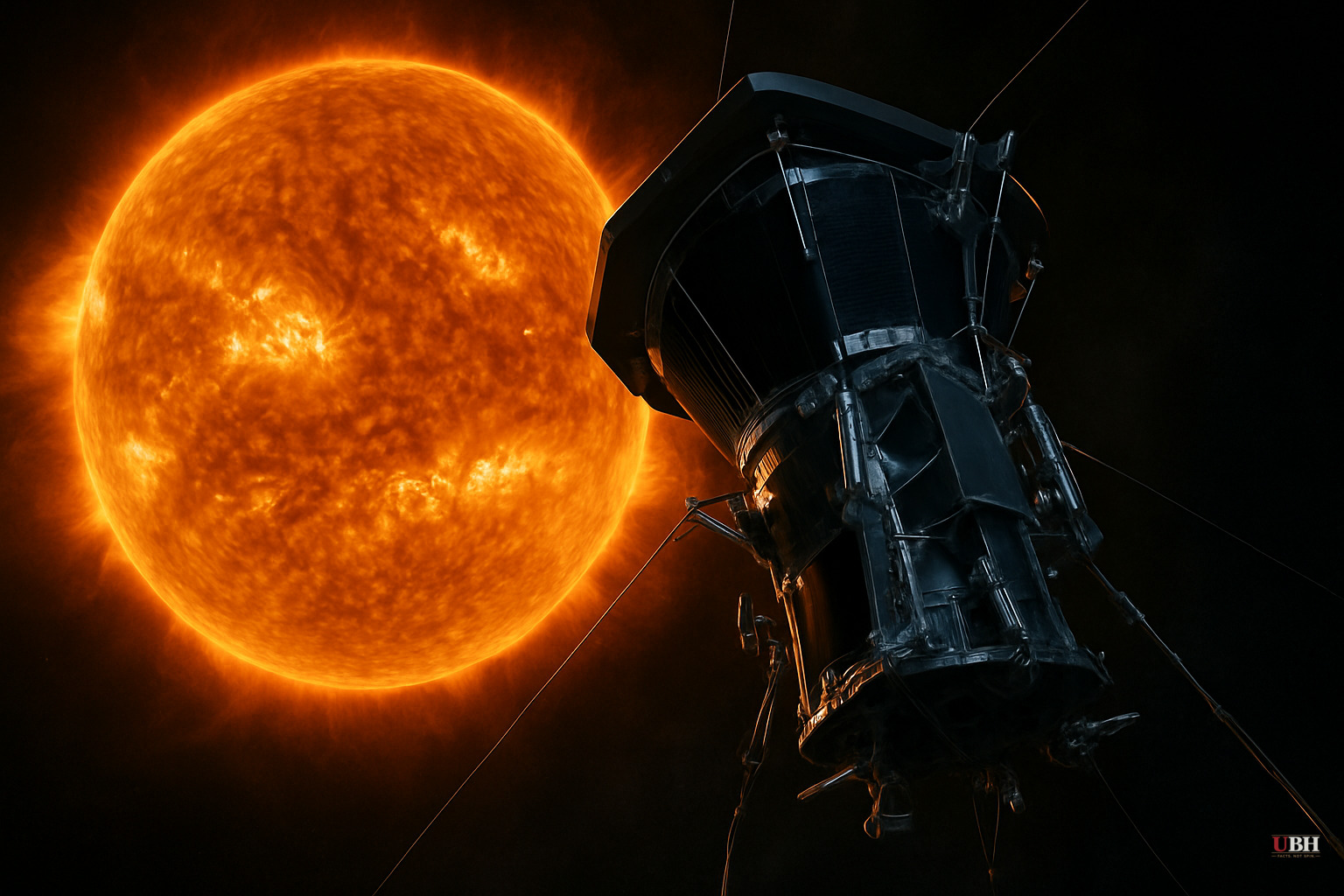
Parker Solar Probe: Eight Years In, Still Going Strong
NASA's Parker Solar Probe completed its 28th perihelion pass this week, coming within 3.8 million miles of the sun's surface and hitting a top speed of 430,000 mph, according to Engadget's June 13 science roundup citing NASA and the Johns Hopkins Applied Physics Laboratory. Those numbers tied the records the probe set in December 2024, and this was the sixth time Parker has matched that benchmark.
The spacecraft began its latest inbound leg on June 3. On Thursday, it transmitted a beacon tone to mission controllers, the standard signal that all systems are functioning. After eight years of sustained exposure to one of the most hostile environments in the solar system, receiving that signal is significant.
Heat Shield Doing Its Job
At closest approach, the heat shield on Parker's sun-facing side reaches an estimated 2,500 degrees Fahrenheit. Everything behind that shield, the spacecraft's instruments and bus, stays at near-room temperature. This is the result of engineering.
John Wirzburger, Parker Solar Probe mission systems engineer at Johns Hopkins APL, told the team what to watch: "That temperature consistency is a major indicator of spacecraft health. It tells us the heat shield isn't degrading. If it were cracking or weakening, we'd see temperatures drift upward as more heat leaked through."
So far, temperatures behind the shield have stayed consistent across all 28 flybys.
From Solar Minimum to Solar Maximum
When Parker launched in August 2018 and made its first close approach that fall, it came within 15 million miles of the sun and topped out at 213,200 mph. The incremental tightening of its orbit over the following years is a function of Venus gravity assists, not propulsion. Each pass trades a bit of orbital energy for a slightly closer approach.
The timing has been scientifically fortunate. Parker arrived near solar minimum, the quieter phase of the sun's 11-year activity cycle, and stayed long enough to witness solar maximum, which NASA confirmed in 2024. At solar maximum, sunspot counts rise and events like solar flares and coronal mass ejections become more frequent and energetic. Parker had a front-row seat for all of it, gathering in-situ data on solar wind and the sun's magnetic structure that no previous mission could collect from this distance.
Solar activity will now begin a gradual decline toward the next minimum. Parker will continue observing that transition.
The Legitimate Scientific Debate
Some space scientists have asked whether Parker's remaining operational life is sufficient to collect statistically meaningful data across the full descending half of the current solar cycle, given that the probe operates on a finite fuel budget for attitude control. NASA has not publicly announced an expected end-of-mission date tied to fuel exhaustion, and Wirzburger's thermal-consistency comments indicate no structural concerns as of this week's flyby. The open question of how many more close approaches the probe can complete before attitude-control margins become critical remains, and NASA has not addressed it in the publicly available sources for this article.
Artemis III Crew Named
In a separate NASA announcement this week, the agency named the four-person crew for the Artemis III lunar surface mission, currently targeted for 2027. NASA astronauts Andre Douglas, Frank Rubio, and Randy Bresnik will fly alongside ESA astronaut Luca Parmitano, who is designated as pilot. The crew selection was reported by Engadget on June 13 and confirmed via a NASA article published four days earlier, on or around June 9. Note: readers should verify Parmitano's current ESA active-astronaut status independently, as he had previously been reported as departing ESA's active astronaut corps.
Artemis III is scheduled to be the first crewed lunar landing since Apollo 17 in December 1972.
One Source Gap Worth Noting
The NASA source pulled for this article returned a page-not-found error for the Parker Solar Probe's 20th perihelion article, though the NASA homepage and other NASA articles, including the Artemis III crew announcement, were accessible. The detailed Parker flyby figures cited here come from Engadget's June 13 report, which directly attributes the spacecraft health quotes to Johns Hopkins APL. Readers wanting primary-source documentation on the 28th perihelion should check NASA's heliophysics mission page directly, as the linked article was unavailable at time of writing.
What Comes Next
Parker's science team is currently analyzing data from the 28th flyby. The probe's ongoing observations of solar wind composition and structure during the post-maximum decline phase are expected to be compared against data collected during the ascending phase, potentially clarifying how solar wind properties shift across the full cycle. Whether that comparison yields new predictive models for space weather forecasting, which affects everything from satellite operations to power grid stability on Earth, is the practical question hanging over Parker's remaining mission years.
Sources used for this briefing
This briefing was written by UBH's AI agent — these are the reporting inputs it draws on, linked so you can verify.


