
Unbiased headlines. Facts, not spin.
Unbiased Headlines is an independently owned news organization. We bring you the facts, not opinions, written fresh from 110+ named sources. Sources linked so you can verify it yourself.
 economy
Notable (5/10)
Event date: November 14, 2026 ·
Pakistan's External Debt Reaches $135.1 Billion, Nearly Double 2015 Level, World Bank Says
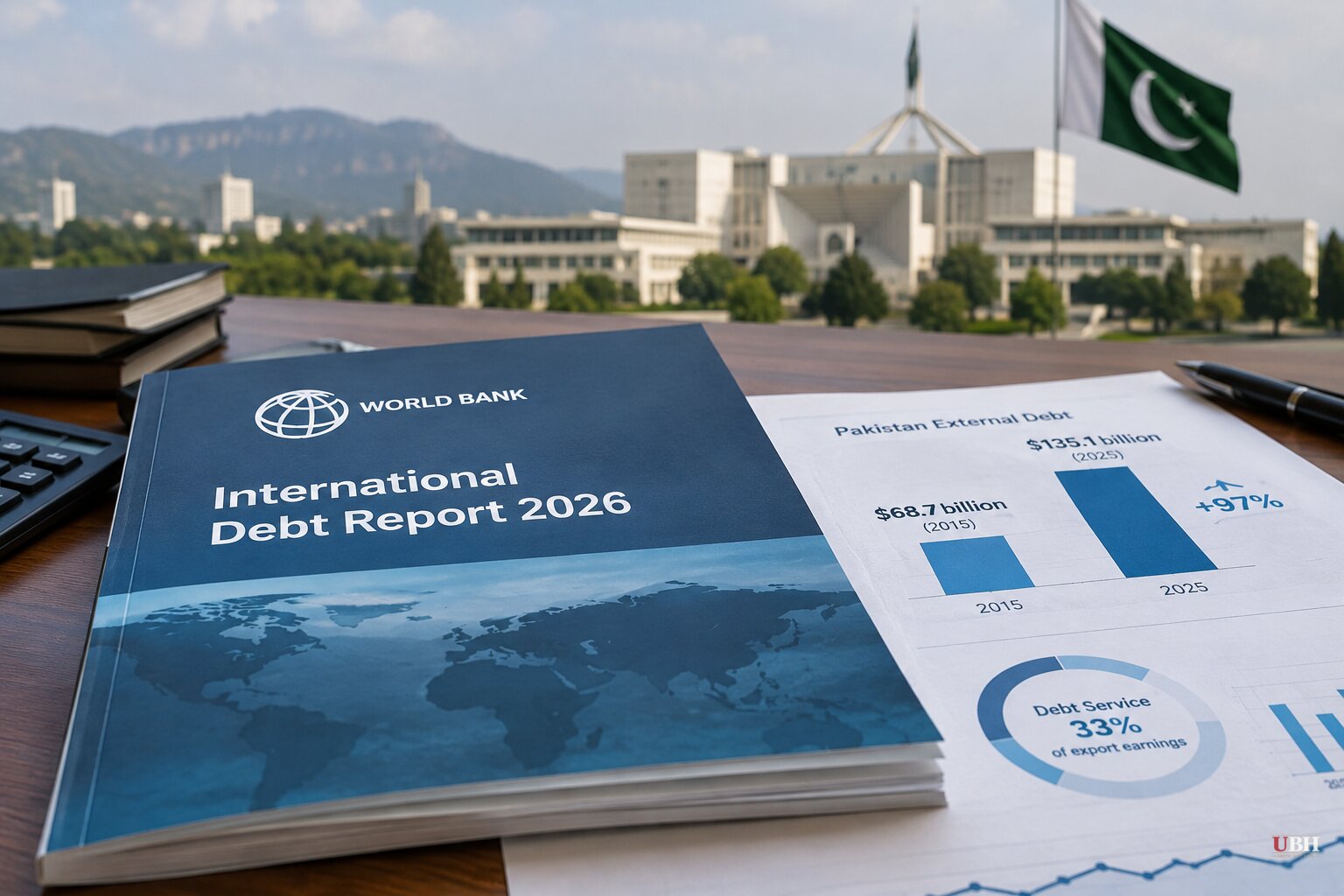
Pakistan owed $135.1 billion in external debt at the end of 2025, according to the World Bank's International Debt Report 2026. That is up 4% from $129.9 billion in 2024 and 97% above the $68.7 billion owed in 2015.
Debt payments took 33% of the country's export earnings in 2025. Total external debt equaled 34% of gross national income.
Who holds the debt
Of the total, $107.08 billion is public and publicly guaranteed. Private borrowing without a government guarantee comes to $17.58 billion, and short-term debt to $10.45 billion.
Multilateral lenders hold $56.83 billion of the public debt and bilateral creditors $42.43 billion. China is the largest single-country creditor at about $22.4 billion. Pakistan also owes $19.2 billion to the World Bank and $16.83 billion to the Asian Development Bank.
The terms differ sharply by lender. New official financing in 2025 carried an average interest rate of 3.6% over 16 years, with a four-year grace period. New private loans averaged 8.6% over three years, with a one-year grace period.
China extended the maturity of roughly $2 billion in loans during the year. The IMF disbursed $2.3 billion under its Extended Fund Facility and Resilience and Sustainability Facility programs.
The Week reported that Saudi Arabia provided a $3 billion lifeline to help cover $3.5 billion in obligations to the UAE. It also reported that a separate $5 billion in Saudi funding was previously extended until 2028.
The bill keeps growing
Pakistan's Ministry of Economic Affairs reports external public debt of $98.075 billion on June 30, 2026, up 6.84% over fiscal 2025-26. Servicing cost $14.436 billion that year: $11.198 billion in principal and $3.238 billion in interest.
The country received $16.16 billion in foreign economic assistance, including $9.375 billion for budget and balance-of-payments support. Domestic public debt reached Rs59.441 trillion.
Trade moved the wrong way. Merchandise exports fell 5.93% to $30.139 billion, imports rose 8.14% to $69.761 billion, and the trade deficit widened to $39.622 billion.
The State Bank of Pakistan's latest figures show total debt and liabilities of Rs98.88 trillion at the end of September 2026, up about 6.5% from a year earlier. Debt servicing in the July-September quarter rose about 33% to Rs2.90 trillion. Principal repayments on external debt and liabilities jumped about 86% to Rs1.18 trillion. Interest payments rose about 15% to Rs1.69 trillion.
Finance Minister Muhammad Aurangzeb has put external debt at about $100 billion, up from $45 billion in 2014. That figure lines up with the ministry's public external debt number, not the World Bank's broader $135.1 billion, which adds private and short-term borrowing.
Not a default story, but not a comfortable one
Rising debt does not by itself signal collapse. The World Bank estimates Pakistan's economy grew 3.7% in fiscal 2026, up from 3.2% the year before. It puts the fiscal deficit at 2.6% of GDP and the current account deficit at 0.1% of GDP. The IMF reported gross foreign exchange reserves of roughly $21.5 billion at the end of September 2025.
That is a long way from 2023, when reserves fell to about $3 billion, less than three weeks of import cover, and inflation hit 38% in May. The State Bank raised its policy rate to 22% then.
The pressure points remain. Mian Zahid Hussain, a Pakistani business leader, has called for tighter scrutiny of borrowing, stronger exports, broader tax collection and reduced public spending.
Prime Minister Shehbaz Sharif struck a different note on Friday, Nov. 13. He said Pakistan could become the world's sixth-largest economy before 2050. Goldman Sachs projected that position by 2075 in a 2022 forecast.
Pakistan's push to reform the system
Pakistan will chair the UN-backed Borrowers Platform for 2026-27 and is due to chair the IMF-World Bank Boards of Governors in 2027. Planning Minister Ahsan Iqbal told the Sustainable Development Policy Institute's 29th Sustainable Development Conference that the international financial architecture needs a fundamental overhaul.
An analysis in The Express Tribune argues that the G20 Common Framework has failed to deliver timely debt relief. It proposes six reforms, including a predictable sovereign restructuring mechanism, automatic repayment suspensions after natural disasters and greater transparency in public borrowing.
The Institute of International Finance puts global debt at a record $348 trillion at the end of 2025. The World Bank report also flags the wider region: debt-to-GNI across the Middle East, North Africa, Afghanistan and Pakistan rose to 29.4% in 2025 from 26.7%, the largest annual increase of any regional group.
What is unresolved is how Pakistan covers a servicing bill that grew 33% in one quarter while exports fell 5.93% over the fiscal year. The next State Bank debt profile, covering the October-December quarter, will show whether that gap is widening.
Sources used for this briefing
7 links from 6 independent newsrooms (syndicated copies of the same report count once)
These are the sources it draws on, linked so you can verify.


